
Written by Chieh-Ting Yeh.
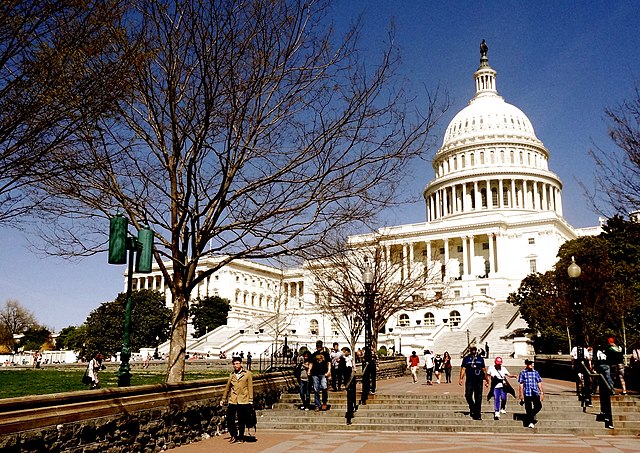
Image credit: The Capitol in the Winter by Rizka/ Wikimedia Commons, license: CC BY-SA 4.0.
In 2005, I went to my very first meeting with a congressman on Capitol Hill. I had just graduated college and was part of a two-week intensive congressional advocacy training program. We walked around with a piece of paper listing our talking points: arms sales, supporting Taiwan’s international participation, and a bilateral free trade agreement with Taiwan.
In the close to two decades since then, the US-Taiwan FTA has always been a cornerstone of a talking point for advocates of US-Taiwan relations.
On paper, this should not have been hard. According to the Congressional Research Service, in 2021, Taiwan was the US’s 8th-largest merchandise trading partner, 10th-largest export market, and 7th-largest source of imports (the European Union (EU) counts as one single trading partner). South Korea, the US’s 7th largest trading partner, has had an FTA with the US since 2007.
Nonetheless, the Taiwan-US FTA was almost a pie-in-the-sky request to ask for. There were sharp issues of contention, like Taiwan’s ban on American beef and American pork. Like with every trade liberalisation relationship, there was domestic opposition to specific industries or products.
However, a US-Taiwan agreement has an added geopolitical layer of difficulty because Taiwan was not recognised as a state. Most importantly, China adamantly opposes any interaction with Taiwan and threatens to retaliate and derail its relationship with the US over Taiwan.
Therefore, when the initial agreement of the U.S.-Taiwan Initiative on 21st Century Trade was signed on June 1, 2023, we found ourselves finally celebrating a milestone for US-Taiwan trade relations.
The agreement focuses on simplifying customs procedures, including enabling online processing, more data transparency, and more collaboration in enforcing customs regulations. These initiatives will no doubt help facilitate smoother trade between the US and Taiwan, reduce the costs for export and import, and incentivise businesses to consider the US or Taiwan as a market or a supplier.
Of course, this initial agreement is very far from an actual FTA. Genuine free trade agreements focus on reducing or abolishing tariffs over the vast majority of sectors in the economy. They are usually agreed to only after heated rounds of substantive negotiations, as well as difficult politicking in the domestic arena of both countries to deal with sectors that the FTA will hurt.
That said, the 21st Century Trade Initiative is still a good, if small, step forward. In a negotiation, it’s common to lock in an agreement on smaller issues before moving on to the more substantive issues. Moreover, this is a good indication of how the two sides are paying attention to important trade and economic pressure points in the bilateral relationship. Another example is the legislation in the US Congress on the issue of double taxation for US and Taiwanese corporations.
The bilateral relationship, however, still has to be placed in a larger, regional, and global context. With each bilateral trade relationship forged, it helps Taiwan’s trade relationship with others in three ways. First, the lowered tariffs and barriers to trade between two countries will incentivise businesses in third countries to sell or find suppliers in those two countries because the costs of moving goods through a supply chain with those two countries are lowered. Second, the substantive gains for the economy brought by the trade deal allow investments in expansion or upgrading existing business activities. Third, a trade deal signals to others that a country is “open for business,” and one trade negotiation often serves as a precedent for subsequent negotiations, whether bilaterally or in multilateral and global institutions.
Specifically for Taiwan, FTAs have a layer of geopolitical significance. Despite being a member of the World Trade Organization (WTO), any country that wants to enter trade talks with Taiwan faces geopolitical retribution from China. If economies around the world can point to more examples of successful trade agreements with Taiwan, the less weight China’s political threat has. Currently, Taiwan has FTAs with Panama (2003), one with Guatemala (2005), and one with El Salvador and Honduras (2007), as well as Economic Cooperation Agreements (ECA with six countries, including New Zealand and Singapore (2013), and Belize (2020). The 21st Century Trade Initiative serves as one more case of successful trade negotiations even in the face of Chinese opposition.
Taiwan was fortunate to join the WTO in 2002 when globalisation and trade liberalisation were in full swing. At the time, there was a lot of appetite for global solutions and institutions like the WTO, but as the inefficiencies of a global multilateral platform became apparent, the appetite turned to regional solutions like the Trans-Pacific Partnership (TPP) and The Regional Comprehensive Economic Partnership (RCEP).
Over time, even regional trade pacts ran into issues because multilateral organisations will invariably be affected by geopolitical concerns between member nations, even if these problems are outside of the arena of trade. Therefore, in recent years, meaningful trade negotiations have become more focused on the bilateral level.
Taiwan needs more than just bilateral links; it also must engage in regional and global multilateral platforms, especially because China frequently excludes Taiwan where it can. With the United States having taken a passive role in the TPP successor Comprehensive and Progressive Agreement for Trans-Pacific Partnership (CPTPP), it is unclear whether success in the bilateral US-Taiwan trade relationship will translate to other countries becoming more open to the idea of Taiwan joining their trade blocs. Still, it would help for the United States to not only be more proactive in pursuing regional trade itself but point to its ongoing trade relationship with Taiwan as a sign that Taiwan is a worthy member for regional trade.
In addition to regional and global implications, the US-Taiwan trade negotiations will still have to deal with more substantive issues, which are much more difficult than streamlining customs procedures. Even though the ban on US beef and pork products has been lifted, agriculture will remain a major point of contention. In 2022, Taiwan’s average tariff for agricultural products from the US is at 15.06 per cent, with rice being a particularly contentious issue. The automotive sector will also be a key topic of discussion; Taiwan has placed a tariff of 17.5 per cent to encourage a home-grown auto industry, but this is likely to be challenged.
Looking further into the future, other trade issues have geopolitical implications, namely semiconductors and other innovative technologies. With elections next year for both Taiwan and the US, the continuity of the trust and progress between the two sides will be put under greater pressure than ever before.
In 2005, I understood the FTA to be an aspirational long-shot—something that we can press for but not something we should expect to see in the foreseeable future. Recent developments such as the 21st Century Trade Initiative are milestones for sure, but milestones to mark just the beginning of a long road for a true free trade agreement with the US, as well as meaningful participation in regional trade blocs.
Chieh-Ting Yeh is a venture investor in Silicon Valley and a director of US Taiwan Watch, an international think tank focusing on US-Taiwan relations. In addition, he is a co-founder and the editor of Ketagalan Media and an advisor for the Global Taiwan Institute and National Taiwan Normal University’s International Taiwan Studies Center.
This article was published as part of a special issue on Taiwan-US Trade Agreement.
 Taiwan Insight
