
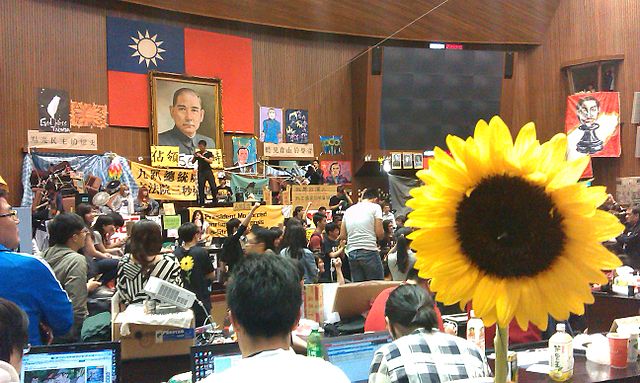
Written by Adrian Chiu.
Image credit: Taipei Sunflower Movement 2014-04-09 23.35.41 (13900827836) by Jesse Steele from China/ Wikimedia Commons, license: CC BY 2.0 DEED.
Ten years ago, the Sunflower and Umbrella Movements represented a peak in Taiwan-Hong Kong relations in response to the so-called China factor. These social movements were significant not only for their domestic impact but also for their role in transnational activism and broader geopolitical dynamics in the Asia-Pacific region. Ten years later, both Hong Kong and Taiwan experienced unrecognisable political changes. The tenth anniversary seems to be a timely moment to ask what the legacies of the two movements are. This special issue gathered experts from different fields and disciplines to offer fresh perspectives on the two important events. This introductory piece briefly sets the scene for their excellent analysis by reviewing some of the significant political changes both internationally and domestically.
When the Sunflower and Umbrella Movements broke out in 2014, the West was starting to realise the internal and external challenges to the global order of neo-liberal globalisation that has been sustained since the end of the Cold War. Nevertheless, even though recognised authoritarian regimes like China are not turning towards democracies any time soon, there is a consensus on seeing engagement and cooperation with them as necessary and important. Indeed, the threats of autocratisation were not as prominent then as they are today in both academic and policy circles. In this context, the two movements sounded alarms about the potential expansion of influence by authoritarian regimes. The term “China factor” was popularised by these movements to describe the social, economic, and political impacts exerted by Beijing authorities on their neighbours. Though the movements were perceived to be a local confrontation between the pro-democracy civil society and governing parties with authoritarian tendencies, with hindsight, it could be argued that they are part of the reaction against the erosion of democracy and authoritarian expansion shared in other parts of the world.
Since 2014, the world has become more acutely aware of the threats to democratic institutions, notably through the rise of populism within democracies. Noteworthy events include the Brexit vote in the UK, the election of President Trump in the US, and the emergence of populist leaders in Hungary, Brazil, India, and other countries. Though the relationship between populism and democracy is contested, the rise of populism demonstrates that this wave of democratic backsliding happened more gradually and subtly than before. Instead of overthrowing democratic institutions explicitly, the undermining of democracies was often done under the mandate of electoral competition. The COVID-19 pandemic arguably further reinforced some of the advantages of authoritarian regimes by imposing strict lockdowns and other public health regulations. The most blatant external challenge to democracy and international order was Russia’s full-scale invasion of Ukraine in 2022. It was not just an infringement of the sovereignty of a nation-state; it also represents the growing confidence and assertiveness of authoritarian regimes around the world to impose their will on their neighbours, believing that confidence in liberal democracies – particularly in the Global South – is shrinking. Given these developments over the past decade, the conflict between democracies and autocracies feels much more intense than it did ten years ago. Consequently, if movements like the Sunflower and Umbrella protests occurred today, they would likely attract significantly more international attention as part of this heightened struggle.
Unfortunately, these political events also placed Hong Kong and Taiwan on the front lines of the two sides of the divide, which exposes the political reality of the two entities. The Sunflower and Umbrella movements were the high point in Taiwan-Hong Kong connections because both of them shared the opposition to the expansion of the China factor. The Sunflower Movement opposed further economic integration with Beijing through the cross-Strait service trade agreement. The Umbrella Movement opposed elections under Beijing’s control and demanded real universal suffrage. Thus, around the time of the movements and their aftermath, the slogan ‘Today’s Hong Kong is tomorrow’s Taiwan’ (今日香港,明日台灣) was immensely popular to echo the common threat of the China factor. There was even talk of a ‘community of common destiny’ between Hong Kong and Taiwan (台港命運共同體).
However, Taiwan and Hong Kong were, since then, on divergent political trajectories which rendered these ideas hard to resonate among their population today. Since the Sunflower Movement, Taiwan experienced the 2016 election electing the DPP president and parliamentary majority that implement policies to control further economic integration with China and implement safeguards against future cross-Strait negotiations and treaties. Many movement leaders went on to join the governing party. On the contrary, not only did the Umbrella Movement fail to achieve its core goals, but Beijing was able to impose further political control over the territory both institutionally and legislatively as retribution for the social movement. Starting from disqualifying ‘radical’ candidates in elections, the campaign accelerated after the anti-extradition movement in 2019. It ended with the imposition of National Security Laws in both 2020 and 2024 and the manipulation of the electoral system to ensure the victory of its own candidates. These divergent political trajectories certainly shed light on the importance of democratic institutions in Taiwan to protect the erosion of sovereignty and identity. However, they also undermined the basis of Taiwan-Hong Kong connections. Based on my research, even after 2016, while there were close interactions among movement activists, some began to feel impotent and dissonant due to their positions on opposite sides of the significant divide between democracy and autocracy. That was made more obvious after the imposition of National Security Laws in Hong Kong, which resulted in securitisation measures from Taiwan authorities and politicians against immigration from Hong Kong.
Against the backdrop of these political changes both internationally and domestically, this special issue presents a brilliant line-up of scholars and observers of the two movements, providing insights and perspectives to analyse and reflect on the tenth anniversary of the Sunflower and Umbrella Movements. Following this introductory piece, the first article by Ming-sho Ho analyses the commemorative events of the Sunflower Movement in Taiwan. Next, Brian Hioe reviews the political exchanges between Taiwan and Hong Kong in the last decade, not least the ’Hong Kong factor’ in Taiwanese electoral politics. After this, Jackson Yeh argues that the Sunflower Movement is an unfinished journey in the sense that Taiwan continues to protect its democratic society against the expansion of the China factor.
The next three articles in the special issue adopt a comparative perspective on two social movements. Klavier Wang’s article examines the place-making processes of the two occupy movements, occurring physically, online, and in mobile protests. The forthcoming article by Leon Kunz critiques the comparison between the Sunflower Movement and the January 6 storming of the US Capitol, contrasting the two in terms of their actors, driving ideas, values, and repertoires. Michael Mo’s piece analyses the state of polarisation between Hong Kong and Taiwan’s party politics following the movements. While the Umbrella Movement exacerbated the polarisation between activists and politicians, the aftermath of the Sunflower Movement witnessed activists gravitating towards the Democratic Progressive Party (DPP).
The final three articles of the special issue come from the panellists of the two workshops co-hosted by the Taiwan Research Hub and Hong Kong Research Hub. Desmond Hok-Man Sham focuses on the legacies of the Umbrella Movement in terms of the construction of an overseas Hong Konger identity and particularly on its connection with Taiwan. Malte Kaeding’s article analyses instead the construction of the localist identity in Hong Kong in the aftermath of the Umbrella Movement, highlighting the unprecedented nature of the movement in terms of its scale and reaction. To conclude the special issue, the final article by our editor-in-chief, Chun-yi Lee, reflects on the question of whether the two movements still matter today. By examining the divergent media environment of Taiwan and Hong Kong, the two movements remain important in reminding us that the fight against authoritarianism is ongoing.
A decade after the two movements, Taiwan has arguably continued its journey towards democratic consolidation, a path initiated by the Sunflower Movement. Meanwhile, Hong Kong has persisted in its quest to find alternative methods to maintain the ideals and values that were central to the Umbrella Movement. Although the prospect of any meaningful political connections between Taiwan and Hong Kong looks bleak, the two peoples can certainly invest more in mutual understanding in the social and cultural spheres.
Adrian Chiu has a PhD in Politics and International Studies from SOAS, University of London. His PhD’s title is “The Dynamics of Post-Handover Party Interactions between Hong Kong and Taiwan: An Ontological Security Framework”. His research interests are on Taiwan-Hong Kong connections, Taiwan’s party politics and international relations in East Asia. He is also an editor of Taiwan Insight.
This article was published as part of a special issue on ‘Tenth Anniversary of the Sunflower and Umbrella Movements‘.
 Taiwan Insight
.jpg)