
Written by Brian Hioe.
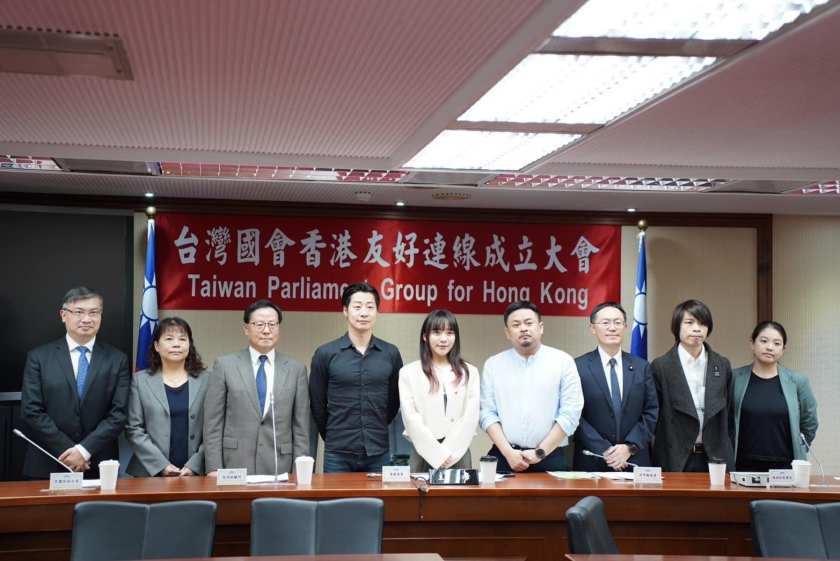
Image credit: 黃捷/Facebook.
Ten years after the Sunflower and Umbrella Movements broke out in 2014, the fates of Taiwan and Hong Kong have sharply diverged.
In particular, the outbreak of the Umbrella Movement in fall 2014 received significantly more attention in 2014 than the Sunflower Movement earlier that year. At the time of the Sunflower Movement, much international news coverage was focused on the disappearance of Malaysian Airlines Flight 370. Yet the Umbrella Movement benefited from the fact that many international correspondents who had been driven out of China in previous years had relocated. As such, there were a large number of international journalists who were based in Hong Kong when the Umbrella Movement broke out. Likewise, Hong Kong has long been a world financial and economic hub.
The 2019 protests in Hong Kong also received much international attention at the time. Like the Umbrella Movement, the demonstrations were highly visual in nature, which contributed to the circulation of images of them internationally. At the same time, one notes that later developments in Hong Kong politics, such as the passage of Article 23 of the Hong Kong Basic Law, have received far less attention. There are ways in which international media coverage has moved on.
By contrast, Taiwan has received more international attention in past years in line with rising geopolitical tension between the US and China. Beforehand, the COVID-19 pandemic had led to international accolades for Taiwan’s response to the coronavirus. In the wake of the pandemic, global supply chain shortages also illustrated to what extent the world was reliant on Taiwanese semiconductor manufacturing, with Taiwan producing 65% of global supply and more than 90% of advanced chips.
Indeed, Taiwan was always more geopolitically significant than Hong Kong was. And ironically, in past years, Taiwan benefited from the wave of journalists that departed Hong Kong after 2019 given the worsening political conditions there–as well as because the next big story seemed to be the 2020 Taiwanese presidential elections. Yet, at present, the two places are on very different trajectories, with Hong Kong firmly under CCP control and Taiwan still seeking to maintain its de facto independence. At times, the political situation in both Hong Kong and Taiwan has come up as key points of contention between the US and China, but it cannot be disputed that Taiwan is of greater geopolitical significance for the US or other regional powers.
Still, Taiwan and Hong Kong had long been in political dialogue with each other in some sense. With the outbreak of the Sunflower and Umbrella Movements in 2014, the leading activists in both contexts often were well acquainted with each other before either movement elevated them to the status of political stars. This was due to the fact that Taiwanese and Hong Kong youth activists had long seen a common cause with each other in the face of a shared threat from China and often had travelled to each other’s political contexts before.
The Sunflower and Umbrella Movements shared structural similarities; both were occupation-style movements such as were common in the early 2010s. Like other occupation-style movements at the time, there were clear leaders to the movements. This is to be contrasted with the 2019 protests, which were not based on maintaining an occupation but took the form of fluid, highly mobile roving protests through the entirety of Hong Kong in line with the ethos of “Be Water.” The 2019 protests were mostly anonymous in that participants hid their identities, given advances in surveillance technology in the past decade. Having clear leader figures was eschewed in that authorities would target such leaders in order to decapitate movements, with a focus instead on collective, decentralised decision-making.
In the years after 2014, even as it became more difficult for Taiwanese activists to travel to China, it was relatively common for Hong Kong activists to continue to travel to Taiwan–particularly to observe major political events such as presidential elections. But whether with regards to the Umbrella Movement or the 2019 demonstrations, one observes how there were efforts to learn from Taiwan. An August 2014 attempt to occupy the Hong Kong Legislative Council (LegCo), as well as an attempt to occupy LegCo that took place in July 2019, both illustrate this. The Sunflower Movement was directly referenced in the 2019 attempt to occupy LegCo. Similarly, Hong Kong activists acted to exploit splits within the Hong Kong political leadership in 2014, much as Sunflower Movement activists had months prior.
Taiwan has not seen any social movement on the scale of the Sunflower Movement in the decades since. The Sunflower Movement was, after all, a response to fears regarding the KMT’s efforts to facilitate closer political and economic links between Taiwan and China–the KMT has not held power since 2016. So, there was no sense of threat to trigger another movement.
Instead, many Sunflower Movement activists entered politics, running as candidates or becoming part of pan-Green political parties such as the DPP or NPP. Much of the energy that would have otherwise found an outlet in another social movement if the KMT held power was instead diverted to electoral politics.
Yet one observes how the “Hong Kong factor” has sometimes had a role to play in Taiwanese electoral politics. Taiwanese paid much attention to the 2019 protests, as observed in donations of protest supplies to Hong Kong when there were shortages of safety helmets, gas masks, and other items, and cases of activists travelling over to participate directly in the demonstrations. Likewise, during the most intense period of the protests, solidarity rallies for Hong Kong were held in Taipei daily.
Tsai Ing-wen of the DPP leveraged on the issue of Hong Kong in elections, calling attention to how KMT presidential candidate Han Kuo-yu had met with Hong Kong Chief Executive Carrie Lam not long before the start of the protests and suggesting that Taiwan could see a similar fate to Hong Kong if the KMT took power. Although such fears regarding China historically undergird Taiwanese elections and prove a crucial determinant of the outcome, Hong Kong served as a locus for crystallising such long-standing concerns and repackaging them in a new form. And while the KMT tried to backpedal on the issue, condemning “One Country, Two Systems” and trying to emphasise that the “1992 Consensus” that it advocated was not the same as “One Country, Two Systems.”
But this may have been too little, too late, and the election swung in favour of Tsai. The election proves a means by which Hong Kong played a crucial role in influencing Taiwanese politics in 2019 and 2020, then.
At present, one notes the waning of political interest in Hong Kong by Taiwan. Measures to assist Hongkongers in immigrating to Taiwan have sometimes been shot down by pan-Green politicians, with the claim that this could allow Chinese spies to travel to Taiwan posing as Hongkongers. Furthermore, there has been lacking measures for Hongkongers seeking political asylum in Taiwan, including cases in which Hongkongers sought to flee to Taiwan by speedboat and were caught by the Chinese Coast Guard or were held incommunicado once they arrived in Taiwan.
Particularly in the wake of the passage of Article 23, Hong Kong may increasingly be seen in Taiwan as a lost cause–as having become de facto a part of China that is no different than the rest of it. At the same time, given the long-term history of political interactions between Taiwan and Hong Kong, one expects exchanges to continue to occur, whether at the level of social movements or electoral politics.
Brian Hioe is one of the founding editors of New Bloom. He is a freelance journalist, as well as a translator. A New York native and Taiwanese-American, he has an MA in East Asian Languages and Cultures from Columbia University. He graduated from New York University with majors in History, East Asian Studies, and English Literature. He was a Democracy and Human Rights Service Fellow at the Taiwan Foundation for Democracy from 2017 to 2018. He is currently a non-resident fellow at the University of Nottingham’s Taiwan Research Hub.
This article was published as part of a special issue on ‘Tenth Anniversary of the Sunflower and Umbrella Movements‘.
 Taiwan Insight