
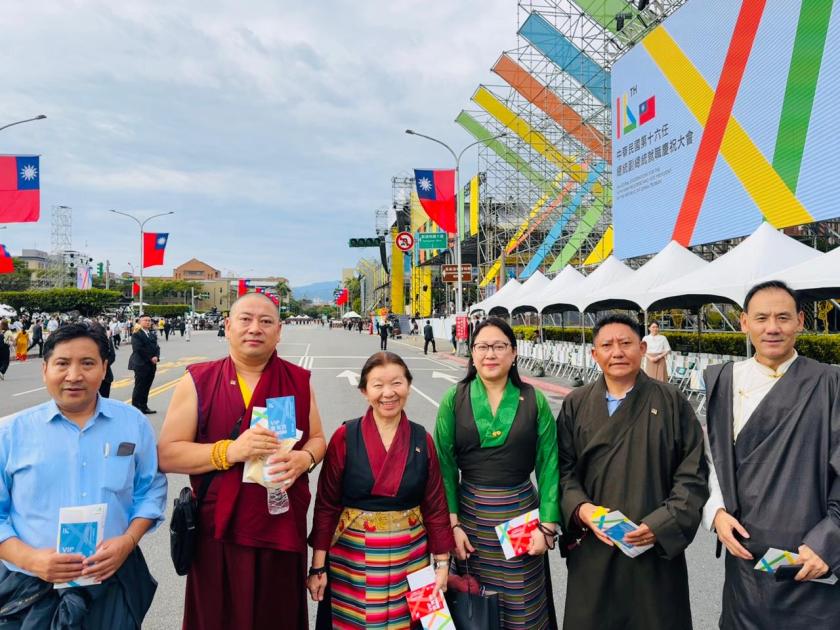
Written by Dolma Tsering.
Image credit: Tibet.net.
On May 20, elected President Lai Ching-te and Vice President Hsiao Bi-khim were sworn in as the 16th-term President and Vice President of the Republic of China-Taiwan, respectively. There are many speculations about his administration and policies, particularly concerning approaches towards China. Many argued that he would be Tsai Ing-wen 2.0, meaning that there would not be much change from the Tsai Ing-wen administration’s foreign policies. However, since 2019, international politics has witnessed a major geopolitical and diplomatic drama between China and the United States. This also impacted Tsai Ing-Wen’s diplomacy. Escalating the trade war between the two major powers immediately impacted their allies.
Furthermore, China’s growing assertive and aggressive diplomacy in the post-Covid period also led to a new regional forum, such as the Quad, which essentially aims to counter Chinese aggression. This new post-Covid era of international politics had immediate implications for Taiwan’s foreign policy conduct, especially in the context of dealing with China. One of the obvious changes in Taiwan was the shift in attitude from refraining from antagonising China to contending China’s aggressive foreign policies. Tsai Ing-wen, dealing with the Central Tibetan Administration (CTA) (aka the Tibetan government in exile), is one example to witness this shift.
President Tsai attended and addressed the Free Tibet marches held in Taipei early in her political career as a Democratic Progressive Party (DPP) legislative member. She also met the Dalai Lama as a chairwoman of the party in 2009. However, during her two terms of presidency, her administration maintained a distance from the CTA, not to mention the absence of a Tibetan representative attending the inauguration of her presidency. In 2009, she was also criticised for rejecting visas for the Dalai Lama and Rebiya Kadeer to attend the International Religious Freedom Forum. Some parliament members of the CTA visited Taiwan, but their engagement was largely limited to meeting with human rights NGOs and a few DPP lawmakers. When there was a shift in the geopolitics of the Asia-Pacific region in the post-COVID pandemic period, the U.S. also became more vocal in expressing the solidarity of the Tibet issue. The U.S. Secretary of State met with the Dalai Lama representative in Delhi, and this was unprecedented as this kind of high-level meeting rarely happens. Subsequently, there was a shift in the Tsai Ing-wen administration’s approach towards the CTA. There is a renewal of diplomatic outreach between the CTA and Taiwan. The meeting between the Minister of the Department of Information and International Relations (DIIR) of the CTA and the Minister of Foreign Affairs of Taiwan in 2023 was the best indication of this renewal of high-level outreach between the two. There was also some leniency in Taiwan’s sanctions imposed on Tibetan refugee students wanting to study there.
Now, going back to the discussion about Lai Ching-te and his continuation of the Tsai Ing-wen legacy, Lai Chiang-te’s relationship with CTA goes back to his day as the Mayor of Tainan. In 2016, as a Mayor of the Tainan city, he visited the office of the Religious Foundation of the Dalai Lama in Taipei to express gratitude for the Dalai Lama’s aid in the earthquake that devastated his city. Except for this encounter, there is no other evidence of his involvement with the Tibetans. However, Vice-President Hsiao Bi-khim had a deeper connection with the Tibetans. She frequently participated in the Tibetan National Uprising Anniversary rallies in Taipei. Also, she served as Vice-Chair of the Taiwanese Parliamentary Group for Tibet when she was a Member of Parliament.
Moreover, when Dicki Chhoyang, Minister for Information and International Relations of the Central Tibetan Administration, arrived in Taiwan in 2012, Hsiao Bi-khim, as a legislator of the DPP, invited her to speak at the Taiwan Legislative Yuan. Hsiao Bi-khim has long been an advocate for the protection of human rights. Being a Taiwan ambassador to the United States also provided an opportunity to closely observe Tibetan advocacy at the white house.
In contrast, Tsai Ing-wen’s government’s conservatism approach towards the CTA, in fear of irritating China, both have extended an invitation to the representative of the CTA to attend the inauguration of the new government. The first time CTA representatives were invited to participate in Taiwan’s presidential inauguration was in 2001 when Chen Shui-bian was elected as the first elected President of the DPP. CTA representatives were also invited during his second-term presidential inauguration. Additionally, a day before the inauguration ceremony on May 20, there was also a new development of the formation of the 11th Taiwan Parliamentary Support Group for Tibet. Attendees include major figures like Wen Li, one of the spokespersons of the President’s office and who had previously served as Deputy Director of the Department of China Affairs, DPP, Hung, Sun-Han, a DPP legislator and Wu Pei-Yu, a DPP legislator. Legislator Hung Sun-Han took part in the World Parliamentary Support Group for Tibet in Washington in 2022, and he met with the speaker Nancy Pelosi, two months before her historic visit to Taiwan. More importantly, the Vice President has also met with the Tibetan delegations after the inauguration ceremony. This is the first time after the Chen Shui-bian presidentship, despite pressure from the Chinese government, such high-level close diplomatic exchanges eventuated two close allies.
Historically, Taiwan and CTA share a bitter relationship because of Kuomintang’s policy that advocated for Tibet as a part of the Republic of China. Consequently, the Mongolian and Tibetan Affairs Commission (MTAC) was re-established in Taiwan. CTA has accused the MTAC of threatening the legitimacy of the CTA by creating regional segregation and harming the unity among Tibetans in exile; as a result, there was no official contact established. The first official relations were established under the Lee Teng-hui leadership with the first visit of the Dalai Lama to Taiwan in 1997. However, the Chinese government continued to pressure both the CTA and Taiwan for such ties and accused them of a separatist collaboration. The Chinese government pressure played a critical role in the absence of any diplomatic engagement between the two sides during the Ma Ying-jeou and Tsai Ing-wen presidencies. It is also important to note the U.S. role in this complex nexus of Taiwan, Tibetans, and China relations. U.S. support to Taiwan and Tibet will play a crucial role in continuing to this new beginning as it did in the 2023 meeting.
Besides the political implications of these meetings, Taiwan is home to about 650 Tibetan diasporas and has about half a million Tibetan Buddhist followers. There is also a close transnational cultural connection established between India, Taiwan, and Tibetans in India because the majority of the Tibetan diaspora hailed from India. For instance, annually, about 500 Taiwanese attend the Dalai Lama teaching in Dharamsala, India. There are about 400 Tibetan Buddhist centres in Taiwan.
While President Lai Ching-te and Vice President Hsiao Bi-khim might continue with many of the Tsai Ing-wen foreign policy conducts, their approaches towards the CTA and Tibetan issue, despite pressure from the Chinese government is an indication of change in Taiwan’s approach to the CTA in particular and China at large. There is a clear sign of warming relations and hopefully, these warming relations have a positive impact on lingering visa sanctions imposed on Tibetan refugees by the Taiwanese government.
Dolma Tsering is a Postdoctoral fellow at the International Center for Culture Studies (ICCS) of National Yang-Ming Chiao Tung University.
This article was published as part of a special issue on ‘Presidential Inauguration‘.
 Taiwan Insight