
Written by Jung Chen.
Image credit: author.
Legal, social, and economic constraints shape individuals’ accessibility to reproductive means and, therefore, map out an uneven reproductive landscape across the globe. While both activists and academics have been calling for reproductive justice and transnational solidarity to enhance the accessibility to reproduction and eliminate the exploitation of reproductive labour, attention has also been turned to the ‘emerging reproductive subjects’—LGBTQ+ intended parents. The most heated debate around queer reproduction and stratified reproduction might be gay men’s third-party reproduction, considering that the process involves help from other women to conceive a child—egg donors and surrogates.
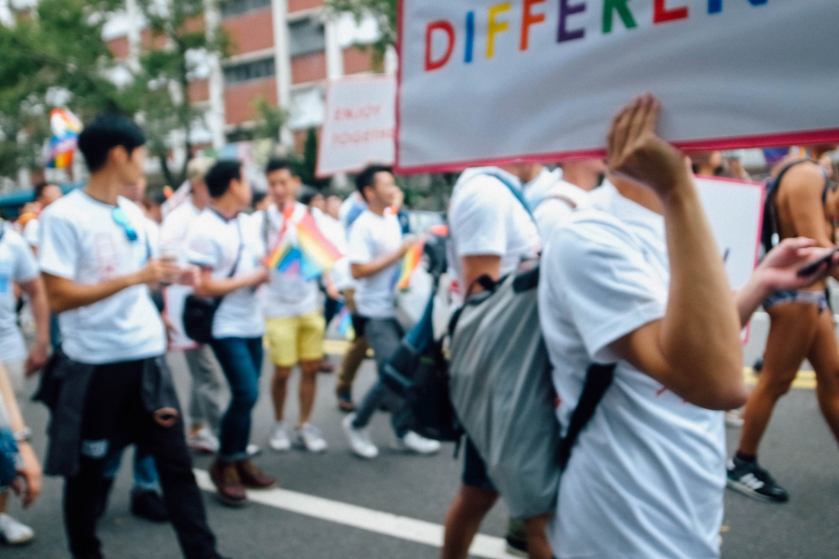
Turning to the case of Taiwan, it has been five years since same-sex marriage was legalised under the Act for Implementation of Judicial Yuan Interpretation No. 748 (748 Act). The legalisation came along with ecstatic celebrations both domestically and internationally, which attracted global attention to the island’s tremendous success as the first country in Asia to grant marital rights to same-sex couples. Till 2023, more than 62 thousand Tongzhi couples’ intimate relationships are legally recognised, including transnational couples (excepting those from China) whose marital rights were granted under the amendment of the 748 Act in May 2023. Nevertheless, for Tongzhi couples who want to have children, their parenting visions are still very limited.
The current Assisted Reproductive Act (ARA) excludes all non-heterosexual individuals from accessing assisted reproductive technologies (ARTs) and donor gametes. Tongzhi couples are ambushed by constraints that opposite-sex couples do not usually face—exclusion from local ARTs accesses, significant financial burden deriving from overseas fertility treatments, and lacking information on potential reproductive options as well as social and familial support. This is one of the multiple layers of ‘stratified reproduction’ that can be observed in Tongzhi’s reproduction—the inaccessibility to ARTs domestically. Besides legal constraints, gay men, in particular, encounter even greater barriers when they seek assisted reproduction to become parents. Gay men need donor ova as well as help from women who act as surrogates to gestate the babies for them, which brings out another layer of stratified reproduction—the economic disparities between comparatively affluent intended gay fathers and the surrogates who are from less privileged socioeconomic backgrounds.
The most popular destination for Taiwanese gay men to seek surrogacy services is the United States, which is known for its high-quality biomedicine, gamete banks with ample supplies and commercial surrogacy protected by legal contracts. In the past decade, some intended gay men also travelled from Taiwan to countries such as Thailand (before 2015) and Russia (before 2022), but now these locations are no longer available due to the restrictions on international surrogacy in many countries, including Thailand and India, as well as Russia’s invasion to Ukraine that dramatically disrupted the used-to-be flourishing surrogacy industry in both countries. As a result, Taiwanese gay men seem to have no choice but to ‘exile’ to the United States to fulfil their parenting dreams. Nevertheless, not all those gay men who are aspiring to become fathers have affluent resources to support their cross-border reproductive projects. A surrogacy arrangement in the United States is around 150,000 USD and can be up to 250,000 depending on varied situations, which is about 4.5 times higher than the average annual household income in Taiwan. The disparities among gay men who have reproductive quests show the second layer of stratified reproduction. Only very few gay men in Taiwan are financially capable of affording the expense of overseas ARTs and surrogacy.
In this sense, the concept of stratified reproduction signifies not only the inaccessibility to local reproductive means because of individuals’ sexualities, as previously mentioned, but also intersects with class. Drawing on gay men who lack access to cross-border reproductive care due to their socioeconomic status also helps us see a broader picture of the lack of reproductive rights, which refers to the coalition between the middle-class ideal parenting styles as well as the intensive parenting culture and the neoliberal logic of family-making and children-cultivating. Individual gay men who find themselves unable to secure enough finance for surrogacy take the blame on themselves by drawing on the discourse of ‘not qualified to be a father’ or ‘cannot provide my children with a good education. They constrained their desires to become fathers by devaluing themselves as ‘unqualified intended parents’ because they could not financially afford the surrogacy cost. Even though the middle-class parenting style is only one of the many possible parenting scripts, the predominant intensive parenting practices with increasing educational investments in children in many contemporary societies, including Taiwan, have become the backdrop for gay men to connect their self-doubts of parental potentiality to their lack of reproductive accesses.
The third and most critical stratified reproduction is the disparities and inequalities among the commissioning parents and women who become surrogates in the context of the blossoming reproductive industry across national borders. Beyond the Taiwan context, there are critiques of the exploitation in the surrogacy industry. For example, white middle-class intended parents from Western countries seek reproductive opportunities in the so-called Third-world countries, such as India and Thailand, both of which used to be the ‘reproductive hub’, where women are in challenging conditions and have no other choices but to take on surrogacy labour in order to provide their families. The stratified reproduction between the affluent commissioning parents and the women coming from poor living conditions raises global attention on surrogacy practices, and the debates around the moral aspects of using surrogacy as a means of becoming parents also emerge in both academia and public spheres. Under the pressure of the discourse around surrogacy practices being accused of depriving Third-world women and serving Western customers, as well as of the aftermath of several scandals, most Asian commercial surrogacy hubs closed the door to international intended parents. For instance, Thailand, the emerging ‘hub’ for international surrogacy, was closed after the ‘Baby Gammy’ scandal in 2014.
The controversy of surrogacy continues and can also be found in the LGBTQ+ community. Gay men in Taiwan are concerned about the moral aspects of surrogacy. Based on my research on gay men’s transnational reproduction, I observed that they proactively gathered information on moral debates around surrogacy in different countries and drew what I termed as ‘flexible moral boundaries’ to distinguish the ‘problematic’ and the ‘ethical’ surrogacy practices. Gay men’s proactive preparation before embarking on their reproductive journey is the ‘strategic caring practice’ they employ as an attempt to eliminate the stratification between themselves and their surrogates. Taiwanese gay men are in an ambiguous position that partly they suffer from stratified reproduction due to their sexual identities, and partly they are privileged compared to their surrogate candidates who receive the compensation fee to gestate their future children. Therefore, gay men in Taiwan felt like they had no choice but to be exiled to other countries that could offer them surrogacy services, but they were also aware that their reproduction might only be achieved at the expense of other women. Gay men in my study considered the decision on the destination country for surrogacy by drawing on their ‘flexible moral boundaries’ with the hope that their choice is ‘ethical’ and avoids the exploitation of women.
What I mean by ‘flexible moral boundaries’ is the ways in which intended gay fathers understand and conceptualise ‘ethical surrogacy’ not only depend on the information they gather but also on their own positioning. On the one hand, those who are more financially affluent often go to the United States and consider surrogacy there to be the most ethical because of the comparatively profound legal contracts and interactive friend-like relationships with surrogates. On the other hand, those who choose Thailand and Russia are often less economically privileged and cannot afford surrogacy in the United States; they sequentially develop a different discourse on ‘ethical surrogacy’ and consider the ‘win-win commercial model’ as the best practice.
Surrogacy remains a controversial practice in many countries, and it provokes us to cautiously ponder the issues around reproductive rights, stratified reproduction, and women’s body rights. As Taiwan is now considering the potentiality of drafting the amendment on ARA to legalise surrogacy, it is crucial to think about the multiple layers of stratified reproduction. Drawing on the analysis of gay men’s reproductive constraints and practices, I propose that it is vital to enrich the concept of reproductive rights by looking at individuals’ positioning as well as its intersection with class, sexuality, and nationality. I therefore invite us to think: What kinds of reproductive justice do gay men in different positions need, in terms of their disparate backgrounds? Who needs surrogacy in Taiwan? Who would become the surrogates in Taiwan? What kinds of surrogacy practices can we accept and support, or should surrogacy remain illegal in Taiwan? What kind of solidarity do we need to build, and what kind of principles do we need for all individuals who participate in transnational reproductive activities, including LGBTQ+ intended parents and reproductive labourers? Last but not least, the ultimate question we need to ask ourselves might be: What is Taiwan society’s vision of reproductive justice?
Jung Chen (She/Her) is a PhD Candidate in Sociology at the University of Cambridge. As a Taiwanese and a young queer scholar, she is concerned about LGBTQ+ people’s rights in Taiwan and beyond. Her PhD project looks at queer reproductive justice and the (re)making of ‘queer relatedness’, with a specific focus on Taiwanese gay men who access transnational third-party reproduction to become fathers. Her next project will look at Cross-Strait Tongzhi couples’ intimacy practices, family-making, and reproductive plans in the context of sociolegal changes and geopolitics regarding the Taiwan-China political tensions.
This article was published as part of a special issue on ‘In the Name of Birth: Technology, Care and Circumstances‘.
 Taiwan Insight