
Written by Yo-Ling Chen.
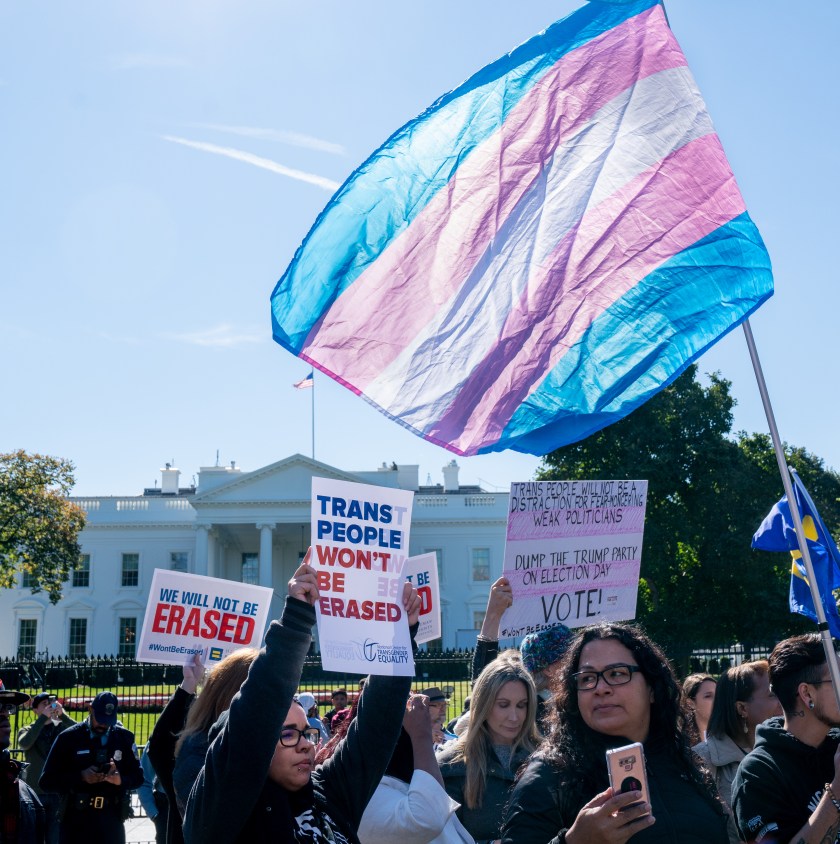
Image credit: Transgender healthcare rally by Victoria Pickering/ Flickr, license: CC BY-NC-ND 2.0.
It is no secret that anti-trans positions were a prominent part of Trump’s presidential election campaign. As early as February of 2023, Trump vowed to “revoke Joe Biden’s cruel policies on so-called ‘gender-affirming care’,” “sign a new executive order instructing every federal agency to cease all programs that promote the concept of sex and gender transition at any age,” and “pass a law prohibiting child sexual mutilation in all 50 states.” Towards the end of his campaign with the now notorious “Kamala is for they/them, President Trump is for you” election ad, Trump once again emphasised his hardline stance against transgender rights. As transgender communities and organisations brace for impending rollbacks, some anti-gender groups in Taiwan have unabashedly celebrated Trump’s election victory.
In the lead-up to the US presidential election, Taiwan Solidarity Union (TSU) Chairwoman Chou Ni-an (周倪安) published an op-ed proclaiming that “‘Conservative Values’ Will Be Significant Factor Deciding US Election.” Being self-described as a conservative Taiwanese independence party, TSU was the first minor political party in Taiwan to (unsuccessfully) attempt campaigning on a platform against transgender rights. It comes as no surprise that TSU issued a statement celebrating Trump’s election victory, proclaiming that “The US elections remind us that the pursuit of progressive values ultimately leads to defeat!” While TSU did not directly cite transgender issues as a contributing factor to Trump’s victory, previous social media posts suggest that advancements in transgender rights–specifically efforts to abolish compulsory surgery for legal gender change–were nevertheless one of the “progressive values” defeated by Trump’s election.
The Taiwan Parents Protect Women and Children Association (TPPWCA), a minor anti-gender group, was more explicit in naming the importance of transgender issues in Trump’s campaign. Immediately after Trump’s victory, TPPWCA posted on social media with the hashtag “#反對跨性別運動” (“resist the transgender movement”) that one of the reasons for Trump’s win was due to his hardline stance against transgender rights. TPPWCA’s post further advised political parties in Taiwan to learn from the US election results that people have had enough of “the political correctness of the left.”
The Taiwan Women’s Association (TWA), a newer anti-gender group established last year, was perhaps the most imaginative in its interpretation of Trump’s election victory. In an op-ep titled “Transgender Frenzy Foiled in the US, Taiwan’s Government Should Stop” (美跨性狂潮挫敗,臺灣政府應止步), TWA claimed that the Democratic Party was enthusiastically pushing “sex self-identificationism” (性自認主義) and that because of this, they were unable to get over half of female voters during the election. In reality, over 50% of women overall voted for Harris; only in the demographic of white women did Trump receive a 53% majority of votes. Nevertheless, TWA framed Trump’s election victory as an opportunity for Taiwan to “start waking up and clearly draw the line at transgender and gender self-identification ideology.”
TWA’s attempts to falsely claim that the majority of women were disillusioned by transgender inclusion and hence supported Trump plays into a populist rhetorical strategy that Taiwan’s anti-gender movement has been utilising since its founding in the fall of 2021. This populist strategy argues that advocating for transgender rights stands in opposition to a disapproving public. Responding to a historic Taipei High Administrative Court (THAC) ruling made in late September of 2021 in favour of a transgender plaintiff seeking to change her legal gender without undergoing sexual organ removal surgery, over 5,000 concerned citizens signed two petitions on Taiwan’s Public Policy Online Participation Platform (公共政策網路參與平台) demanding the maintenance of both gender-segregated spaces on the basis of biological sex and the surgery requirement for changing one’s legal gender. This initial wave of mobilisation soon coalesced into Taiwan’s largest and most active anti-gender organisation, No Self ID Taiwan, which featured both petitions on its homepage under the heading “Will the Public Get a Say?”. For anti-gender groups such as No Self ID Taiwan, efforts to ensure the civil rights of transgender people are being undemocratically pushed forward against the will of the people by government bodies and civil society organisations who have been corrupted by gender ideology.
For instance, an episode earlier this summer of No Self ID’s podcast, 尋常百姓思聊私聊 What the Woke?, framed the passing of gender self-identification laws in Germany (00:01:08) and Switzerland (00:03:38) as occurring despite “the majority of public opinion being in opposition.” In this same podcast episode, No Self ID cited a research article from the US-based sexology journal Archives of Sexual Behaviour to falsely claim that over 90% of the Taiwanese public is against abolishing compulsory surgery for legal gender change. This so-called public opinion research—which has been cited elsewhere by No Self ID Taiwan, the anti-gender social media account @memetranspolicy, and US expat co-founder of TWA Jaclynn Joyce—was in actuality an online survey by TPPWCA that contained biased design and made use of convenience sampling.
The rhetorical strategy of positioning transgender rights against a disapproving public can be better understood through Lucy J. Miller’s analysis of “populist transantagonism.” With regards to J.K. Rowling, Miller writes that Rowling and her supporters interpret her continued popularity as evidence of anti-gender positions being both correct and commonplace. Within the populist transantagonist imagination, a cisgender majority is framed as the proper beneficiaries of legal protection whose rights and interests are being eroded by a (usually elite) transgender minority. Be it for Rowling or Trump, anti-gender movement groups interpret popular support for figures staunchly opposed to transgender rights as a circular confirmation that the majority of “ordinary people” support a “commonsense” biological essentialism when it comes to gender.
Trump did indeed win the popular vote by a small margin, making his election victory especially tempting for anti-gender groups to reference as vindication of their views. Anti-gender groups in Taiwan, such as TSU, TPPWCA, and TWA, have deployed this rhetorical strategy in their attempts to legitimise their politics with transnational popular force. It should be noted, though, that not all anti-gender groups have resorted to this rhetorical strategy, as No Self ID Taiwan and LGB Alliance Taiwan did not issue formal statements celebrating Trump’s election win.
In the weeks following Trump’s election, anti-gender groups in Taiwan have quickly moved on to other news, such as Li Kotomi’s outing. Nevertheless, these groups will likely celebrate rollbacks on transgender rights in the US under Trump’s second presidency and interpret these events through the rhetoric of populist transantagonism to argue that the will of “the people” against “transgender ideology” has finally been realised in the US—and that Taiwan, too, should follow suit.
Yo-Ling Chen (they/them) is a trans nonbinary activist, translator, and independent scholar based in Taipei. They are a contributing editor at New Bloom, as well as managing editor and translator at 酷兒翻越 Queer Margins.
Financial Disclosure

This article was made possible by grant funding from the Transgender Educational Network: Theory in Action for Creativity, Liberation, Empowerment, and Service (TEN:TACLES) Initiative for the Transpacific Taiwan Transgender Studies (3TS) Research Collective.
This article was published as part of a special issue on ‘US Election: Implications for Taiwan’.
 Taiwan Insight