
Written by Yi-Ting Lu.
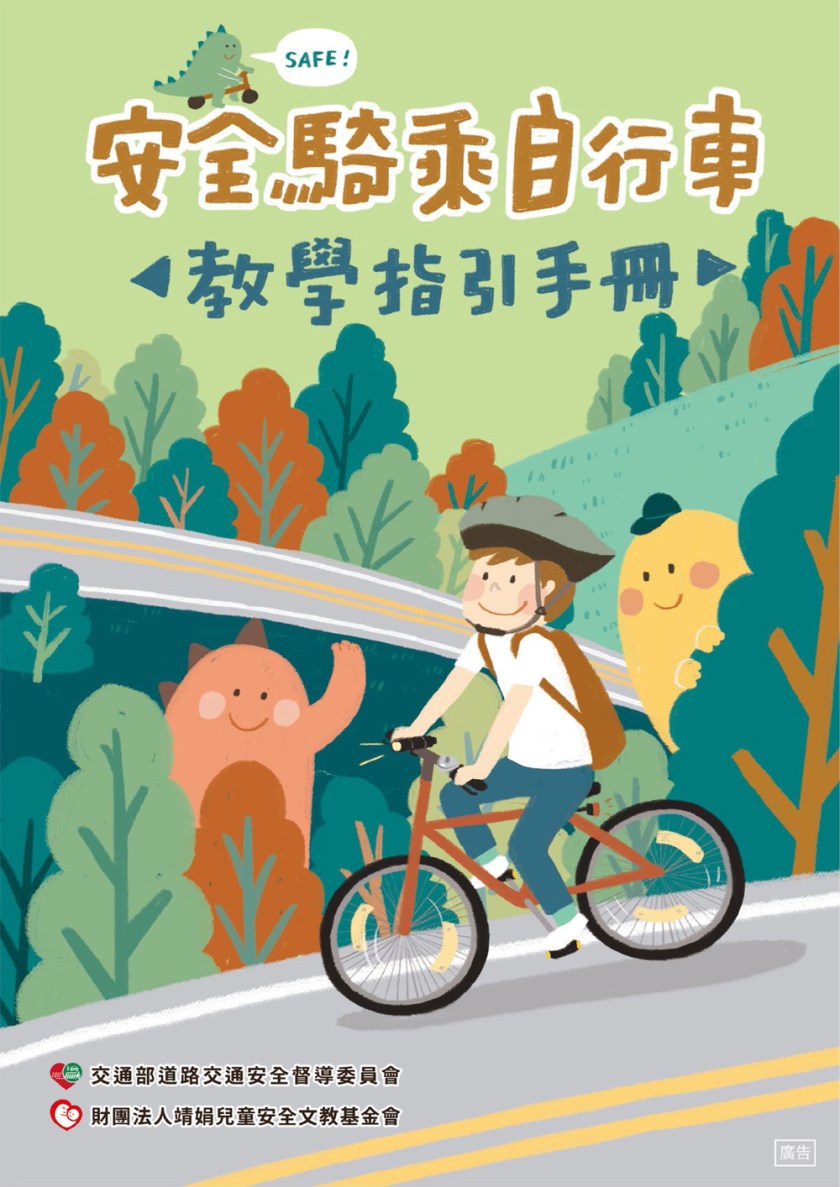
Image credit: Cover of the “Safe Cycling” teaching instruction manual by the Ministry of Transportation and Communication and Jing Chuan Child Safety Foundation.
In Taiwan, about 200 cyclists lost their lives, and almost twenty thousand of them were injured annually over the past decade. As bicycles are defined as “slow-moving vehicles” by the Ministry of Transportation and Communication (MOTC), cyclists in Taiwan are only permitted to ride on slow lanes or outer lanes with scooters and motorcycles unless there are signs or independent lanes on the sidewalks, which poses threats to their safety. According to WHO (2022), adopting active transport modes, such as cycling and walking, not only benefits the well-being of people by increasing physical activity but also improves the health of the earth by reducing the emissions of air pollutants and greenhouse gases. While safe cycling is a significant public health concern warranting greater focus, research has yet to examine how cycling safety is taught to students in Taiwan. This article discusses findings from an initial literature review and analyses a Taiwanese cycling safety manual using critical discourse analysis.
What factors are found to be related to safe cycling?
Objectively, safe cycling is associated with three variables (Wegman et al., 2012), including exposure (the time or distance you travel by bicycle), risk (the probability of being involved in a crash per certain period or distance), and consequences (the severity of injury got in a crash). Since more and more countries are promoting cycling, interventions are implemented to reduce the risk and to lessen the severity, such as improving the road surface to prevent single-vehicle crashes. The importance of local empirical research is emphasised to bring about suitable and effective solutions to enhance the safety of cycling (Schepers et al., 2014).
As for the perceived safety of cyclists, environmental factors such as whether the lane for cyclists is separated from motorists, the width and the colour of the lanes, and the presence of parked cars matter (Gössling & McRae, 2022). Moreover, confrontation with aggressive drivers, feelings of hostility toward cyclists, and awareness of the ambiguity of cyclists’ right of way also make cyclists feel unsafe (Mayers & Glover, 2021). An evaluation of the Safe Cycle program targeting schoolchildren in Australia found that despite gaining knowledge of safe cycling, the fear of cycling from parked cars also increased significantly (Hatfield et al., 2019).
About the analysed manual and the applied methodology of critical discourse analysis
The “Safe Cycling” teaching instruction manual is designed for teachers and parents whose students or children are in elementary school, junior high school, or high school, with junior high school teachers as the main target since junior high school students are considered to be the beginners in adopting cycling as a main commuting mode, and examples of lesson plans for junior high school teachers are included in the manual. The manual was jointly developed by the Ministry of Transportation and Communications (MOTC) and the Jing Chuan Child Safety Foundation, a non-governmental organisation that focuses on various aspects of children’s safety, including transportation, playground, and home safety. It was founded in 1993 to commemorate the teacher Jing-Chuan Lin, who lost her life in a tour bus fire in 1992 while trying to save students.
Fairclough (2013) stated that critical discourse analysis concerning “dialectical relations between the material and the semiotic” needs to focus on both values and causes, which requires theories from multiple disciplines (for instance, the cultural political economy framework used by Fairclough) to address the research issues. The transdisciplinary research methodology consisted of four analytical stages: “focus upon a social wrong,” “identify obstacles to addressing the social wrong,” “consider whether the social order needs the social wrong,” and “identify possible ways past the obstacles.”
How “safe cycling” is framed in the teaching instruction manual in Taiwan.
The manual opens by characterising cyclists as slow-moving vehicles and attributes their frequent involvement in traffic crashes to two factors: the absence of licensing requirements and cyclists’ inadequate understanding of both traffic rules and proper interaction with other road users.
The section describing cycling locations reveals Taiwan’s complex and ambiguous cycling environment, which forces cyclists into a continuous if-else decision loop during their journey: cyclists must first use dedicated bike lanes if available; in their absence, they should use sidewalks marked as “shared-use paths” (where pedestrians have priority); if no shared-use paths exist, they must use the slow lane; and if there is no slow lane, they must use the outer lane. The complexity extends beyond simply choosing the correct lane – cyclists must follow different rules and signals depending on where they are riding. Additionally, the manual states that cyclists should always be ready to brake to avoid traffic crashes. Processing the above tasks simultaneously may lead to a cognitive overload of cyclists, which, on the contrary, tends to increase the risk of traffic crashes.
Negative perceptions of bicycles and cyclists can be an obstacle to addressing the lack of a safe cycling environment. This is presented not only at the beginning of the manual mentioned above but also in the examples of lesson plans. Although the lesson plan aims to enable students to identify and deal with the potential risks of cycling, the conclusion is that “bicycles are unstable vehicles, and cyclists need to protect themselves.”
While the manual provides safety recommendations for cyclists, it fails to address the specific needs of schoolchildren. For example, it does not account for their developing physical and cognitive abilities, which may prevent them from meeting the manual’s expectations of an ideal cyclist, nor does it consider children’s perceptions of safety. Beyond the passive measures aimed at preventing traffic crashes involving schoolchildren cyclists, the manual should also include more proactive approaches, such as teaching children how to identify and report the risks they encounter in their daily cycling experiences.
Conclusion
While the current version of the “Safe Cycling” teaching instruction manual in Taiwan endeavours to promote safe cycling practices among schoolchildren, it presents certain limitations that require attention. Although the manual acknowledges the complexities of Taiwan’s cycling environment, it presents negative images of cyclists, overemphasises the duty of cyclists in preventing traffic crashes, and neglects the needs and opinions of schoolchildren.
Regarding the suggestions for future revisions, I recommended that the manual should recognise the agency and address the unique needs and challenges faced by schoolchildren. Beyond passive prevention, the manual should empower schoolchildren to take active action to mitigate risks in their daily cycling experiences. Finally, instead of framing cyclists as incompetent, the manual should emphasise their role as responsible road users contributing to a healthier environment and society.
Yi-Ting Lu is a master’s student from the Institute of Health Policy and Management, National Taiwan University.
 Taiwan Insight