
Written by Jiun-Da Lin and Kuei-Tien Chou.
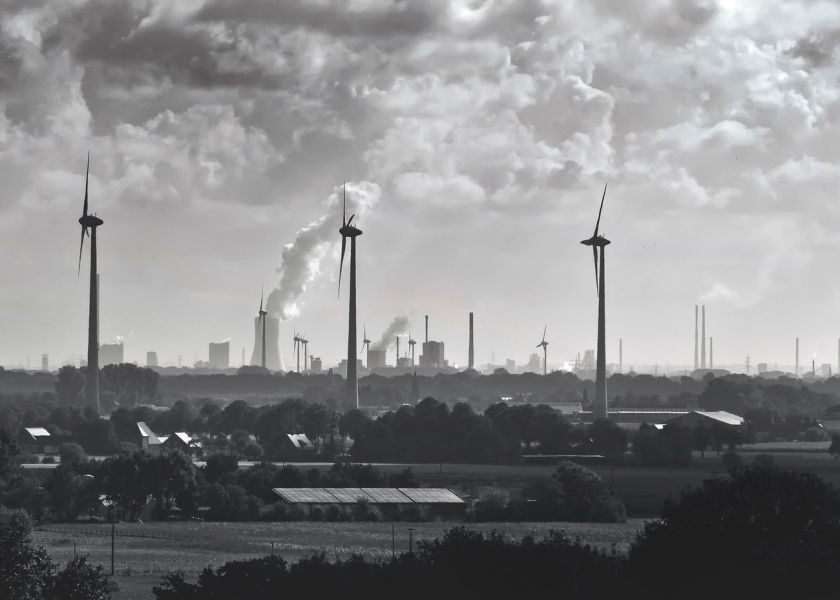
Image credit: public domain.
In the face of climate change, the frequency and intensity of extreme weather events are on the rise, underscoring the pressing need for global action towards achieving net-zero emissions. Taiwan is on the front lines of the battle against climate change, with its geographical location making it particularly vulnerable to typhoons, heavy rainfall, and rising sea levels. The move towards net-zero emissions is not just an environmental necessity but a societal imperative.
However, the path to net zero is fraught with challenges that could potentially exacerbate existing societal inequities. Thus, ensuring a just transition—where no one is left behind—is critical. Taiwan’s proactive approach towards this objective, particularly through its plans for “net-zero emissions by 2050,” involves intricate strategies balancing environmental goals with social equity. As Taiwan sets to impose a carbon fee on businesses starting in 2025, there is a significant focus on how these policies will affect various sectors and communities, especially the underprivileged.
Recognizing the importance of public attitudes in shaping effective policies, the Risk Society and Policy Research Centre at National Taiwan University has been conducting annual surveys on just transition. The latest survey reveals perspectives from Taiwanese citizens on this pivotal issue. The survey was conducted from October 17 to October 25, 2024, targeting residents of Taiwan aged 18 and older, including those in Kinmen County and Lienchiang County. A total of 701 valid samples were collected via landline phones, and 401 valid samples were collected via mobile phones, resulting in a total of 1,102 valid samples. With a 95% confidence level, the margin of error is estimated to be within ±2.95 percentage points. Key findings from the survey are summarized as follows.
Key Findings from the 2024 Survey
First, results show that income inequality is perceived as severe by a large majority, with many not understanding net-zero policies but feeling the impact on their lives and work. 86.5% of respondents consider income inequality in Taiwan “severe,” and 62.1% report “not understanding” government carbon reduction policies. When asked about changes to personal life due to the government’s net-zero pathway, 61.1% are most concerned about rising prices; regarding national issues, 46.5% worry about an increasing wealth gap.
Second, most respondents are concerned about the impact of extreme weather on vulnerable groups and support proactive government policies to help affected individuals. 80.9% express concern over global warming, with the concern rate among those aged 18-24 rising to 89.5%. 79.9% believing the negative impact of extreme weather (such as heavy rain, drought, and high temperatures) on Taiwanese workers is “severe.” Additionally, 90.1% support the government providing more resources to workers to cope with extreme weather.
Third, many respondents believe that the government’s net-zero policy planning lacks public participation. 45.5% of respondents feel that there is “no” decision-making mechanism involving the government, employers, and employees during the planning stage; 48.7% think there are “no” channels for public opinion in carbon reduction policies; and 59.8% say public opinions are “not” properly considered.
Fourth, most survey participants support the government’s push for industry net-zero transformation and carbon fee policies, also advocating for increased subsidies for affected groups. 78.1% of respondents’ “support” the government imposing a carbon fee on businesses. When asked whether they support the government raising the carbon fee rate, 50.7% indicated “support,” with the support rate among the 18-24 age group reaching as high as 53%. 80.2% “agree” that the government should actively subsidize high-carbon businesses transitioning to low-carbon operations, and 77.1% “support” using carbon fees to subsidize electricity costs for low- and middle-income households. If carbon reduction policies lead to unemployment, 85.1% “agree” that the government should “fully subsidize” vocational training in addition to unemployment benefits.
Lastly, there is high expectation for green job opportunities, especially among the youth. 49.5% of respondents believe that new jobs created by net-zero carbon policies will be available in their area, with the agreement rate among those aged 18-24 reaching 57%. Additionally, 43.0% believe that these new jobs will offer better salaries than current ones, with the agreement rate among those aged 18-24 even higher at 52.3%.
Compared to the 2023 survey, certain findings remain consistent. For instance, in the previous survey, 55.2% of respondents identified a lack of a collaborative decision-making mechanism involving the government, employers, and employees during the planning stages of net-zero carbon policies. Furthermore, if net-zero carbon policies result in unemployment, 76.3% of respondents favour the government fully subsidizing vocational training in addition to offering unemployment benefits. About 46.1% of respondents are optimistic that the new jobs created by these policies will be available in their local areas.
Policy Recommendations for Taiwan’s Just Transition
The survey findings are a call to action for Taiwan’s government. First, the government could establish a Social Climate Fund or a Just Transition Fund in accordance with the Climate Change Response Act. The objective of this fund is to support enterprises in developing carbon reduction technologies, assist small and medium-sized enterprises (SMEs) in lowering carbon emissions and fostering innovation, enhance job and training opportunities for workers amidst the green transition, and provide subsidies for electricity, transportation, and living costs to low- and medium-income individuals.
Moreover, the government should strengthen negotiations and communication between the government, businesses, and workers during the net-zero policy-making process, pay special attention to the younger generation, and actively plan for more involvement of youth, workers, and small-to-medium enterprises in net-zero decision-making processes. Finally, the government should assess and strive to create green job opportunities across the country while simultaneously improving vocational training programs to better equip workers for emerging green sectors.
As Taiwan advances toward its 2050 net-zero target, maintaining the principles of a just transition is crucial. By emphasizing inclusive policies, vigorous public participation, and enhanced support for vulnerable populations, Taiwan can demonstrate globally how to harmonize environmental sustainability with social equity. This transition extends beyond emission reductions; it is about constructing a resilient society equipped to prosper in a shifting climate.
Jiun-Da Lin is a Research Fellow at the Risk Society and Policy Research Centre at National Taiwan University.
Kuei-Tien Chou is the Director of the Risk Society and Policy Research Centre at National Taiwan University.
This article was published as part of a special issue on ‘Farewell 2024, Fresh start 2025?’.
 Taiwan Insight