
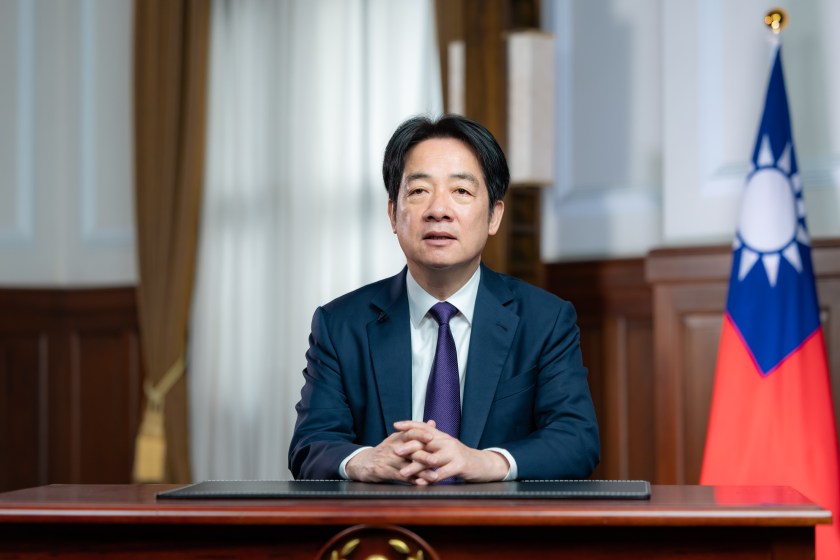
Image credit: 04.06 總統針對政府因應美國關稅政策發表談話 by 總統府/ Flickr, license: CC BY 2.0.
On April 2, 2025, United States President Donald Trump announced a policy order under the International Emergency Economic Powers Act (IEEPA) ‘s authority and introduced a sweeping 10% universal baseline tariff on its imports from all trading partners. The Trump administration also sought “reciprocal tariffs”, with an additional rate from 1 % to 40 % on nearly 60 trading partners. This move toward a blanket reciprocal tariff has significantly raised concerns about a potential global trade war, leading to a downturn in stock markets worldwide. In response, President Trump made a policy shift on April 9, pausing most countries’ “reciprocal tariffs” for 90 days. Trump’s back-and-forth policy shifts have also resulted in a drastic swing in the global markets. Despite the pause, the new minimum 10 % tariff, effective April 5, applies to goods imported from all countries, excluding semiconductors, pharmaceuticals, and critical minerals.
Another source of uncertainty for many East Asian countries is the Trump administration’s pursuit of sector-specific tariffs targeting products that the U.S. government perceives as imports threatening national security. Such practices include the Trump administration’s announcement of 25% tariffs on all steel and aluminium imports to the U.S. in February 2025 and 25 % tariffs on auto and certain auto parts entering the U.S. in March 2025, based on the investigation reports by the Commerce Secretary under Section 232 of the Trade Expansion Act. Given the context, concerns have arisen regarding the possibility of the Trump administration’s probing of new tariffs on semiconductors and electronics. The U.S. administration’s tacit use of punitive tariff threats to negotiate pressures trading partners to increase investment in the U.S. or demand economic concessions, imposing economic uncertainty on many of its key trading partners.
East Asian countries have been on the top lists of countries with higher tariff rates. Taiwan was hit with a steep tariff of 32%, and several Southeast Asian countries listed by Trump received tariffs between 32% and 49%. By comparison, Japan and South Korea faced tariffs of 24 % and 25 %, respectively. Immediately following President Trump’s announcement of a 32% tariff on Taiwanese goods, Taiwan’s Executive Yuan issued a news release describing the high tariff rate as unfair. The Cabinet spokesperson, Michelle Lee, criticised the U.S. for its unclear methodology behind the tariffs. She highlighted Taiwan’s significant export growth to the U.S. and the high demand for semiconductors and AI products.
Many in Taiwan are concerned about the challenges and uncertainty ahead. Economically, there are worries about the tariff effects on the competitiveness of Taiwanese businesses in terms of exports and profit returns. According to trade statistics from the Ministry of Economic Affairs, as of March 2025, the U.S. market accounts for approximately 25.7% of total Taiwanese exports, making it the largest export destination. Most exports are industrial non-semiconductor products, such as servers and network equipment, machinery, auto parts, petrochemicals, plastics, rubber, and hardware. The Ministry of Finance data indicates that the U.S. market represents the most significant segment of these industrial products, making up nearly 50% to 75% of their export shares. Many of these industries are small-to-medium-sized enterprises (SMEs) distributed in six manufacturing clusters with a combined export value to the U.S. exceeding NT$1.3 trillion. If the U.S. imposes a 32% tariff, it will directly impact many local jobs and households. Some telecommunications and electronics products and equipment previously exempted from tariffs under the World Trade Organization’s Information Technology Agreement (ITA) now face at least a 10% tariff, affecting outputs as high as NT$1.5 trillion. If imposed, relatively high tariffs on Taiwanese companies would place them at a disadvantage in trade compared to other Asian peers with lower tariffs. Higher U.S. tariffs on Southeast Asian countries, exceeding 40%, have also caused soaring costs for Taiwanese firms with investments in Southeast Asian nations.
Taiwanese firms have considered increasing their investments in the U.S. or relocating production to lower-tariff regions to mitigate the tariff risks. Both strategies face some uncertainty. Taiwan Semiconductor Manufacturing Company (TSMC) has committed to investing another $100 billion in the U.S. concerning possible semiconductor tariffs. Other large-scale industries (e.g., electronics petrochemicals) may be forced to follow suit. However, this will require significant capital and technology transfer, which is too great a burden for SMEs. There are also unclear effects on Taiwan’s domestic economy if Taiwanese firms shift their high-value production overseas. Trade experts also caution that adjusting supply chains to benefit from tariff differences is complex and depends on the U.S. administration’s enforcement of new trade rules. Shifting production to new countries could be risky, as Trump may change tariffs based on countries’ behaviours. While building overseas facilities can strain corporate resources, tariffs and subsequent inflation could shrink U.S. and global demand. It could also put downward pressure on Taiwan’s imports and growth. Recent alerts also suggest that trade conflicts may spread to currency and monetary policy, adding new impacts to Taiwanese businesses due to a sharp surge in the NT dollar.
Concerns about Trump’s unpredictable policies and transactional approach now extend to Taiwan’s geopolitical standing. U.S. pressure on Taiwan’s leading companies to invest in America risks undermining Taiwan’s geo-economic leverage. Trump’s transactional nature and the administration’s criticism of Taiwan’s defence spending also raise concerns that support could wane or come at a higher cost. China’s retaliatory measures against Trump’s tariffs trigger new waves of reciprocal tariffs between the U.S. and China, imposing levies ranging from 125% to 145% and higher on each other. The confrontational stances between the U.S. and China could lead to hard decoupling strategies among the two economies while pressuring other countries to take sides, resulting in broader effects on Asian nations. However, Trump’s preference for managing relations with China remains uncertain, and it could take months for such a negotiation. With that said, President Trump’s overall strategy on trade and security remains difficult to predict.
The tariff effects and potential strains have sparked domestic contestations in Taiwan among policy elites amidst its recent domestic turmoil over constitutional deadlock. In a recently released survey, the public’s confidence in U.S. support during military conflicts has decreased in Taiwan and South Korea. In March 2025, only 37.5% of Taiwanese believed that the U.S. would intervene in a conflict with China, down from 44.5% in July 2024. The overall positive perceptions in Taiwan toward the U.S. have also dropped to 20.8 % under the Trump administration.
The Taiwan administration has responded to address some of the economic effects. On April 6, 2025, President Lai Ching-te delivered recorded remarks to the public regarding the U.S.’s tariff impacts, seeking negotiations with the U.S. to improve tariff rates and addressing the U.S.’s concerns about non-tariff barriers, high-tech export transhipment, and investment and purchases. In a Bloomberg article on April 10, 2025, President Lai covered Taiwan’s core principles in responding to the U.S.’s reciprocal tariff policy, detailing the roadmap for enhancing Taiwan-US economic relations and emphasising shared economic and security interests. These measures aim to preserve positive relations with the Trump administration, avert potential trade disruptions, and ensure continuous U.S. security assistance. The Lai administration has also announced an NT$88bn relief package and measures to assist traditional industries and small enterprises impacted by tariffs.
Taiwan is strategically leveraging its semiconductor manufacturing expertise and innovative technology for medium and long-term advantage. President Lai’s “Taiwan plus one” strategy aims to diversify supply chains while sustaining domestic industry. This initiative complements Taiwan’s New Southbound Policy by encouraging Taiwanese firms to strengthen supply chain connections with the U.S., Japan, and the European Union. This approach is not limited to the semiconductor industry, where Taiwan holds a leading position, but also extends to emerging sectors, such as clean energy, AI, next-generation communication satellites, autonomous vehicles, robotics, and maritime industries, to explore Taiwan’s new niches and industrial upgrades. Lai’s vision aims to ensure Taiwan’s indispensable role in the global economy by fostering supply chain security and promoting global partnerships in the face of geopolitical challenges.
There have also been business collaborations among firms from various manufacturing sectors to share warehousing logistics and reduce costs for serving clients setting up in the U.S., including industries involved in engineering, automation equipment, and consumable parts necessary for front-end semiconductor processes. Taiwanese firms are also converting their distribution platforms to support peers and trading partners. To enhance competitiveness and adaptability, increasing uncertainty will necessitate American businesses and local stakeholders collaborating with international or non-national investors and industries for hedging and risk management, thus creating new cross-border investment and production opportunities. Recent research has shown that collaboration, flexibility, and redundancy are essential for managing disruptions and maintaining supply chain resilience.
The Trump administration’s first 100 days have sparked uncertainty among its partners and allies. Some refer to the signs that Mr Trump could retreat on the tariffs, facing market reactions and the growing disapproval rate of his handling of economic issues. However, Trump’s economic disruption will likely remain after his second term. Despite the pause of reciprocal tariffs, the average U.S. import tariff is estimated to rise to 24%, reaching its highest level in over a century and marking a significant shift in U.S. trade policy. As Peterson Institute’s study shows, despite the US-EU agreement to lift barriers on steel and aluminium trade in October 2021 under the Biden administration, such a deal cannot bring the tariffs back to the lower level before 2018, as the production network and local interests have changed throughout 2018-2021.
During that period, it is also worth noting that Taiwan’s economy has shown resilience amidst geopolitical risks. Taiwanese firms previously faced the most significant adverse effects in relocating their supply chain due to the US-China trade conflicts during Trump’s first term. Thus, despite the new challenges and uncertainty posed by Trump’s 2.0 tariff policy, there may be new opportunities with proper policy guides to encourage the Taiwanese economy and firms to redesign, enter, and advance their industries and competitiveness.
Guan-Yi Leu is an Assistant Professor at the Department of Political Science and International Affairs at the University of Mary Washington. She can be reached at gleu@umw.edu.
This article was published as part of a special issue on ‘Trump’s Tariffs: What does it mean for Taiwan?‘.
 Taiwan Insight