
Written by Dr Chieh-chi Hsieh.
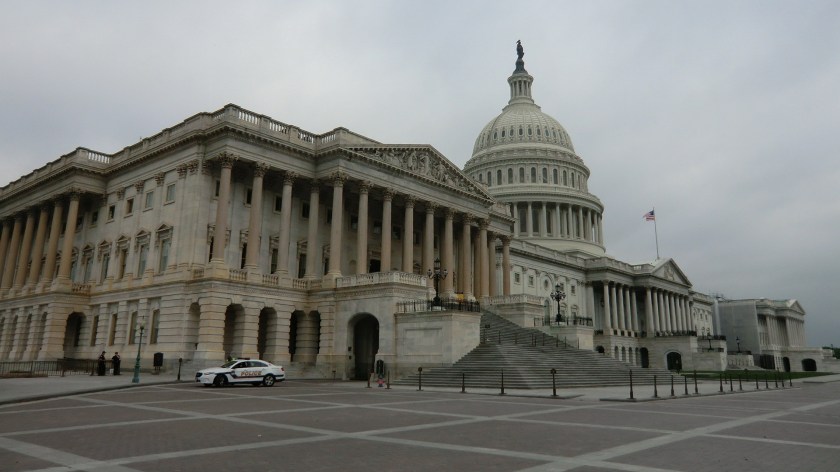
Image credit: Washington D.C.: South-East view of the United States Capitol by Reinhard Link/ Flickr, license: CC BY-NC-SA 2.0.
On April 2 2025, United States (US) President Donald Trump announced Executive Order No. 14257, which he claims addresses decades of unfair international trading relationships that have long placed local US manufacturers in a disadvantageous position. Trump’s tariff policy, which is now commonly dubbed as the ‘Liberation Day Tariff’ or ‘Reciprocal Tariff,’ sent shock waves around the world.
For Taiwan, the country seemingly received the short end of the stick. For one, tariffs levied on Taiwan are a staggering 32%, and are substantially higher than other regional countries such as Japan (i.e. 24% ), South Korea (i.e. 25%), and India (i.e. 26%). The tariff hike on Taiwan seemed at odds with the first Trump Administration, which witnessed a series of policies (e.g. Taiwan Travel Act in 2018, the Taipei Act in 2020 and more), and recorded high arms sales (i.e. US$18.278 billion) that fostered a closer Taiwan-US bilateral relationship. Hence, this raises the question: are we witnessing a potential divergence of Trump’s foreign policy on cross-strait relations? In order to respond to the question, the article is arranged into two sections. First, we debate the implications of Trump’s reciprocal tariffs. In turn, we dissect the potential impacts on Taiwan and whether these changes have affected the political dynamics in Taiwan.
Trump Returns and the Economic/Political Implications of the ‘Liberation Day Tariffs’
President Trump has returned. Yet this time round, Trump’s comeback is unquestionably impressive. Not only did he secure victory in both the Electoral College and the popular vote by a margin of 2.7 million ballots, an aspect that sparked controversy in his victory against Hillary Clinton in 2016, but the Republican Party secured both chambers of the legislature of US government. It was not long before President Trump announced Liberation Day in April.
So, what does Trump’s liberation day tariffs aim to achieve? As concisely denoted by researchers at the Center for Strategic and International Studies (CSIS), the economic rationale is twofold. First, correcting asymmetrical foreign tariffs that have made US products less competitive in the global market. Second, when US products become increasingly competitive, this would contribute to a rise in state revenues, which would allow for other stimulative economic policies to be introduced by the administration (i.e. tax cuts). Yet, as much as it seems good on paper, Trump’s approach is a bold gamble that may have mixed results.
Starting with what may work against Trump’s favour, there are two factors. The first factor is that Trump’s antics may create market uncertainty, which in most cases discourages business investments. For instance, Trump’s recent economic war with neighbouring countries by levying 25% tariffs on all imports from Mexico and Canada (except of oil and energy) this February, yet backtracking and delaying its implementation merely the next day after a phone conversation with the Mexican President and after negations between Canadian and US officials took place. Another example is the ensuing Liberation Day tariffs’ announcement, it was shortly put on a 90-day pause merely a week later. The constant 11-hour U-turn tariff policies of the Trump administration may reduce the level of impact on existing investments, but it would encourage a ‘wait-and-observe’ mentality for potential market actors who wish to invest in the US market. This is because investors have no idea what to expect by the time their investments mature.
The second factor is that market uncertainties would encourage an increase in speculative market transactions. A notable example is the 1997 Asian financial crisis, when Soros Fund Management, led by George Soros, sold short the Thai baht and Malaysian ringgit in the early 1997, which signalled market investors (e.g. hedge funds) to retreat their short-term capitals from the region. Although these speculative investments do not always work, as the case of Soros Quantum Fund in Hong Kong demonstrated during the Asian financial crisis, they may increase systemic financial instability amongst capital markets in open economies. Again, increased uncertainty is not favourable for businesses to expand their investments.
Yet, if one views Trump’s policy from a political lens and considers it a tactic to force governments to renegotiate new and more balanced bilateral trade deals, it would be hard to disagree that it has not been effective. Governments such as Mexico, Japan, Australia, and more have either already conducted the first round of negotiations with the US or have been confirmed with the opportunity to engage in bilateral trade talks with the US. In addition, arguably an important factor that allows the US government to exert substantial clout in this aspect is that it obtains the largest consumer market in the world. In fact, statistics in 2022 show that US household final consumption expenditure accounted for roughly 34% of the world’s household consumption, with the European Union in second place (i.e. 15%) and China in third place (i.e. 10%). Hence, any deal above the baseline of existing tariff levels would be a win for the US. In addition, a high probability exists that countries would make concessions in other policy fronts as a trade-off to secure lower to zero-tariff levels.
Taiwan in the Midst of Trump’s Policies
The pending question is whether Taiwan should be concerned with President Trump’s recent policies. I argue that although the country needs to remain cautious, the long-term impact might be less severe than one expects. First, undoubtedly the Liberation Day tariff levied on Taiwan is significantly higher than other regional countries, and it felt like a slap on the face, especially after the Taiwan Semiconductor Manufacturing Company, LTD.’s (TSMC) high-profile US$ 165 Billion investment plan in the US was publicised in March. Yet as denoted, the immediate impact of tariff hikes on Taiwan’s economy has been minimised due to the 90-day pause period. Furthermore, contrary to most critics, I would argue that the fact that TSMC’s investment plan in Arizona was announced prior to Trump’s Liberation Day tariff provides a great bargaining chip for the Taiwanese government in future negotiations with the US. This is because it can be used as an example that demonstrates Taiwan’s good intention to work with the Trump administration to foster politically and economically mutually beneficial partnerships. This is not to say that concessions will not be made on Taiwan’s end, but rather it provides Taiwan with an advantage point in negotiations. In fact, Taiwan was amongst the first group of countries that entered into tariff negotiations with the US on April 10. Subsequently, additional talks were held, and as of current it has been reported that Taiwan’s Office of Trade Negotiations has concluded its first substantive tariff talks with the US just this past week.
Secondly, recent developments demonstrate that the Trump administration has not altered its foreign policy on the cross-strait issue. Starting with the obvious, although Trump’s liberation day tariff on China was 34%, merely 2% higher than levied on Taiwan, it was quickly raised to 84% after China announced its retaliation to the tariff hike. Over the course of the month after China openly criticised Trump’s tariff policy and sought the support of other trading partners such as the European Union against the US, Trump has furiously responded by excluding China from the 90-day tariff pause, whilst also raising tariff levels from 84% to 125%.
In turn, the Taiwan International Solidarity Act (TISA) was approved on May 5 by the Senate. The legislation consists of amendments to the 2019 TAIPEI Act, which instructs the US Government to support Taiwan’s membership in international organisations. The TISA is significant insofar as it targets the United Nations Resolution 2758 and states explicitly that the resolution per se did not address the issue of Taiwan’s representation in the United Nations (UN) and its affiliated organisations. This came shortly after US deputy counsellor of the US Mission to the UN Ting Wu openly criticised China at a UN Security Council (UNSC) meeting for ‘misusing’ the 1971 UN Resolution to exclude Taiwan from participating in international organisations. With China holding a veto vote in the UNSC, it is unlikely to induce any changes in the UN framework. Yet, it indicates the consistency of the US government’s support for Taiwan.
Conclusions
In this article, I discussed the rationale of Trump’s reciprocal tariffs and provided analyses on why we can expect mixed results. From an economic perspective, drastic changes in economic policy orientations would negatively impact the economy, given that they would increase levels of uncertainty, which discourages new investments. Moreover, when uncertainty reaches certain levels, speculative market movements may induce systemic financial instability and lead to the occurrence of a financial crisis. Hence, Trump’s reciprocal tariff may not attain the type of economic results as intended. However, from a political perspective, the Trump administration has successfully forced governments to come swiftly to the negotiating table to address existing misbalances in bilateral tariff levels. This is expected to allow the US government to have significant clout over issues beyond economic policies.
As for the impact on Taiwan in the midst of these ongoing political dynamics, I argued that there seems to be no alteration to the US’s existing foreign policy orientation on supporting Taiwan, especially considering the recently approved TISA and Ting Wu’s statement in the UNSC. Nevertheless, concessions will certainly be made from Taiwan’s end to secure more advantage tariff levels moving forward.
Chieh-chi Hsieh received his PhD from the Department of Politics and International Studies, University of Warwick (UK). He also holds an MSc degree in International Political Economy from the Department of International Relations, London School of Economics and Political Science. You can follow him on Twitter @DrHsiehCC.
This article was published as part of a special issue on ‘Trump’s Tariffs: What does it mean for Taiwan?‘.
 Taiwan Insight