
Written by Mei-chuan Wei.
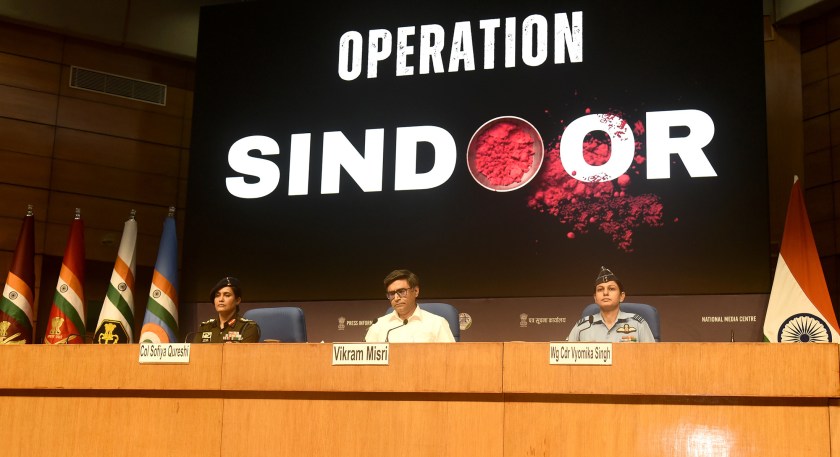
Image credit: Operation Sindoor Press Briefing by Press Information Bureau on behalf of Ministry of Defence, Government of India / Wikimedia, license: Government Open Data License – India (GODL).
The recent military hostilities between India and Pakistan from May 7 to 10 were brief but very intense, thought to be the most significant crisis between the two nuclear-armed adversaries in several decades and a ‘near war’. The armed conflict was triggered by the terrorist attacks on April 22, which killed 26 tourists in Pahalgam in the Indian-administered portion of the disputed territory of Jammu and Kashmir. The attack was regarded as a very provocative act. Unlike previous attacks with significant casualties in Kashmir in 2016 in Uri and 2019 in Pulwama, civilian tourists, not soldiers or troops, were targeted in the recent attack.
On May 7, India struck nine sites across Pakistan shortly after midnight. Precision-guided artillery and drone-delivered munitions were reportedly utilised in the day’s attacks. In the following days of conflicts, the Line of Control that separates Indian-administered from Pakistan-administered Kashmir, and the related Working Boundary/International Border that separates Indian-administered Kashmir from Pakistani Punjab, witnessed intense firing between the two nations with small arms, mortars, and artillery. Tanks and anti-tank guided missiles were less frequently employed.
What should be noted is the response of the United States to the India-Pakistan conflict. The United States has stated that it is not going to get involved in a war that is ‘fundamentally none of our business’ since the military hostilities broke out, saying that it can only encourage the two nuclear-armed neighbours to de-escalate. Vice President J. D. Vance said in an interview on the conflict, ‘Look, we’re concerned about any time nuclear powers collide and have a major conflict,’ when asked how concerned the Trump administration is about a potential nuclear war between India and Pakistan. The U.S. view of the conflict changed because of new ‘alarming intelligence’ indicating that ‘there was a high probability for dramatic escalation as the conflict went into the weekend.’ Central to the United States’ concerns and worries were the possibility of a broader regional war and nuclear conflict, as the conflict escalated.
High-tech weapons, systems integration and information warfare
After India and Pakistan launched drone attacks on each other, Taiwan expressed its support for India on May 10 for ‘all legitimate and necessary actions’ taken by India to ‘safeguard national security and fight terrorist forces.’ Concerns among Taiwanese analysts and defence experts began to grow as Chinese media outlets and social media amplified the downing of Indian jets, including French-made Rafales. However, India has neither denied nor confirmed reports that its Rafales were downed during Operation Sindoor. Military experts regard the downing of India’s French-made jets as a ‘real-life validation’ of the relative supremacy of Chinese-made jets in the India-Pakistan conflict. Chinese-made weapons have been questioned for not having been tested on real battlefields.
Most analyses and commentaries of the armed conflicts between India and Pakistan focus on following issues: whether China helped Pakistan fight against India and used the battle for testing weapons it has manufactured; extensive use of various Unmanned Aerial Vehicles (UAVs; including kamikaze drones, reconnaissance drones, and decoy drones); the importance of ‘data link system’ and ‘air defence system integration’; and information warfare.
Articles that specifically discuss the lessons or implications of recent India-Pakistan military hostilities for Taiwan when facing Chinese aggression address all issues mentioned above. Chou Yu-ping, a retired air force colonel from the Air Missile Defence Command, stressed the importance for Taiwan’s army to prioritise developing its data link system and integrate battlefield communications structures rather than focusing solely on acquiring new weapons in a media interview. He added that during the aerial exchange, the Pakistan Air Force effectively employed tactical coordination between ground radar, early warning aircraft, and fighter jets. Moreover, the ‘information link technology’ Pakistan utilised was reportedly supported by the People’s Liberation Army (PLA).
Former Honorary Chair Professor of War College of Taiwan’s National Defence University, Holmes Liao summed up his discussion about the implications of India-Pakistan military hostilities, arguing that the air battle fought between India and Pakistan offers a profound strategic lesson for Taiwan: ‘a smaller country, possessing unwavering will to resist, effective asymmetric warfare capabilities, robust whole-of-society efforts, and flexible tactical adaptability, can resist against a more powerful invading force.’ (emphasis added). Liao emphasised that ‘to impose unbearable costs on the Chinese aggressor’ should be the core of Taiwan’s defence strategy of deterrence.
Awareness of security threats and the will to resist are particularly needed for Taiwan.
What Taiwan should prepare for the possible invasion of China has been discussed more extensively than ever before, specifically when Beijing appears to be more aggressive in its attempts to break through the first island chains in the Asia-Pacific and expand its influence into the South China Sea and the Indian Ocean. Taiwan is also more alert after Xi Jinping publicly stated that force will be used for unification if necessary and announced the ‘Taiwan Proposal of One Country Two Systems.’
How should Taiwan cope with the severe challenges to its national security and future? What would be the most effective strategy to deter Beijing? Nuclear deterrence has emerged in some comments on this issue. Years back, I attended a gathering in London where experts and scholars met to exchange views about Asia and Europe. When a Pakistani researcher working with a think tank based in London knew that I am from Taiwan, the first thing he said was ‘Taiwan should develop nuclear weapons’ with India-Pakistan relations as his example. Specifically, he believed that being a nuclear-armed nation is the most effective strategy for Pakistan to deter India.
The same suggestion was also made by other strategic experts I have met on various occasions, especially when the Ukraine-Russia war entered the stage of nuclear deterrence. However effective the strategy of nuclear deterrence might be, the chance for Taiwan to develop nuclear weapons is next to zero. The issue of the role of nuclear weapons in a conflict over Taiwan has been analysed in a policy report recently, focusing on the use of limited nuclear strikes by the United States to ‘defeat a Chinese amphibious invasion of Taiwan’ with limited nuclear strikes if necessary.
Shortly after the terrorist attacks happened in Pahalgam in the Indian-administered Jammu and Kashmir, I was stricken by the reactions of Indian colleagues and friends in terms of their firm belief in the unwavering will of the government and people of India to resist and retaliate. The strikingly strong nationalistic sentiments of Indians entail a clear awareness of the security threats Pakistan has posed to India since their independence in 1947. The main sources of India-Pakistan conflicts and wars are territorial disputes and cross-border terrorism.
Unlike the relations of India and Pakistan, the relations across the Taiwan Straits have been perceived by some, if not many, Taiwanese as not so straightforwardly ‘hostile’ due to historical connections and economic ties between the two. China had long been the largest trading partner of Taiwan until recent years, when it was replaced by the United States. The absence of clear awareness of security threat posed by China among Taiwanese population might be the main reason why when PLA initiated joint air and naval live-fire exercises that included missile tests over Taiwan and in Japan’s exclusive economic zone (EEZ), and a simulation of a military blockade of the island after the 2022 visit of the then U.S. House Speaker Nancy Pelosi, the Taiwan society appeared to be so oddly ‘business as usual’.
A related issue is whether the Taiwanese people have an unwavering will to resist when facing Chinese aggression. Research has been conducted to investigate this issue, particularly the will to resist among young Taiwanese and the soldiers. Whilst a newspaper article indicated that few young Taiwanese will be willing to fight against Chinese invasion, using the data from Dcard, a popular social platform among the youth in Taiwan, a counterargument based on various academic survey data was made, stating that roughly about 80% of the Taiwanese under 30 years old are not defeatists. As for the soldiers in the military, research conducted by one of my master’s students serving as officers responsible for security in the military has shown that frequently watching Chinese short videos such as TikTok and Rednote does influence how soldiers feel about and evaluate China. But when it comes to the issue of whether frequently watching Chinese short videos negatively affects the will of soldiers to resist, the relationship is not clear. What appears to be the more influential factor is the perception of most soldiers about their role. In short, they tend not to associate their role with defending the nation but see it as a job.
Concluding remark
What Taiwan should and could learn from the recent India-Pakistan military hostilities, according to many analyses and comments, includes the extensive use of high-tech weapons, specifically various UAVs, data link systems, air defence system integration, asymmetric warfare capabilities, and information warfare. What is equally, if not more important for Taiwan, is to raise the awareness of the security threat and strengthen the will to resist, among the common population. This is particularly important for the military. Building ‘whole-of-society defence resilience’ is one of the four major tasks for Taiwan’s sustainable development set by the current president, Lai Ching-te. Raising awareness of security threats and strengthening the will to resist is no doubt core to this endeavour.
Dr. Mei-chuan Wei received a doctorate in comparative politics from the Department of Government, London School of Economics and Political Science (LSE), United Kingdom. She is currently an associate professor in the Graduate Institute of Development Studies at National Chengchi University. Prior to joining GIDS, NCCU, she worked as a post-doctoral research fellow at the Research Centre for Humanities and Social Sciences, Ministry of Science and Technology, Executive Yuan, and the Department of Political Science, National Cheng Kung University. Her research interests focus on democracy and democratisation in East and South Asia, gender and development, public culture and political development, and social innovation and development. She has published journal articles in these fields.
This article was published as part of a special issue on ‘India-Pakistan Conflict: Strategic Insights for Taiwan‘.
 Taiwan Insight
