
Written by Brian Hioe.
Image credit: 青鳥行動 by 顥中 王/ Flickr, license: CC BY-NC-SA 2.0.
Despite the immense political momentum behind it, Taiwan’s “Great Recall Movement” did not succeed in recalling a single KMT legislator when it came down to the actual vote that took place on July 26th. This was a result that likely surprised both the pan-Blue and pan-Green camps, given the uncertainty going into the vote.
Haunted by the Spectre of Past Movements and Elections
The “Great Recall Movement” was a historic event in that there had never before been an attempt to recall all legislators belonging to a specific political camp. There had been past attempts to use the recall to remove much-hated KMT legislators in the years after the 2014 Sunflower Movement, but these were never on the scale of attempting to recall all KMT legislators. Likewise, the recall of Han Kuo-yu as Kaohsiung mayor after his defeat in the 2020 presidential election as the KMT candidate occurred by widespread margins, reflecting the anger of the Kaohsiung electorate against him with the perception that he had abandoned his post to run for president. The recall against Han was not as contentious as the “Great Recall Wave,” given the large margins by which he was recalled.
The dynamics in society ahead of the recall proved reminiscent of an election year. Both major parties held rallies to drum up participation in the recalls. Voters who live abroad were also called upon to return home to cast their ballot, given the importance of the vote for Taiwan’s democracy. Indeed, though pan-Green recall organisers often directed appeals to Taiwanese voters living in America or Europe, according to the Mainland Affairs Council, China offered 40% discounts on plane tickets from China to encourage Taiwanese living in China to return and vote.
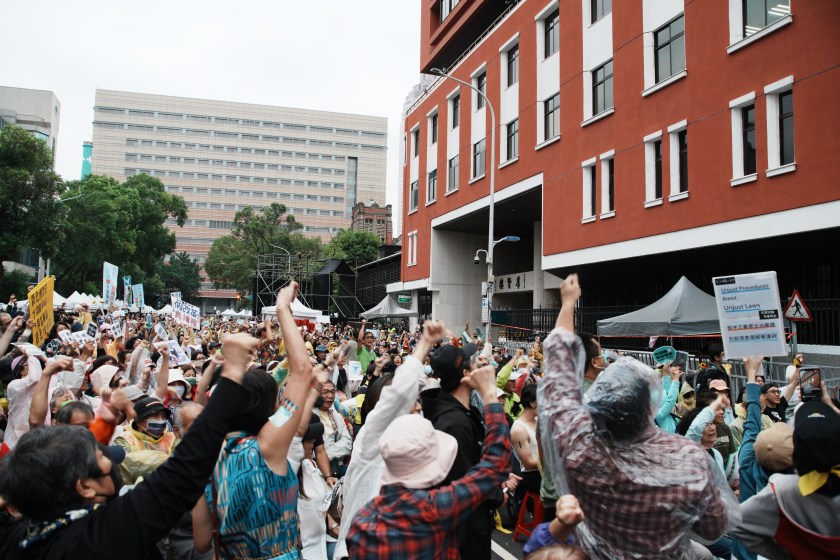
To this extent, the recall took place a year after the Bluebird Movement, which broke out against efforts by the KMT-controlled legislature to expand legislative powers to allow for new powers of investigation. Subsequent KMT actions, such as drastically cutting or freezing significant portions of the government budget and freezing the Constitutional Court, continued to anger members of the public. This is what led to the organisation of recalls against KMT legislators.
In this sense, the Great Recall Movement was sometimes interpreted as the immediate successor of the Bluebird Movement, in that the Bluebird Movement had been transmitted into an electoral form. Certainly, political momentum from the Bluebird Movement fed into the Great Recall Movement.
It is important to note that with the Bluebird Movement, protest organisers largely sought to prevent the movement from growing to the uncontrolled size of the Sunflower Movement, as well as to wind down the movement quickly, so as to direct it toward electoral ends. In particular, participants were dissuaded from forms of direct action, such as charging the legislature, with the claim that those who did so probably hoped to become movement superstars, such as those who had emerged from the Sunflower Movement—and eventually betrayed the movement, as in the case of TPP chair Huang Kuo-chang. A common slogan during the Bluebird Movement was that whoever charged the legislature would be the next Huang Kuo-chang.
This was a way in which the Bluebird Movement was haunted by the spectre of the Sunflower Movement, in seeking to avoid some of the pitfalls of the movement. Hopes were probably to avoid another social movement that would be all-encompassing of Taiwanese society and uproot and destroy many of the civil society networks that had been cultivated in the years prior to the Sunflower Movement, given the extreme burnout that set in among activists after the movement—which in itself proved to be traumatic for many activists.
And yet, with efforts to speed up the transition of the movement toward electoral ends, this was probably also an attempt to mimic the perceived success of the 2016 elections. 2016 was, after all, when the Tsai administration rode into power, buoyed by momentum from the Sunflower Movement. 2016 was also the start of eight years in which the DPP held the majority in the legislature—the only time in Taiwanese history that a non-KMT political party held the majority in the Taiwanese legislature.
Dynamics Fundamentally Different From That of an Election
As the results of the Great Recall Wave show, the attempt to restage 2016 was not successful. But it is important to examine the causes as to why. Perhaps there were ways that the dynamics of recalls are fundamentally different from elections.
For one, some have extrapolated that the Great Recall Wave shows that Taiwanese society is no longer interested in political messaging about threats from China. This has been a claim repetitively brought up anytime the pan-Green camp has suffered a political loss since 2014.
But quite the opposite, the Great Recall Movement shows that a sizable portion of the electorate is concerned about threats and is motivated enough to organise recalls across the nation. Moreover, because it was KMT legislators who were facing recall, recall votes only took place in areas that voted for the pan-Blue camp in the 2024 elections. Public opinion in such areas is, by definition, not representative of the nation as a whole.
It is also important to note that the dynamics of recalls prove different from elections. Voters were asked whether they wanted to keep or discard local KMT legislators, with the possibility of another election in which they could decide if they wanted a DPP legislator or a different KMT legislator than the one currently in office. What voters were not asked to do was to vote between two different sets of faces—a pan-Green and a pan-Blue candidate—as to which they preferred.
This points to a broader dilemma of the recalls. The recalls were organised not by the DPP party machine, but by civil society groups. The DPP hung back for much of the recalls to allow civil society organisers to take centre stage, given that the KMT accused the recalls of being organised by the DPP and damaging Taiwan’s democratic institutions. But civil society efforts did not always successfully crystallise around strategic target points or specific politicians that could serve as spokespersons and public faces for the movement.
Likewise, during elections, one notes that lesser-known candidates are supported by more powerful and well-known politicians, such as mayors or presidential candidates. This was a defensive strategy that the KMT used in campaigning for its legislators to remain in their seats. But, as recall campaigns did not take place in the context of legislative or presidential elections, this could not take place. And, again, the DPP wished to avoid the perception that it was behind the recalls.
In this sense, as the KMT was playing defence in the recalls and only they were up for a vote, the KMT could more successfully rely on strategies normally used during elections. By contrast, because recalls had never occurred on this scale in Taiwan before, civil society groups and the DPP did not have a set script they could follow in campaigning. It was largely to their detriment that recalls were not, in fact, elections in spite of the overall dynamics being similar to a campaign year.
With seven more KMT legislators set to face votes in late August, the recalls are not over. However, the DPP would have to win six seats in the legislature in order to change the balance of power in the legislature, making it a tall order for the pan-Green camp to flip the legislature. Still, the failure of the Great Recall Wave probably means that—despite warnings that the barrier for recalls is now too low—there will probably not be attempts to organise recalls on such a scale in the near future. It was, of course, the pan-Green camp that originally pushed for lower benchmarks to hold recalls. Yet the result perhaps reminds one of the 2018 elections, in which national referendums were held for the first time after benchmarks were lowered. But the outcome was a defeat for the DPP, in spite of having been the party that had called for lowering benchmarks for recalls. In this sense, what we saw in the Great Recall Wave was not a restaging of 2016, but 2018.
Brian Hioe is one of the founding editors of New Bloom. He is a freelance journalist, as well as a translator. A New York native and Taiwanese-American, he has an MA in East Asian Languages and Cultures from Columbia University. He graduated from New York University with majors in History, East Asian Studies, and English Literature. He was a Democracy and Human Rights Service Fellow at the Taiwan Foundation for Democracy from 2017 to 2018. He is currently a non-resident fellow at the University of Nottingham’s Taiwan Research Hub.
This article was published as part of a special issue on ‘Recall elections: Practice or problem for Taiwan’s democracy?‘.
 Taiwan Insight