
Written by Meng Kit Tang.
Image credit: 民主進步黨/ Facebook.
Historical Echoes
In 1848, U.S. President James K. Polk reflected on his country’s territorial expansion following the Mexican American War. Though the acquisition thrilled many Americans, Polk wrote that “everyone was glad with it, but no one was proud of it.” (人人皆樂,無人引以為傲). His words spoke to a deeper discomfort: the uneasy feeling that success, when built on polarising means, can hollow out its own meaning.
More than 175 years later, this paradox echoes in Taiwan’s 2025 Mass Recall Movement (大罷免運動). Launched as a citizen-led campaign to challenge legislative gridlock and perceived foreign influence, it quickly became a flashpoint of social energy and political division. While many citizens felt glad to participate in a powerful democratic act, few walked away feeling proud of the aftermath.
The recall movement stands as a mirror to Taiwan’s democratic journey: robust and participatory but marked by the strain of political polarisation and institutional fatigue. At stake is not just who holds office but how a society practices democracy when the path to accountability feels morally and strategically unclear.
Gladness: Democratic “Flip the Table” (民主翻桌)
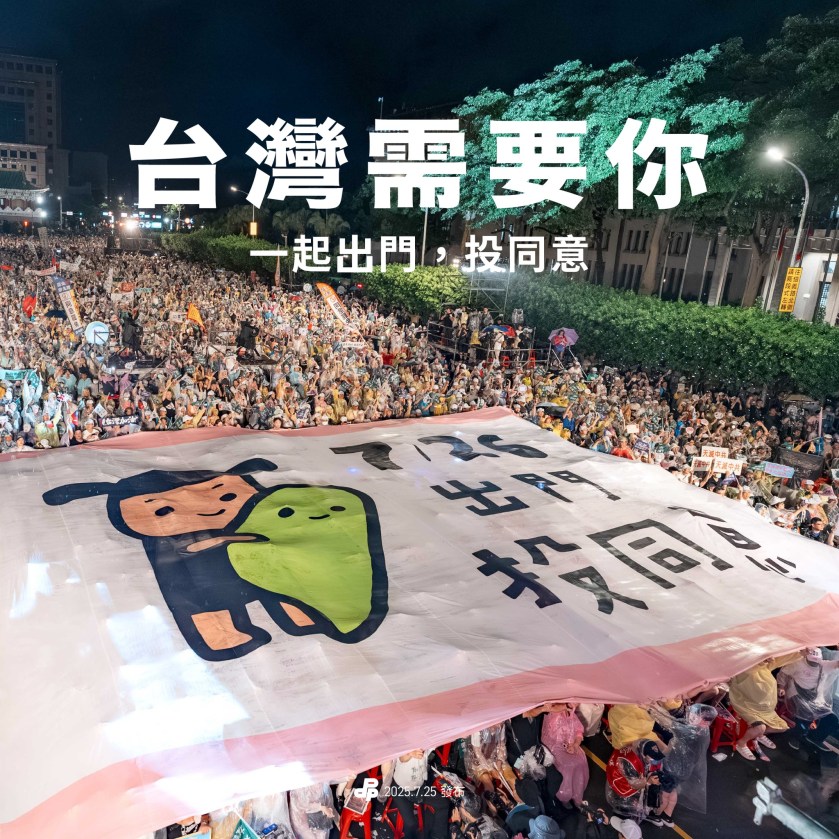
On July 26, 2025, Taiwan held the largest recall vote in its democratic history. Twenty-four lawmakers, mostly from the opposition Kuomintang (KMT), and Hsinchu Mayor Ann Kao (高虹安) were targeted in a sweeping effort driven by grassroots frustration. Nearly 90% of campaign volunteers were women, many first-time political participants. They rallied under slogans such as “Anti-Communism, Protect Taiwan” (反共護台) and “Flip the Table” (翻桌), reflecting a growing sense that electoral politics had failed to check legislative obstruction or foreign-friendly narratives.
This was not just a partisan effort. The Democratic Progressive Party (DPP) threw its weight behind the campaign, but it also drew civil society activists, disillusioned centrists, and former backers of the People’s Party (TPP). In a rare convergence, pro-independence nationalists and anti-communist ROC loyalists found common cause: an unusual but telling alliance that expanded Taiwan’s democratic spectrum.
The message was clear: the people had a voice, and they would use it.
Taiwan’s civic culture, long praised for its vitality, once again showed that political engagement here is not a spectator sport. Recall was no longer just a legal mechanism; it became a democratic statement.
Pride Absent: “Flip the Table” Dream Shattered (翻桌夢滅)
Yet the results told a different story. Despite a high voter turnout: 50–60% in many districts, all 24 recall attempts failed, including the one against Mayor Kao. Many districts met the necessary threshold of supportive votes (over 25% of registered voters), but under the law, recalls only succeed when “Yes” votes outnumber “No” votes.
In every case, the opposition prevailed.
The KMT’s ground game proved highly effective, mobilising loyal voters and framing the recalls as an attack on democratic legitimacy. Even in districts where dissatisfaction ran high, the threshold for removal proved elusive. The final verdict: the table remained unflipped.
Responding to the outcome, DPP Secretary-General Lin Yu-chang (林右昌) emphasised the need for restraint and reflection, that this is not a partisan election and should not be reduced or simplified, and the DPP humbly accept the result.
Others were less restrained. It can be described on both sides of the campaign as all effort spent, nothing gained (用盡心機,一場空). The sheer scale of the campaign and the high hopes attached to it only deepened the disappointment. Rather than empowering voters, the failed recalls left many wondering whether the system could truly hold those in power accountable.
Democratic Strain: After the “Table Flip” (翻桌之後)
Beyond the electoral numbers, the recalls left lasting marks on Taiwan’s social fabric. For the DPP and its allies, the recalls were framed as acts of democratic self-defence in the face of pro-Beijing narratives and legislative obstruction. But for the KMT and its supporters, the recalls felt like partisan persecution, a reckless gamble that disrespected voters’ original mandates.
Campaigns often descended into politics of hatred (仇恨政治), amplified by social media echo chambers, doxxing, and even hidden camera footage, turning political discourse into a personal vendetta. This toxic atmosphere frayed public trust and strained the norms of respectful debate.
Judicial impartiality also came under scrutiny. The prolonged pretrial detention of opposition leader Ko Wen-je (柯文哲), in contrast to the more lenient treatment of some DPP-aligned figures, sparked claims of judicial double standards. Public confidence in the courts, already fragile, took another blow.
Moreover, holding such a consequential vote less than a year after a general election raised concerns about institutional stability. While legally permitted, the recalls added to electoral fatigue and governance uncertainty, prompting many to ask whether Taiwan’s democracy had overcorrected in its zeal for participatory accountability.
Democracy thrives on tension, but it also requires trust, rules, and time to breathe. In 2025, that balance felt precariously thin.
Political Stalemate, Global Eyes
The stakes were not merely domestic. Had the recalls succeeded in removing at least 12 KMT lawmakers, the DPP might have regained a legislative majority, enabling it to pass key national security laws in the face of mounting cross-strait pressure (兩岸緊張). Instead, the failure left the legislative status quo intact, with the KMT-TPP alliance continuing to challenge the executive’s agenda.
International media such as CNN noted the mass mobilisation with admiration, but also voiced caution. Taiwan’s democratic resilience was evident, but so were its growing pains.
Particularly worrisome was the role of social media platforms such as LINE, Facebook, and TikTok, where misinformation and hyper-partisan narratives spread quickly and often unchecked. Taiwan’s information ecosystem (資訊生態系), long a point of concern for cyber experts, showed signs of stress that could hamper democratic deliberation.
The lesson for Taiwan’s leaders, and probably for democracies everywhere, is that elections alone do not sustain freedom. Legal tools like recalls must be wielded carefully, lest they become normalised as political weapons. In the absence of reform and restraint, democratic instruments can backfire, hardening divisions rather than healing them.
Pride Deferred: Taiwan’s Democratic Crossroads
Taiwan’s 2025 Mass Recall Movement was an unprecedented moment in civic activism. It brought people together across regions and generations, infusing the public sphere with new energy and purpose. For that, many were glad.
Yet gladness is not pride. And pride requires more than participation, demands reflection, responsibility, and institutional integrity.
In the end, no one felt proud speaks to the sense of missed opportunity. The recalls revealed the strength of Taiwan’s civil society but also its democratic vulnerabilities. They underscored the courage of grassroots mobilisation but also the danger of reducing politics to battle lines.
Like President Polk’s uneasy legacy, Taiwan’s democratic experiment in 2025 offers both hope and warning. The way forward will require not only better laws or more elections, but also maturity, dialogue, reform and healing.
Taiwan has the civic spirit. Now it needs the democratic imagination to match it.
Meng Kit Tang is a Singaporean freelance analyst and commentator who works as an aerospace engineer. He graduated from the S. Rajaratnam School of International Studies (RSIS), NTU, Singapore in 2025.
This article was published as part of a special issue on ‘Recall elections: Practice or problem for Taiwan’s democracy?‘.
 Taiwan Insight