
Written by Jacob Parker.
Image credit: Public domain.
Since 2022, the Russo-Ukrainian War has continued to leave indelible marks on global conflict and diplomacy. As it has developed, America’s position and decisions have also changed. With a new administration in power, it is clear that President Donald Trump takes a different stance on the war than former President Joe Biden, even going so far as to say that the cause of the war was Ukraine’s interest in joining NATO and repeatedly faulting Ukraine for the ongoing conflict. However, his positions have shifted over time, more recently signalling increased support for Ukraine. This inconsistency damages the credibility of the United States in upholding commitments to its allies. Coupled with often fiery disputes between Trump and Ukrainian President Volodymyr Zelenskyy, such rhetoric has also given Trump’s administration an opportunity to justify withholding aid from Ukraine, leaving many around the world concerned about the future of America’s role and reliability in global politics, especially in matters of allied support and defence. Taiwan is of primary interest here, as a flourishing democracy with a threatening authoritarian nation on its doorstep; it shares many commonalities with Ukraine. Most importantly, it relies on the credibility and aid of the United States, both of which have been put in peril by the Russo-Ukrainian War. We must recognise the effect that this war has on Taiwanese politics, defence, and relations with their allies and enemies.
Such a discussion is already occurring internally in Taiwan, as recent developments have concerned Taiwanese nationals who are closely monitoring the situation in Ukraine, given the perceived parallels. In April of 2025, President Zelenskyy announced the capture of several PRC nationals, who were allegedly fighting for Russia, on Ukrainian soil. Taiwanese citizens are naturally wary of Chinese involvement in this war, as they fear that the Russian advances might inspire the PRC, and that a takeover of Taiwan is plausible in today’s political environment. Parallel to this, in regards to the American response, many Taiwanese worry that the choices that President Trump might make should the PRC decide to invade Taiwan might be similar to the ones that he has made throughout the Russo-Ukrainian War; cutting aid, withholding intelligence, and criticising the leader of a free democracy fighting in a war for its survival for all the world to see. Generally, Taiwanese concerns have deepened about the PRC and their takeaways from the Russo-Ukrainian War, and their faith in the United States to protect them from such threats continues to become increasingly fragile.
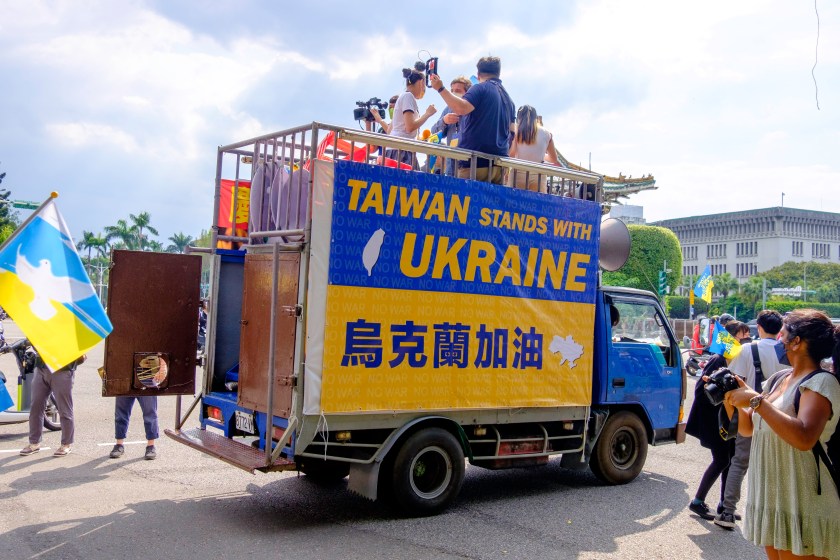
Fear has not been the only shift in Taiwanese society, however. Taiwanese attitudes towards war in general have changed since the start of the Russo-Ukrainian War. An increased willingness to participate in emergency response services, disaster relief services, and civil defence organisations has been the result of a war that has transformed perspectives on a prospective cross-Strait conflict. Such a war has also yielded general policy shifts in Taiwan, both legal and diplomatic. Just a few months ago, Taiwanese (DPP) and Ukrainian lawmakers created a friendship group to enhance cooperation and relations between the two countries, strengthening ties and solidifying their mutual understanding of their respective situations, dealing with authoritarian neighbours who may seek to destroy them. The Taiwanese defence budget was also upped by 18% from 2022 to 2024, a potentially reactionary decision, and recently, Taiwan has invested in and held demonstrations of naval drones that they plan to use for defence, inspired by the Ukrainian usage of drones in their own capacity. Clearly, the Taiwanese people and government have much to unite over regarding Ukraine and the Taiwanese response.
However, as politics in Taiwan have addressed the Ukraine issue, splinters in the government remain, and they often show quite clearly, even on such a uniting issue. As mentioned, it was the Democratic Progressive Party (DPP) that created a friendship group with Ukrainian lawmakers. The DPP has decided collectively to be consistently vocal in their support for Ukraine, not shying away from highlighting the ties that they wish to keep intact and strong. In contrast, the opposition KMT has slowly drifted toward a stance more akin to the one assumed by President Trump, with KMT politicians frequently absent at public events supporting Ukraine, inconsistent in their rhetoric, and occasionally propagating narratives that place the blame for the war squarely on the U.S., with the ties between the Ukrainian government and NATO as the central thesis to their argument. These views are, at least in part, echoed by party supporters: In a survey taken in 2024, 46% of KMT supporters surveyed blamed the United States for the Russo-Ukrainian War, which stands in contrast to the general Taiwanese population, where most surveyed individuals blamed Russia. Just a year ago, the KMT invited a Russian representative to an international banquet in Taiwan, which many U.S. and EU representatives boycotted. Shortly after, they reversed course and apologised for doing so. And especially because of China’s close ties with Russia and involvement in the war, it is occasionally the KMT’s strategy to take a similar position, positing that a parallel exists between Ukraine’s closeness with NATO and Taiwan’s closeness with the United States. It is therefore within Taiwan’s best interest, according to the KMT, to maintain some distance from the U.S. to avoid a wider war. Such behaviour is demonstrative of the differing attitudes towards the players in this war within the Taiwanese political system, as well as each party’s understanding of how this war might affect cross-Strait relations and foreign involvement.
It is clear that the ongoing Russo-Ukrainian War has had immense effects on global policy pertaining to Taiwan, and its continuation and resolution will continue to hold similar weight on a global scale. It remains to be seen how each major Taiwanese political party will use this conflict to prop up their respective policies once it has been resolved. American governmental behaviour towards the war doesn’t just affect Ukrainians and Americans at home; it has far-reaching effects that, while challenging to see, manifest themselves in policy and attitude shifts in Taiwan. A war two continents away is shaping Taiwan’s political debates, altering its defence strategies, and testing its faith in democratic alliances – a true test of democracy’s ability to withstand the pressures of authoritarian aggression.
As for the United States, the message that politicians and citizens should hear is simple: What happens in Ukraine does not stay in Ukraine. The Russo-Ukrainian War is not an isolated regional conflict, but a defining test for democratic resilience worldwide. As Taiwan faces its own existential questions in the shadow of authoritarianism, the lessons it draws from Ukraine and the signals it receives from the United States will shape its defence strategies and political future. America’s attitude toward Taiwan has shifted in the wake of the Russo-Ukrainian War, with Washington increasing arms sales and public shows of support. President Trump’s announcement of expanded TSMC operations in Arizona, along with a $100 billion investment, appeared to signal increased interest in an expansion of the U.S.-Taiwan partnership. However, the reality is far less concrete. Trump has criticised Taiwan for “stealing the U.S. chip industry” and floated the idea of Taiwan paying for U.S. protection, underscoring the inconsistency and volatility of his approach.
Meanwhile, Washington has increasingly demanded that Taiwan pull itself up by its own bootstraps without guaranteeing American support for the island, levying massive tariffs on Taiwanese imports. At the same time, high-ranking officials have pressed Taiwan to boost its defence spending to 10% of its GDP – a level second only to wartime Ukraine. This is an incredible demand, especially given the persistent delays in American weapons shipments to Taiwan. The irony of the United States asking Taiwan to pay more for weapons systems it is already failing to deliver could not be more evident. Such a demand further erodes American credibility as a reliable defender of Taiwan, as well as Taiwan’s direct security interests.
For its own sake, and the sake of democracy, America cannot afford to allow its support to waver, and it cannot distance itself any further from Taiwan. To preserve credibility, deter aggression, and uphold the international order it helped build, the United States must stand firmly with its democratic partners. Anything less invites doubt, emboldens autocrats, and undermines the foundations of collective security. Volatility, whether in policymaking or in rhetoric, is never in the best interest of global democratic health and security, and it only weakens the credibility and deterrence that Taiwan relies on.
Especially coming from American leadership, arguments that Taiwan should significantly step up its defence efforts – or that America must first focus on the home front before clarifying its commitment to the U.S.-Taiwan relationship – are both frivolous and short-sighted. Supporting democracy abroad does more than advance American values; it bolsters the economy and reminds the world that the United States stands by its allies and stands up to its adversaries. If we are committed to asserting our position in the world, we must do so by standing beside Taiwan, not by rolling over. If the most important issue facing the country today, truly, is regaining our “respect all over the world,” we must earn it, not wait for it.
Jacob Parker is a third-year undergraduate student in Political Science at Stanford University. His research explores the intersections of technology and politics, focusing on artificial intelligence, political polarisation, and media psychology. He is also interested in international relations and security studies, with a focus on how social identity shapes politics and law.
This article was published as part of a special issue on ‘Stanford Student Commentaries‘.
 Taiwan Insight