
Written by Zong-Rong Lee and Thung-Hong Lin.
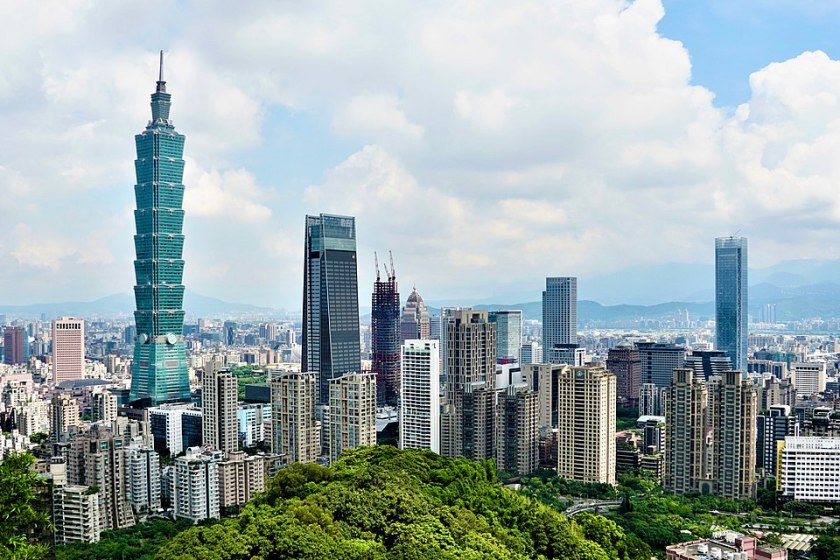
Image credit: Taipei Skyline 2022 by Heeheemalu/ Wikimedia Commons, license:CC BY-SA 2.0.
The postwar economic development of East Asia represents one of the most successful paradigms of growth in modern history, second only to the Western Industrial Revolution. Taiwan, in particular, stands out as a critical case that has attracted extensive scholarly inquiry across multiple disciplines. Once a poor agrarian society that endured colonial rule and wartime turmoil, Taiwan underwent rapid industrialisation in the postwar era and integrated into the global capitalist system. It has since become a key hub for consumer goods and high-tech supply chains.
As Taiwan’s economy has matured, however, scholars have shifted from classic developmental-state theories toward explanations of ongoing structural transformation. Since the 1990s, Taiwan has experienced profound economic and social shifts that challenge conventional frameworks. These transitions can be broadly categorised into three interrelated trends. First, the globalisation of production led Taiwanese firms to relocate much of their manufacturing overseas, particularly to China. Deng Xiaoping’s reforms encouraged Taiwanese firms to establish extensive production bases in China’s southern coastal provinces. Yet deepening integration also exposed Taiwan to external shocks and geopolitical risk, particularly as China’s political–economic strategy evolved under Xi Jinping. Put differently, as Taiwan became more globalised and more tightly linked to neighbouring economies, its domestic political, economic and social structures were themselves reshaped by globalisation.
Second, Taiwan’s domestic political economy has changed dramatically. Democratisation in the 1990s, together with economic liberalisation, diminished the state’s capacity to steer industrial policy—sharply contrasting with the dirigiste model of earlier decades. Liberalisation created opportunities for Taiwanese firms to scale into larger, consolidated business groups that are now the primary drivers of the economy. Yet even as firms grew, control remained concentrated in family hands; small and medium-sized enterprises, once the backbone of the “economic miracle,” have been increasingly squeezed. In tandem, Taiwan’s high-tech sector has displaced many traditional industries and become an increasingly prominent pillar, positioning the island as one of the most critical nodes in global high-tech supply chains. These rapid changes in organisational scale and industrial structure have fundamentally reshaped Taiwan’s economic landscape.
Furthermore, the long-standing neoliberal tilt of economic policymaking has left the state poorly equipped to regulate the growing influence of large corporations and to address widening inequality. With one of the lowest tax burdens in the world, the bureaucracy lacks the fiscal capacity to sustain essential welfare expenditures in education, healthcare, childcare and public housing—each under mounting strain. Skyrocketing property prices, fuelled by capital inflows and speculative investment, combined with stagnant wages, have undermined social mobility, especially for younger cohorts. The result has been widespread discontent and a notable decline in marriage rates, contributing to one of the lowest birth rates globally.
This topical section of the International Journal of Taiwan Studies (IJTS) was initiated by the guest editors as an open invitation to scholars worldwide to reflect on Taiwan’s economic transformation. We aim to convene inquiries that illuminate ongoing debates and to facilitate dialogue on Taiwan’s intertwined economic and social transitions. What have been the most salient structural features of these transitions over the past three decades? What are their major consequences, and what challenges now confront Taiwan? We hope this topical section advances empirical understanding of phenomena critical to Taiwan’s development while also contributing to theoretically informed discussion within the interdisciplinary field of Taiwan studies.
In this topical section, IJTS publishes three articles related to the above-mentioned issues. The first, Yi-Ling Chen’s “From Laissez-Faire to a Market Mechanism: The Formation of Housing Finance in Taiwan,” offers a detailed account of how, since the late 1980s, economic bureaucrats shaped financial institutions and instruments—ultimately underwriting persistently elevated housing prices. Zong-Rong Lee’s “Continued Growth and Consolidation of Family Capitalism in Taiwan: A Historical–Institutional Account” examines institutional and historical factors to explain why an organisational form once deemed archaic and inefficient—family business—continues to dominate Taiwan’s market. Thung-Hong Lin and Chun-Yin Lee’s “Visible Fists: Political Risks and the Performance of Taiwanese Businesses in China, 1995–2022” explores how China’s autocratisation under Xi Jinping has undermined Taiwanese firms’ performance.
In this Taiwan Insight–IJTS Special Issue, each author contributes a short introduction to their article, offering readers an engaging entry point to explore these important debates. Taken together, the three articles offer a multilayered account of Taiwan’s transformation from distinct yet interrelated vantage points. Chen’s analysis of housing finance reveals how state policy and neoliberal ideology jointly fostered a speculative property regime, deepening social inequality. Lee’s exploration of family conglomerates demonstrates the enduring influence of patrimonial capitalism and shows how this mode of corporate control consolidates class power at the top—even amid democratisation and market liberalisation. Lin and Lee’s study highlights how geopolitical shifts and authoritarian resurgence have disrupted Taiwan’s global economic strategy.
As Taiwan stands at the crossroads of economic, demographic, political and geopolitical transitions, this topical section underscores the need for sustained scholarly attention to the structural and institutional forces shaping its future. The US–China trade war, supply-chain reconfiguration and rising tensions in the Taiwan Strait will continue to influence the island’s economic trajectory. Alongside these pressures, Taiwan’s national security faces growing strain, as military threats and regional instability pose new risks to sovereignty and democratic resilience. To navigate these challenges, Taiwan must pursue industrial upgrading, technological innovation and social inclusion. In particular, there is an urgent need for a reinvigorated developmental strategy that balances market efficiency with social equity and embraces a more proactive state in fostering resilience, strengthening national security and addressing inequality.
We hope the contributions gathered here will inspire further research into Taiwan’s evolving political economy. By situating Taiwan within broader debates in comparative politics, development studies and international political economy, we seek to advance both empirical understanding and theoretical insight. As Taiwan grapples with globalisation, regional security and escalating cross-Strait tensions, its ability to safeguard national security while sustaining competitiveness will be an increasingly urgent concern. Taiwan’s experience offers valuable lessons for scholars and policymakers alike, particularly for understanding how economic development and national defence intersect in small-state democracies.
This article was published as part of a special issue on ‘Transitions and Challenges in Taiwan’s Economy and Society‘.
 Taiwan Insight