
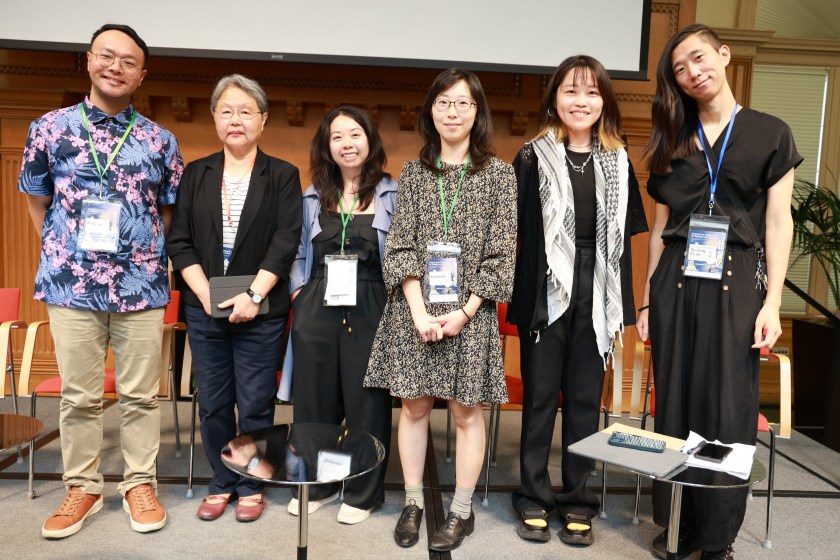
Written by the NATSA 2025 Program Committee.
Image credit: NATSA.
The NATSA 2025 conference continued the organisation’s three-decade tradition of fostering a vibrant and interdisciplinary space for scholars focused on Taiwan. Building upon the rich foundation of existing Taiwan scholarship, the 2025 conference explored new possibilities through original and insightful inquiries into Taiwan’s histories, cultures, and futures.
Over the course of the conference, participants engaged with key questions such as: What are alternative ways of knowing and alliance-making? How can we imagine networks of care amid persistent disparities? And what tensions arise when we attempt to centre Taiwan in projects of transformational knowledge-building and world-making?
Why “Otherwise”? Rethinking Taiwan Studies
We were guided by the central theme of envisioning the “otherwise”. This framework was inspired by fields closely tied to social movements, such as Black, Indigenous, Latinx, Asian American, and Gender and Sexuality Studies. Through this lens, NATSA 2025 became a space for rethinking care and critique, inviting participants to challenge dominant epistemologies and unjust structures while imagining new modes of scholarly engagement.
The idea for our opening forum, “Otherwise Relations between Taiwan and Southeast Asia,” was born from a shared desire to push Taiwan Studies beyond nationalistic frameworks. Rather than viewing Taiwan as a bounded entity, we wanted to centre the historical and ongoing entanglements between Taiwan and Southeast Asia—through migration, labour, gender, race, and Indigenous solidarities. We sought to treat these entanglements not as peripheral topics, but as vital sites of knowledge, connection, and imagination.
This special event invited everyone to think from a place of relation, not separation or comparison. It’s about recognising Taiwan’s place not as an isolated case, but as deeply connected to broader regional and transregional dynamics. It was also about listening—across disciplines and communities, both academic and activist—and to open new ways of imagining futures otherwise.
Tracing Connections: Four Essential Perspectives
We were joined by four remarkable speakers who brought these questions to life from different perspectives. Jointly, the four presentations traced a powerful arc that mapped Taiwan’s entanglements with Southeast Asia across time and scale.
Yi-Yu Lai 賴奕諭 (PhD candidate in Anthropology at the University of Hawaiʻi at Mānoa), born and raised in Taiwan, has been conducting research since 2014 on Indigenous activism and cross-border relationships between Indigenous Taiwanese and Indigenous peoples in the Cordillera region of the Philippines. In his presentation “Doing Taiwan Indigenous Studies on Philippine Soil: An Otherwise Indigeneity; An Otherwise Solidarity,” Yi-Yu reflected on how, since the rise of Taiwan’s Austronesian discourse and the New Southbound Policy, discussions of Taiwan-Philippines relations often obscure their heterogeneity. He highlighted the overlapping yet distinct linkages between Indigenous peoples and between second-generation migrants and their maternal homelands, proposing that we understand these translocal encounters as ongoing processes of reattachment, where Indigenous and migrant subjectivities continually reshape one another. Yi-Yu’s presentation opened the forum with a powerful sense of grounded connection, reminding us that the “otherwise” must begin with relationships already lived and felt across borders. His work asked us to think about Indigeneity not as a category confined to national narratives, but as a dynamic practice of solidarity and becoming.
Yi-Yu’s presentation opened the forum with a sense of grounded connection, a reminder that the “otherwise” must begin with relationships already lived and felt across borders. His work asked us to think about Indigeneity not as a category confined to national narratives, but as a dynamic practice of solidarity and becoming. Building on this theme of movement and redefinition, the next talk turned to a historical moment when Taiwan’s ties to Southeast Asia were shaped through colonial power and migration.
Building on this theme of movement and redefinition, the next talk turned to a historical moment when Taiwan’s ties to Southeast Asia were shaped through colonial power and migration Professor Shu-Min Chung 鍾淑敏 (Director of the Institute of Taiwan History at Academia Sinica) shared her groundbreaking research on the histories of Taiwanese communities in Nanyō (Southeast Asia) during the Japanese colonial period, 1895–1945. Utilising archival records from the Governor-General of Taiwan’s Passport System, Professor Chung demonstrated the development of prewar Taiwanese communities in Nanyō, with compelling case studies on coolies and female labour. She showed how Taiwanese people were sometimes actively, sometimes passively, positioned between China and Japan—replacing Chinese labourers, managing them, or taking over the functions of Chinese merchants—and how women from Taiwan could also hold independent roles. Her presentation highlighted the shifting conceptions of Taiwanese migrants in Nanyō in response to political and wartime concerns. We’re also hopeful that an English translation of this important work will be available in the near future. If Yi-Yu’s talk asked us to imagine Indigeneity in relation, Chung’s historical research showed how mobility itself has long defined Taiwan’s place in Southeast Asia.
This sense of historical continuity between past and present flowed into our next speaker’s work on contemporary migration. Dr Phung Su (Assistant Professor of Sociology at UC Santa Barbara)’s work focuses on the intersections between gender, migration, and mobilisation—especially in inter-Asia and Asian American contexts. One of her current projects examines how Vietnamese migrant women navigate marriage and motherhood in Taiwan. Dr Su offered a gendered analysis of economic inequities between Taiwan and Vietnam, particularly through the lens of transnational marriages. She called on researchers to focus not only on the women in these marriages, but also on the men—such as “left-behind men” and poor men in various countries—who feel pressured to find wives outside their own country. She proposed a “marriage ladder,” where economic inequities between countries shape the patterns of transnational marriage.
From economic analysis, the discussion moved toward the crucial realm of human rights and collective responsibility. Yichia Yu 余宜家, Secretary-General of TAHR—the Taiwan Association for Human Rights—brought the conversation into the sphere of civic engagement. Yichia’s work supports the organisation’s efforts in refugee rights, forced labour in fisheries, and Taiwan’s engagement with human rights platforms. Throughout her presentation, Yichia called for Taiwan to co-create more transnational and international civic spaces in solidarity with local civic players, advocacy groups, and organisers within Southeast Asia. As Taiwan is often regarded as one of the most democratic countries in Asia today, she asked how Taiwanese organisers might navigate the possibilities of making Taiwan a genuine base for regional collaboration on democracy and human rights, beyond legal and bureaucratic barriers. She illustrated this through examples drawn from asylum work and its historical roots, and labour issues in Taiwan’s seafood industry. Yichia also brought along TAHR’s handmade zines, postcards, and stickers to NATSA, inviting the audience to engage more deeply with their work.
Yichia’s reflections grounded the forum in urgent praxis. Her talk reminded us that knowledge-making and activism are not separate realms, but interdependent acts of care. Together, the four presentations traced a powerful arc, from Indigenous solidarity to colonial migration, from gendered economies to human rights advocacy, that mapped Taiwan’s entanglements with Southeast Asia across time and scale.
The Conversation Continues
We were grateful to have Yo-Ling Chen 陳有靈 as our real-time translator, whose work made the discussion more accessible and inclusive for speakers and participants coming from different linguistic and cultural backgrounds. While the formal Q&A was brief due to time limits, we saw the Q&A as the beginning, not the end of the event. Many participants stayed afterwards to continue conversations with the speakers, generating organic, cross-disciplinary exchanges in real time.
Reflecting on the event, what stood out most to us was how the conversation kept growing beyond the formal session into the hallways and continuing throughout the conference. With this Taiwan Insight article, we hope to extend that spirit beyond the venue—to invite more researchers, students, and activists to join in reflecting on the deep and ongoing interconnectedness between Taiwan and Southeast Asia, both historically and today.
This article was written by the NATSA 2025 Programme Committee and edited by Taiwan Insight.
This article was published as part of a special issue on ‘NATSA: Toward an Otherwise in Taiwan and Beyond‘.
 Taiwan Insight