
Written by Aleksandrs Gross.
Image credit: provided by the author.
A unique phenomenon that occurred during the recalls is how many small and private business owners explicitly voiced their stance on the recalls. Such businesses were not few in number, with pro-recall businesses numbering around 3000 by some counts.
No other social movement in recent Taiwanese history has seen such a large-scale involvement of privately-owned businesses. Given the civil society origins nature of the movement, pro-recall businesses were of unlimited variety, including bookstores, cafés, breakfast stores, animal clinics, printing service providers, religious organisations, and more.
Such an expression of civic society is quite high-risk, considering how many pro-recall businesses operated in districts that were blue-leaning. If a business chooses to express its political stance, there is no cover of anonymity.
This means that customers or even passersby whose recall stance is different can retaliate directly by either boycotting the store, flooding it with negative one-star reviews, or even engaging in a physical altercation against store staff.
Additionally, the local government of many of the regions where such businesses operated was staffed by Kuomintang (KMT) politicians. Hence, the local government may also apply pressure by suddenly conducting a number of politically motivated government inspections, known as “water meter checks”. A well-known case was that of Fonglin Charcoal-Grilled Corn (鳳林碳烤玉米) in Hualien, which, after expressing its pro-recall stance, was forced to close due to joint inspections by the National Taxation Bureau, the Health Bureau, and the Fire Department.
A sign of the times
The fact that so many businesses expressed their pro-recall stance regardless of the risk clearly illustrates the heightened sense of crisis that many Taiwanese felt in response to the actions of the KMT-TPP coalition in the Legislative Yuan.
Such a large-scale pro-recall mobilisation of private businesses was absent during previous large-scale social movements, such as the Sunflower Movement. In both cases, the government was perceived as drifting too close to China. The recall signalled a crisis of greater measure: for the first time, it elicited the participation of businesses to safeguard Taiwanese democracy.
Businesses have the ability to break through echo chambers that many recall groups and activist organisations lack. This is because, especially for businesses in blue-leaning districts, they have built up a clientele that does not select for political ideology. Anything that a business puts on display for customers – be it on social media or physically in the store space – will inevitably be seen by people with varied and diverging political stances.
Conversely, recall groups and activist organisations only attract those with similar stances. Most recall groups had ‘air war’ teams, which specialised in creating persuasive content to engage swing voters. The degree to which most of this content, especially online, made it past the pro-recall bubble is questionable.
The pro-recall business movement in Taiwan mirrors earlier patterns seen elsewhere in East Asia — most notably in Hong Kong.
Parallels and differences with Hong Kong’s case
There are a few interesting similarities and differences between the cases of Taiwan and Hong Kong. When China was cracking down on Hong Kong’s freedom, a similar phenomenon of stores expressing their political stance occurred within the Hong Kong pro-democracy movement. Businesses that supported the Hong Kong protests were labelled as yellow, while those that opposed them were blue.
As in Taiwan’s case, choosing where to dine and who to do business with was a form of protest. During both movements, there were online lists of stores that supported and opposed the movement.
Though the majority of Taiwanese (in recall districts) did not support the recall, there were more pro-recall stores than anti-recall stores. In Hong Kong’s case, initially, it was flipped – although most Hong Kongers supported the goals of the protest movement, there were more pro-China stores (1,600) than pro-Hong Kong stores (1,300) (according to recent data, blue and yellow stores now score even). In both cases, pro-recall / pro-democracy stores reported improved business.
In Hong Kong, many pro-China stores became victims of vandalism – a feature that was absent in Taiwan. Perhaps the widespread violence inflicted on protesters by the Hong Kong police force may have led to some retaliation. It could also be the case that some of the vandalism was inflicted by pro-China agents acting undercover to discredit the pro-democracy movement.
In both cases, expressing one’s political stance could attract unwanted attention from authorities. How this has played out in Hong Kong may be a portent of what pro-recall stores in Taiwan will have to deal with if the government keeps drifting closer to China.
A potential risk: sharper polarisation, larger echo-chambers
Some worry that such a trend may further polarise society. If each business takes a stance on current social or political developments, then neutral safe spaces may disappear. In Hong Kong’s case, after the protests, businesses kept taking sides, amounting to 5,000 stores on each side today.
If the trend continues, businesses would then be divided into different camps, each of which would form a large echo chamber only catering to customers with certain ideologies. As a result, the chance for Taiwanese on both sides to engage with and understand those with differing views would be significantly reduced.
During the recalls, before dining out, some pro-recallers would consult these lists to decide where not to dine and who to support instead. Consequently, many pro-recall stores reported improved business after expressing their stance. Positively, this demonstrates how united the pro-recall movement is and how everyday choices, such as where to eat, can support ideals. However, as mentioned above, if taken to the extreme, this can also reinforce the problem by reducing contact between opposing sides.
If all businesses are expected to take a stance, the decision to stay neutral may also become politicised. A Louisa café branch in Puli took down the pro-recall notice some activists put up and responded with a sign saying, “No political activities from any party are allowed”. In response, some recall supporters launched an online campaign against the café. Other pro-recallers said that, due to the recall being a civil society movement, such actions shouldn’t be labelled as political.
Kinds of support
Rather than asking whether businesses should have a stance, it is better to ask how businesses can express their stance in a way that encourages constructive discussion and does not prematurely alienate those with differing views.
To further understand this issue, besides conducting several interviews with pro-recall activists, I also spoke to the owners of three pro-recall businesses – a bakery-café ‘Hyvä’, a bookstore-brunch place ‘回甘’, and a Japanese shaved ice store ‘貓起來吃’.
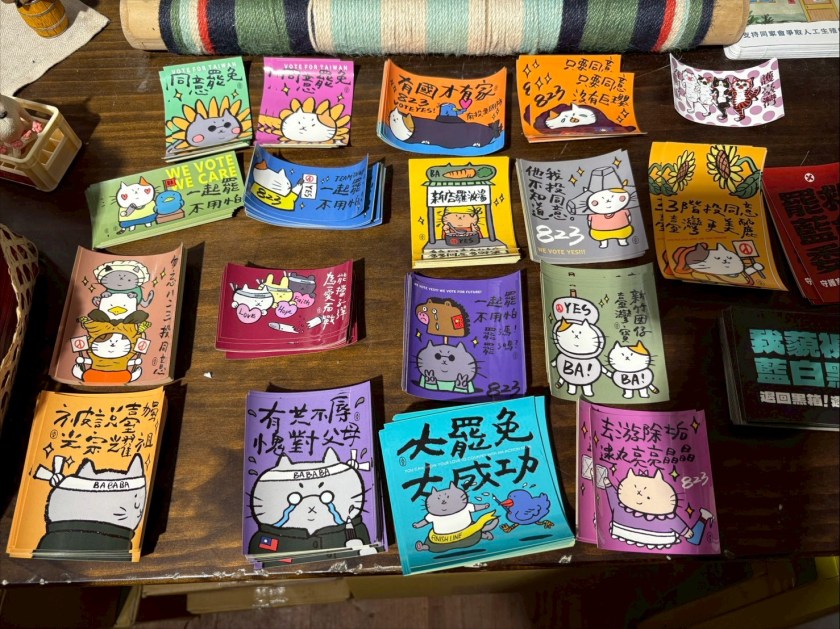
The stores I spoke to put recall promotional material on display, which was free for passersby to take. Such material not only included leaflets explaining the purposes of the recall, but also stickers, fans, toys, hair-ties, and other useful or decorative items, all sporting pro-recall designs.
For example, 回甘 designed the store space so that reference to the recalls was more implicit, only to be picked up by more inquisitive customers. A more direct approach by 貓起來吃 was posting a recall notice right next to the door; though more confrontational, 貓起來吃 would respond to curious passersby in an open, conversational style – not lecturing, but encouraging open discussion.
Most of the items recall-friendly stores put up were contributed (given freely to these stores) by designers who were either working independently, within a recall group or other activist organisation. Due to its civic society origins, the number of designers who were working with recall-friendly stores was large and varied in style.
Hyvä reports having items from more than ten designers, and 貓起來吃 found a designer whose style included cats and hence aligned closely with the store’s aesthetic.
All three store owners I spoke with said that even though the recalls have ended, they have left much of the promotional material on display. In fact, they continue working with many of the initial designers to raise awareness of other important political issues. 貓起來吃 decided to keep recall-specific promotional material in store for as long as they are in business, believing that the movement should inform how Taiwanese understand future political developments.
Besides putting promotional items on display, businesses supported recalls by providing their unique services. Printing shops would help designers print their designs free of charge, cafés would prepare food for activists, and many stores would close on the day of the recall vote to let staff vote. For example, 貓起來吃 closed their store to take part in the bluebird protests, and 回甘 gave away free rice balls (飯糰) during these protests to support other activists.
Many businesses also worked with recall groups. Depending on the store’s capacity, it would do some or even all of the following: printing forms, hosting petition-signing stations, helping customers fill in forms, collecting filled-in petition forms from different districts, checking and organising forms, and submitting forms to the local election commission. Some stores would also help recall groups recruit volunteers.
Recall-friendly stores would also help each other by, for example, sharing pro-recall items. Smaller stores with more limited capacity might also outsource form-printing / organising to larger ones.
Looking forwards
If, in Hong Kong’s case, it was the 2019-2020 pro-democracy protests that were a catalyst for businesses to express their political stance and begin engaging in activism, then for Taiwan, it was the recall movement. In both cases, it was a sense of crisis over the fate of democracy in the face of Chinese influence.
In Hong Kong, after the protests ended, many businesses still kept taking sides. It remains to be seen if the number of stores that take a side on political issues will increase in Taiwan as well.
The stores that have already taken a side continue to be active participants in civil society. It will be interesting to see whether and how these stores respond to the upcoming district elections in 2026.
Such stores also seem to represent a third front of activism. If tensions with China rise or the KMT-TPP coalition continues to provoke the ire of civil society, such businesses will likely respond and raise awareness of such issues.
Of equal importance is how pro-recall stores will continue to engage with swing voters and customers who do not support their stance. Creating a space where open discussion is encouraged while simultaneously espousing one particular stance may prove to be the most challenging part of activism for such businesses.
Aleksandrs Gross is a freelance journalist focusing on the grassroots development of Taiwanese identity. He is particularly interested in the development of Taiwanese civic society, especially social movements, and how younger generations of Taiwanese respond to the unique political, identity-related and economic challenges of Taiwan. Find more of his writing on New Bloom and his Substack Identity Island.
 Taiwan Insight