
Written by Jonathan Leung.
Image credit: 時代力量 New Power Party/ Facebook.
Survival Difficulties: Taiwan’s Third Force and Minor Parties
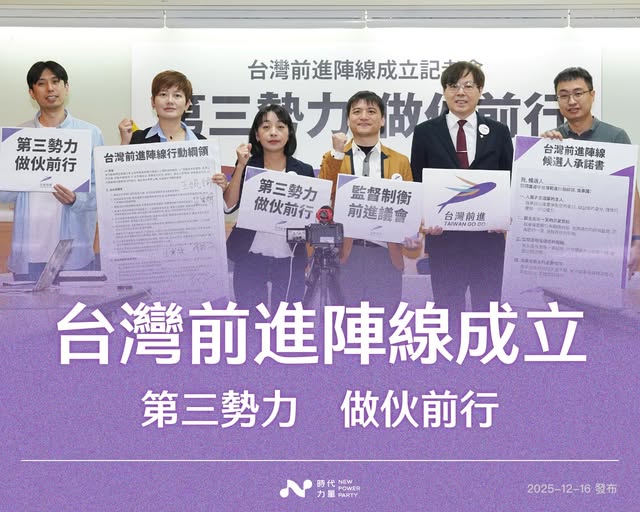
December 16, 2025, four small parties, New Power Party (NPP), Green Party Taiwan (GPT), Taiwan Statebuilding Party (TSP) and Obasang Political Equality Party (OPE), formed an alliance – ‘Taiwan Go Go Front’ (台灣前進陣線). The alliance aims to become a “responsible, predictable and trustworthy third force in order to replace the TPP” by cooperating in the 2026 local elections.
Minor parties represent unique, idealistic, and specific beliefs. Yet, they often find it difficult to find a platform to voice their concerns, as they unfortunately lack institutional representation in public bodies. Consequently, they have formed coalitions to maximise their electoral impact. According to the opinion polls in December 2025, the support rate of ‘other parties’ fell drastically to 1.6%. This pessimistic figure rang the bell of the survivability of small parties. On the contrary, the three mainstream parties occupy 75.5%, while the remaining indicated not specified. Minor parties are severely marginalised as they have already lost the media limelight. In 2024 and early 2025, the NPP was still an option on the opinion poll and received 2.4% supporting rates. However, as the Taiwan People’s Party (TPP) became increasingly ambitious and influential in 2025 after various parliamentary conflicts and the mass recall campaign, the minor parties were forgotten by the people.
The rise of the TPP is the major reason leading to the formation of the alliance. TPP’s replacement of NPP in the parliament by absorbing their party votes and taking all three of their legislative seats in 2024 is the loudest alarm not only to the NPP, but to others who still hope to deserve a spot. The TPP stands out as a new force that unites non-blue and non-green citizens, aspiring to be a solid third-party alternative that will not dissipate like its predecessors. Opinion polls since 2019 demonstrate that the TPP has a strong foundation and capability to distinguish itself, possessing a solid support rate of 20%. If minor parties do not respond effectively, their remaining supporters are likely to return to the three mainstream parties.
Seeing an extremely low support rate and being nearly extinct from the spotlight, 2026 is their final struggle to remind the public they are still campaigning for their beliefs. They were absent in various key political events in 2025, namely the fierce government-opposition parliamentary conflict and the mass recall campaign. Although the minor parties tried to voice their opinion by condemning the opposition and endorsing the recall elections, their presence seemed minimal as the media shaped these events as a DPP-KMT-TPP confrontation. If the minor parties are to survive, they need higher exposure and becoming public representatives is the best way to be formally recognised. Therefore, an election-oriented alliance has to be formed to get faces recognised and voices heard by the public.
Political Alliance: Experiment in the 2026 Local Elections
The fates of minor parties in Taiwan have always been rough and uneasy. Third parties rose rapidly but fell even more quickly. The election systems of Taiwan do not benefit them, as the majority of the legislative seats are elected geographically with first-past-the-post. Although the party list is chosen by proportional representation, there is a 5% threshold, which is not an easy task for minor parties to reach. However, city and county councillors are elected on a single non-transferable vote basis. In other words, a number of candidates can be elected in each constituency. Candidates just have to secure a certain percentage of votes to get elected, and the minimum number of ballots to get elected can be as low as 5-10%. This creates a space for them to break through.
Coordination is the pivotal effect the alliance can make. Minor parties often share similar ideologies and thus share a similar source of supporters. More than one minor party candidate in the same constituency will result in mutual destruction. If they can coordinate by nominating one candidate per constituency, their chances of getting elected will increase sharply, as votes will not be split. Mainstream parties will nominate various candidates aiming to equally share the ballots to get more councillors elected. Yet, politicians with higher popularity often vacuum more ballots while their partners lose. Minor party candidates can break through by focusing on constituencies with higher chances to gather a certain number of votes.
Referring to previous legislative party votes can give a clearer direction for them to choose suitable constituencies wisely. For example, the NPP has received a large number of ballots in Hsinchu and Miaoli in the past elections; the GPT has a certain number of supporters in Taoyuan; the same for TSP in Tainan and Kaohsiung. The alliance should choose constituencies wisely by selecting districts where they have received 5%-8% party votes or above in the past elections and only nominate one candidate to concentrate ballots into one person, the chance will maximise sharply.
Minor parties aligning together instead of cooperating with the DPP can reduce the chance of being seen as small-green allies. They can distinguish themselves from the DPP and stand out for their uniqueness. Minor parties that have cooperated with the DPP mostly resulted in being absorbed and would eventually vanish. The NPP has gone through an example of politicians, including legislators and councillors, being absorbed, and the party is now struggling for survival. Therefore, allying with like-minded minor parties can avoid being absorbed or labelled as small-green.
The Taiwan Go Go Front will experiment in 2026 to see whether representative can gather votes from their allies to stand out. If their strategy succeeds, they will erect the fourth political force.
Here Today, Gone Tomorrow? 2028 General Election and Beyond
Political alliances usually end up breaking up; the endurance of the Taiwan Go Go Front is yet to be examined. The key to success in 2026 is to gather a certain number of ballots in selected districts. Their collaboration is in fact coordination, meaning harmonising the nomination to avoid clashing in the same district. They are not unifying; they possess their own identity and uniqueness. Elections at the national level will be the true challenge.
The alliance is apparently election-oriented, rather than an eternal unification. Despite coordinating in 2026, the 2028 legislative campaign can also be a trial point to test the Taiwanese people’s attitude towards the alliance of minor parties. Without cooperating with mainstream parties, minor parties stand no chance in a first-past-the-post geographical election. However, the party-list can be a platform to experiment. They can jointly nominate one ticket in the party-list election. The sum of these four parties in the 2024 party-list election is 5.04% and 13.32% in 2020. Crossing the 5% barricade and legislative seats can be rewarded. In the 2024 election, none of them could reach the threshold, and in 2020, only the NPP received 7.75%, while both TSP and GPT got 3.16% and 2.41%, respectively. Suppose these parties only nominate a joint ticket and votes can be concentrated, the chance of members from the alliance being elected will increase, instead of ballots wasted in four separate nominations.
However, one times four does not necessarily equal four. Their supporters are usually well-educated elites or enthusiastic citizens who care about politics or society for specific reasons. They might be attracted by the unique manifestoes and ideological advocacy of a particular minor party, thus delivering their mandate. For example, GPT supporters might be very devoted to environmental issues while NPP supporters focus on social justice. Although they are like-minded partners, their foci are different, and their supporters might find other parties unsatisfied. The alliance may lose votes if its supporters find it overly realistic and pragmatic. In other words, their supporters might be disappointed with them forming the alliance to win elections instead of pursuing lofty ideals.
Hence, the nomination of party-list will be a super difficult task to negotiate. According to the 2024 election, suppose all ballots can be transferred to the alliance in 2028, 5% of party votes can reward the alliance with two legislative seats. Yet, there are four members in the alliance; the choice of candidate will be onerous for the decision makers to consider. The NPP obviously carries the largest influence, so the other three could only negotiate one to enter the safe seat. If the alliance proves itself successful in 2026 and supposes all ballots from 2020 can be transferred to the alliance in 2028, 13.32% of party votes can reward them six to seven elected legislators, which can minimise the argument of distributing the candidates as representatives of each party stand a fair chance to be elected. But this is a very challenging task, and the alliance’s charisma to rally support from neutral voters is still questionable. Failing to produce a solution that satisfies all alliance members will result in another coalition split.
Rebranding the third force minor parties by forming a coalition faces two huge obstacles, namely persuading supporters to agree with their election-oriented approach and balancing the interests and voices within the alliance. The 2026 local elections will be an experimental platform. If their coordination succeeds, councillors outstand, and different parties can campaign for their ally, they can proceed to a high-level coalition in 2028. Yet, when it moves to the national level, the challenges become more laborious and strenuous. They give it their best shot; efforts showed, the outcome is subject to observation.
Jonathan Leung is a history teacher in Hong Kong. He earned his Master’s degree in history at SOAS, University of London and his Bachelor’s degree in history at the University of Sheffield. His research focuses on the post-war political and social history of Taiwan. His research interests are situated in the life and decision-making of critical moments of prominent Taiwanese figures from a broad to a micro perspective. His research topics include the histories of power struggles, party politics, elections, democratisation, social movements and institutional changes. He is now pursuing his Postgraduate Diploma in Education in History and Humanities at the Hong Kong Baptist University.
This article was published as part of a special issue on ‘Review Taiwan 2025: Challenges, Continuities, and Change.’
 Taiwan Insight