
Written by Baosheng Guo.
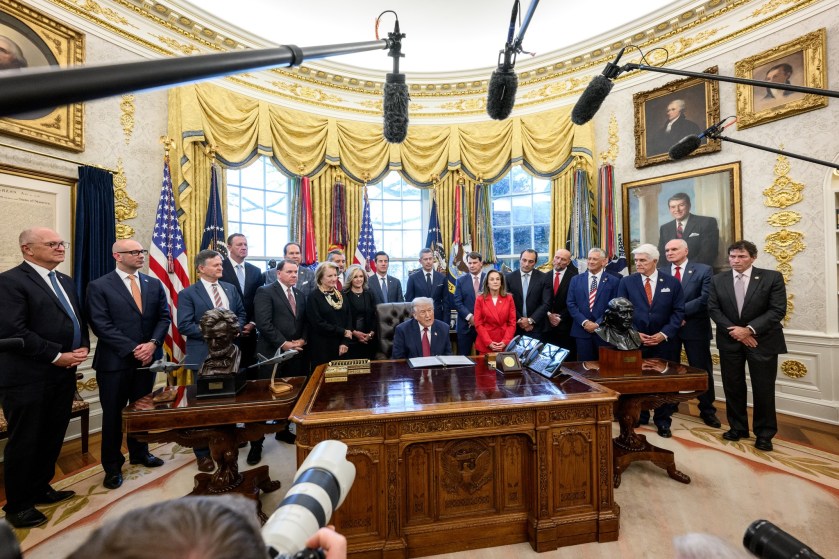
Image credit: The White House/ Facebook.
The U.S. 2025 National Security Strategy (NSS) emphasises Taiwan’s significance for American national security. It declares that the military defence of Taiwan and the First Island Chain merits affirmation and praise for its strategic clarity. However, across the new NSS’s structure, its strategy toward China, and its fundamental principles, there are four contradictions between the new NSS and the defence of Taiwan.
The first contradiction is between the stance of defending Taiwan and the Retrenchment strategy toward China. To deny China’s invasion of Taiwan, the U.S must achieve an advantage in economy, military, technology, and diplomacy through a comprehensive confrontation with China. But in the new NSS, the U.S. not only abandons the framework of Great Power Competition with China but also focuses solely on economic competition and excludes a comprehensive confrontation with China.
Both Trump’s 2017 and Biden’s 2022 National Security Strategy (NSS) explicitly identified China and Russia as the primary targets of the Great Power Competition. The NSS 2017 states, “The U.S. will respond to the growing political, economic, and military competitions we face around the world…China and Russia challenge American power, influence, and interests, attempting to erode American security and prosperity.” And the NSS 2022 states, “We will prioritise maintaining an enduring competitive edge over the PRC while constraining a still profoundly dangerous Russia”. In a regional context, both the 2017 and 2022 NSS place the Indo-Pacific at the top.
In contrast, Trump’s new NSS 2025 abandoned the framework of the Great Power Competition with China and Russia, and designates the Western Hemisphere as the primary strategic target, proposing a Trump Corollary to the Monroe Doctrine. In fact, in the Western Hemisphere, no state can challenge the U.S. and reshape the world order. Yet China is “the only competitor with both the intent to reshape the international order and, increasingly, the economic, diplomatic, military, and technological power to do it”. As the former U.S. Deputy Secretary of State Kurt Campbell testified before Congress, “Frankly, the Cold War pales in comparison to the multifaceted challenges that China presents.” However, in the new NSS, it certainly moves the Western Hemisphere ahead of China in its priority order and abandons the framework of Great Power Competition, it presents the critical feature of Strategy Retrenchment.
Also, the Secretary of War Hegseth said, “deterrence against China – through strength, not confrontation. Under President Trump’s leadership, relations between the US and China are better and stronger than they’ve been in many years,” and “An approach aimed not at domination but rather at a balance of power.” “This is deterrence by denial.” As the U.S. Under Secretary of War for Policy Colby asserts, the Denial strategy “focuses on denial rather than dominance specifically.” Yet scholar Zack Cooper concludes in Tides of Fortune, “weak states seek more limited objectives requiring only denying control to one’s adversary,” “Denial strategies could become more appealing if U.S. leaders perceive the US to be in a position of weakness.” Indeed, the Denial strategy indicates the switch of strategy and the Retrenchment strategy by the U.S., which would signal the U.S. weakness and be detrimental to defending Taiwan. As Zack Cooper asserts, “Allies will also worry about deterrence and reassurance if the U.S. shifts its defence policies.”
Since Trump began his second term, he has attempted to improve relations with China, rescinded the ban on TikTok, loosened control of high-technology exports to China, and permitted shipments of Nvidia H200 chips to China. To avoid a comprehensive confrontation, Trump may not actively pursue anything beyond arms sales regarding the Taiwan issue. And from now until April, when Trump plans to visit Beijing, he could further downplay US-Taiwan relations and constrain Taiwan’s diplomatic space.
In sum, from confrontation to defence, from dominance in the Indo-Pacific to the balance of power, from control to denial, the role of the United States in the Western Pacific is undergoing profound change. Such a retrenchment strategy toward China could be inconsistent with efforts to deter China from invading Taiwan, and Trump’s China policy could mislead China’s assessment of the United States’ determination to defend Taiwan and impel China’s ambition to invade Taiwan.
The second contradiction is that the emphasised burden-sharing could exceed the allies’ tolerance. Both Ebrige Colby and NSS 2025 insist that Burden-Sharing and Burden-Shifting are the priorities of the Strategy. “The days of the United States propping up the entire world order like Atlas are over.” However, overemphasising Burden-sharing can make it difficult for allies to bear the pressure and risks, and can lead to combat morale waning and internal strife. As Professor Blankenship argues, “the primary risk is that U.S. allies alone are not capable of preventing Chinese regional hegemony,” if burden-sharing exceeds the limits, allies could “seek means of achieving security that Washington opposes—such as acquiring nuclear weapons or appeasing U.S. adversaries.”
For instance, Taiwan’s legislature has just blocked the NT$1.25 trillion special defence budget bill. One reason the opposition party opposed the bill was that defence procurement accounts for a large share of the national budget and has produced “lacklustre results of defence procurements.” These two accusations point to the special defence spending exceeding budget capacity and inefficiencies in America’s arms sales. So, excessive Burden-Sharing could become a pretext for the opposition party to attack the ruling party.
Because of a decisive statement that Japan would defend Taiwan if China attacked, the Japanese Prime Minister Takaichi has borne alone the heavy pressure of economic coercion, diplomatic isolation, and intense criticism from China. Japan has urged the U.S. to provide Takaichi with greater public support. Still, Trump has implemented the Burden-Shifting and “Offshore Balance” strategies and has remained silent, making only phone calls to both sides to maintain balance. Additionally, the Takaichi is even considering reviewing the Three Non-Nuclear Principles to address Trump’s tough burden-sharing and offshore balance. As scholar Raja Mohan states, “Even as Trump demands more from Asian allies, he offers less clarity on what the United States will deliver in return.” Therefore, the Burden-Sharing must match the allies’ capabilities and provide sufficient returns.
The third contradiction is that the new NSS suggests that the U.S. “will also work to align the actions of our allies and partners with our joint interest in preventing domination by any single competitor nation,” Yet the U.S. consistently weakens relationships with allies and partners; it becomes difficult for the U.S. to unite allies and partners to counter China and prevent a war in the Taiwan Strait.
Trump imposed massive tariffs on allies, including Europe, India, Japan, Australia, and even Taiwan. As Professor Sutter asserts, “China will gain relative influence as U.S. allies and partners alienated by Trump administration demands adverse to their interests will be less likely to collaborate enthusiastically in efforts to counter Chinese challenges.” During the Biden administration, India played a significant role in the American Indo-Pacific strategy and the Quad. Still, Trump’s harsh criticism and massive tariffs allowed India to participate negatively in the Quad and the Indo-Pacific strategy. Unlike Biden, who united the EU to confront China, the new NSS is hostile to the EU and even asserts that Europe faces “civilisational erasure,” which only weakens the trans-Atlantic relationship.
China has, at multiple times, imposed bans on Taiwan imports because of Taiwan’s political behaviours, and it recently leveraged rare earths to counter U.S. tariffs and retaliate against Japan for its stance on Taiwan by imposing a ban on Japanese seafood imports. The U.S. must make concessions in negotiations, and Japan has not implemented a retaliatory economic policy against China to date. So, the international community still has no economic approach to address China’s economic coercion. However, similar to Article 5 of NATO, Professor Cha’s collective resilience could be the best approach to address China’s weaponised economic interdependence. As Cha proposed that the G7+ Australia group implement collective resilience, the U.S. should abandon economic isolationism and unite allies to build an international economic organisation and collective resilience.
The U.S. triumph in the Cold War did not depend solely on its own efforts; it led to the construction of the world’s multilateral architecture to confront the USSR, including the Bretton Woods system, the Marshall Plan, NATO, and even the coordination of China. During the Biden administration, the U.S. pursued several strategies to deepen relationships with allies through the EU, NATO, G7, G20, and other international institutions to counter China. In addition to global encirclements, the Indo-Pacific encirclements include AUKUS, the Quad Engagement, Bilateral Alliances (US-Japan, US-South Korea), and the Mini-Multilateral System (US-Philippines-Japan). Biden’s efficient multilateral approach to rival China’s aggression and prevent the Taiwan war deserves to be studied by Trump.
Finally, the fourth contradiction is maintaining the American “soft power” and wiping out the democratic values of Taiwan. The 2025 NSS states, “We want to maintain the United States’ unrivalled ‘soft power’ through which we exercise positive influence throughout the world that furthers our interests.” Trump has abandoned Taiwan’s democratic values and has only focused on economic interests and geopolitical strategy values, which weaken the moral legitimacy for defending Taiwan and the essential distinction between Taiwan and communist China. By contrast, Biden’s 2022 NSS states, “The U.S. will continue to defend democracy around the world, even as we continue to do the work at home to better live up to the idea of America enshrined in our founding documents.” In this sense, the Biden administration has multiple times emphasised Taiwan’s democratic values.
These four contradictions that the Trump administration should address are significant for formulating an appropriate Taiwan policy. If it neglects or fails to resolve these four contradictions, the strategy for defending Taiwan cannot be realised. But if the Trump administration prioritises comprehensive confrontation with China, recalibrates its relationship with allies, leads an anti-hegemonic coalition in the Indo-Pacific, and advances democratic values, the U.S. will achieve its national security objective of defending Taiwan.
Baosheng Guo is an M.A. Asia Studies student at George Washington University’s Elliott School of International Affairs. Many of his pieces were published in various media and academic journals, including The Diplomat, Global Taiwan Institute (GTI), Taiwan Insight (University of Nottingham), Taiwan International Studies Quarterly, and other Taiwan academic journals.
 Taiwan Insight