
Written by Gahon Chiang.
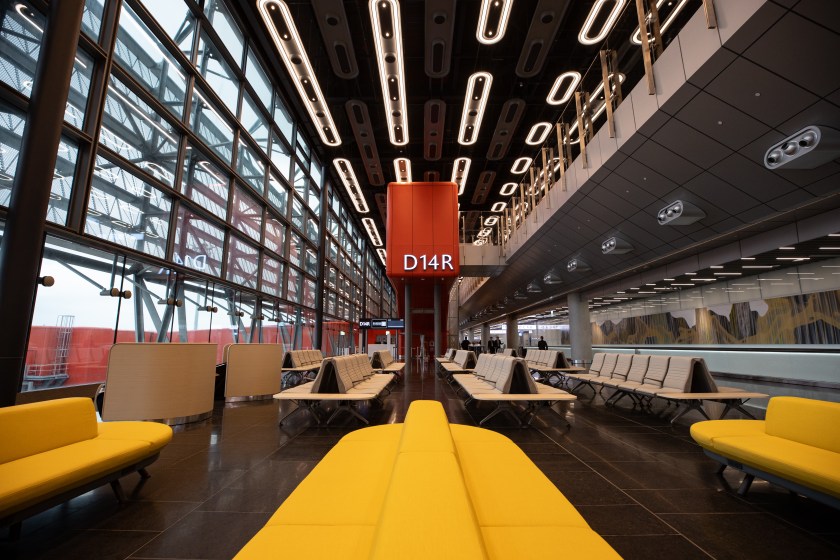
Image credit: 12.25 總統出席「桃園國際機場第三航廈北廊廳啟用典禮」 by Liu Shu fu, Office of the President. / Flickr, license: CC BY 4.0.
On 25 December 2025, the northern concourse of Terminal 3 at Taiwan Taoyuan International Airport began operations, adding a new cluster of gates to the country’s main international hub. Beyond marking progress in a delayed expansion, this opening highlights how the changing spatial logic of Taoyuan’s terminals mirrors Taiwan’s journey from authoritarian rule under martial law to democracy.
Airports are gateways. They are the first public interior visitors encounter and a place where the state’s authority becomes tangible. This article argues that the shift from enclosed boarding “pens” – where visitors are stuck in an enclosed boarding lounge resembling animals kept in a pen – in the older terminals to open, shared concourses in Terminal 3 reflects changing perceptions about how the state relates to its citizens at the border. Designed and engineered by a British-led team, the new terminal embodies a more open understanding of mobility in and out of Taiwan.
Terminal 1: Boxed-in boarding pens under martial law
Taoyuan International Airport opened in the late 1970s, when Taiwan was still under martial law and overseas travel was tightly regulated. (It was renamed “Chiang Kai-shek International Airport” just 11 days before opening and changed back in 2006 to “Taiwan Taoyuan International Airport.”). For many citizens, leaving the island was a managed privilege rather than an ordinary part of life.
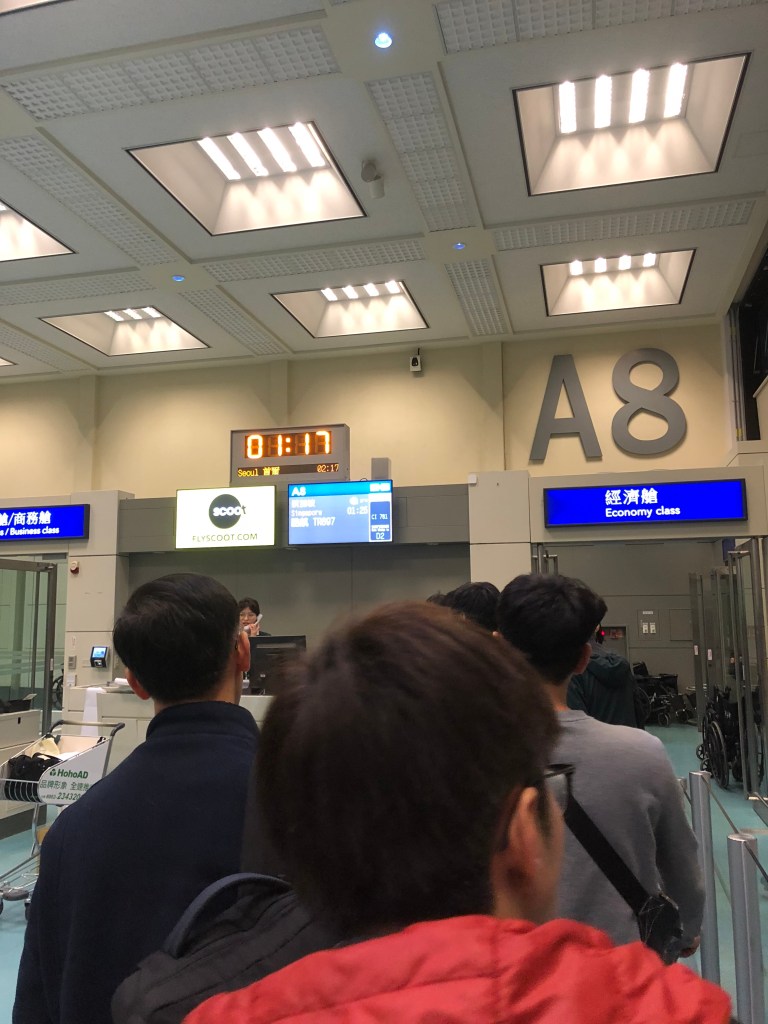
Terminal 1’s layout reflected that world. After check-in and immigration, passengers passed through a door assigned to a specific gate, then moved down into an enclosed boarding lounge. Each flight’s passengers waited in a separate space that could be kept apart from the main departures hall and, if necessary, closed off.
In its early years, the terminal’s security concept could be carried out near gate-adjacent spaces that functioned as small, self-contained zones. This kind of layout was not uncommon in airports built or upgraded in the 1970s and 1980s, and it sat comfortably with a system that still treated overseas mobility as something the state could grant or withhold.
Terminal 2: Tightly controlled gate spaces amid surging passengers
When Terminal 2 opened in 2000, Taiwan’s political landscape had been transformed. Martial law had been lifted for more than a decade, opposition parties were legalised, and Taiwanese voters had already directly elected their president. Yet Taoyuan Airport still faced practical challenges, including rising passenger numbers.
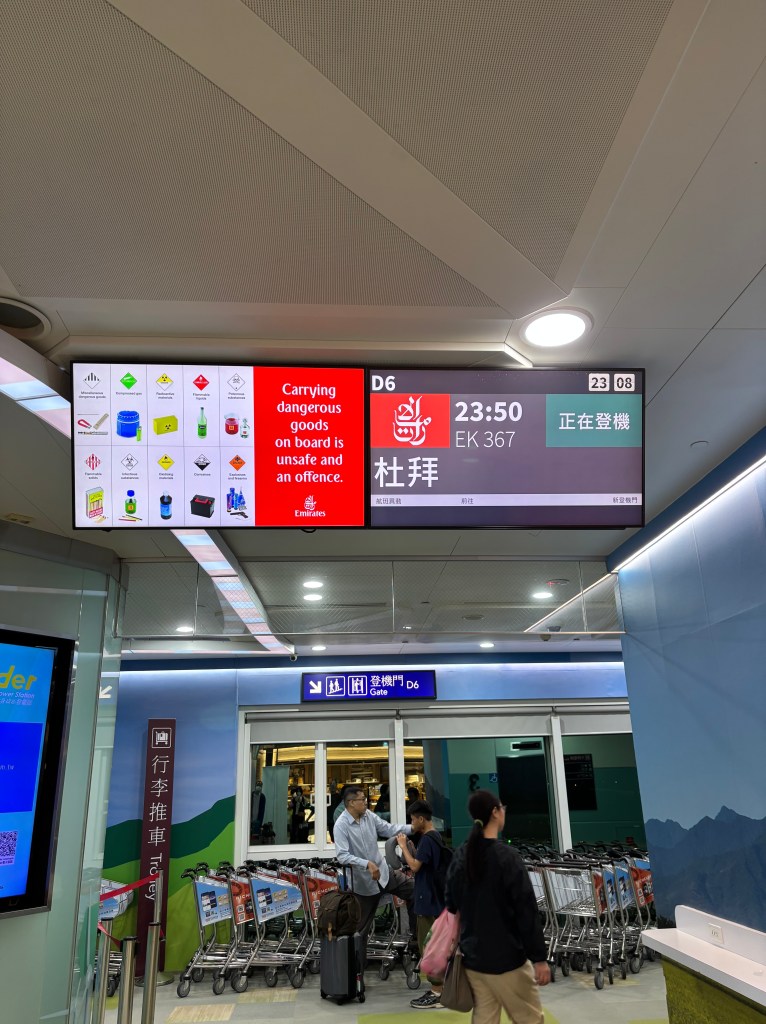
From a planning and design perspective, Terminal 2 was conceived within the same broad security paradigm that had shaped many airports of its era, with an emphasis on managing and, where necessary, containing passenger flows close to boarding, similar to Amsterdam Schiphol’s practice at the time of carrying out security checks at individual gates, which required substantial staffing.
Exactly how this was implemented in day-to-day operations has evolved, but what is clear is that maintaining a high level of control at numerous points in a busy terminal is labour-intensive, costly, and operationally inflexible. As passenger volumes rose and international practice shifted, it became more efficient to push much of the screening process further upstream. Taoyuan Airport has since shifted towards the pattern most travellers now recognise: a centralised security checkpoint earlier in the departures process, followed by outbound immigration, with passengers then free to circulate among many gates.
In that sense, Terminal 2 sits at an intermediate stage in Taoyuan Airport’s story: constructed in a democratising Taiwan, shaped by older security logics, and later adapted towards a more open, passenger-oriented flow.
Terminal 3: A British-designed space for an open democracy
Terminal 3 belongs to a new phase. It also carries a clear British imprint, with the overall concept led by Pritzker Architecture Prize-winning British architect Richard Rogers and his team, working together with Arup and Taiwanese partners. Drawing on Taiwan’s mountain ranges, the design uses an undulating roof and large column-free interior halls to create a continuous, easily legible space rather than a sequence of small rooms.
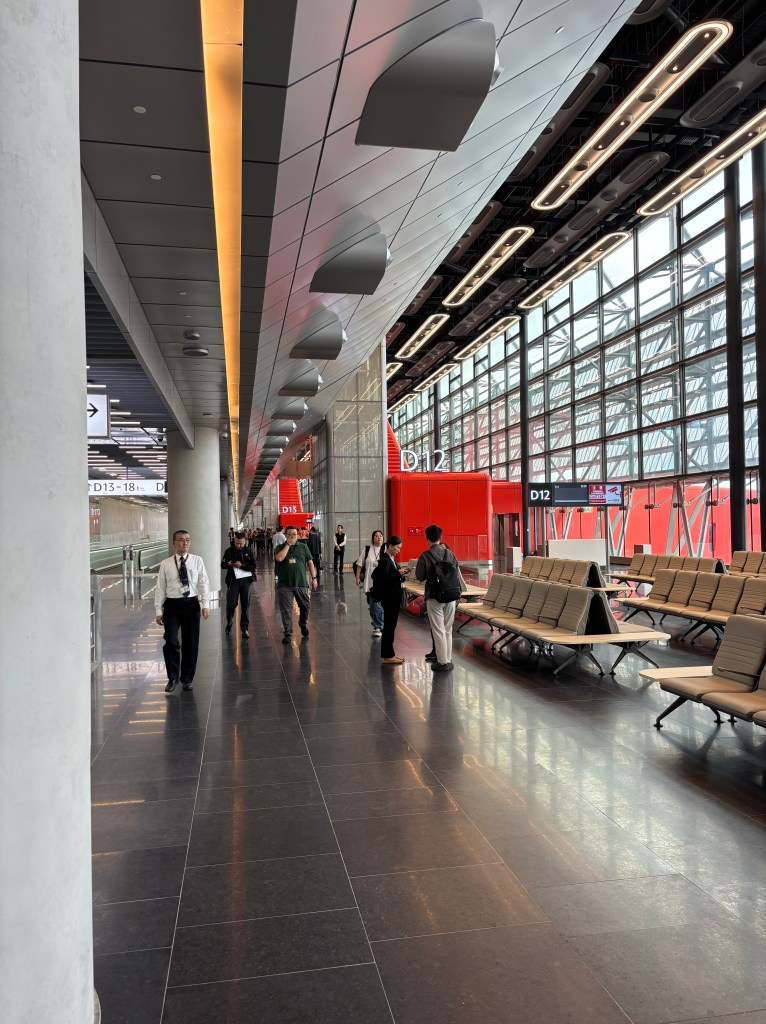
Within this scheme, the northern boarding concourse is especially revealing. Planned as a single-level, open-plan hall connected to Terminal 2, it lines up new gates along a shared concourse. A passenger boarding at Gate D12 can sit near D13 or D14, walk along the frontage, and still keep their gate in view. There is no requirement to go down into a separate room or to be locked in a small holding area well before boarding.
The contrast with the older terminals is clear. Instead of discrete spaces that can be easily sealed, the British-designed concourse prioritises transparency, openness and flexibility. Security remains strict, but it is woven into a journey that assumes most users are ordinary travellers who can be trusted to move freely within a clearly defined secure zone.
Infrastructure, citizenship and everyday democracy
Taoyuan Airport’s story shows that infrastructure is never purely technical. It encodes assumptions about who its users are and how they should be treated. Under martial law, when overseas travel was heavily regulated and often required explicit approval, terminals organised around gate-by-gate control and easily sealed waiting spaces supported a wider system that treated mobility as a revocable concession.
Democratisation, by contrast, has changed everyday encounters with state authority. Since the late 1980s, Taiwan has expanded civil liberties. Today, most citizens clear exit checks through automated e-gates in seconds and regard foreign travel as routine. The movement from enclosed pens to open concourses at Taoyuan both reflects and reinforces this expectation that cross-border mobility is a normal part of life.
A democratic gateway in a contested region
Taoyuan Airport’s new terminal will not decide Taiwan’s political future. But the journey from the enclosed boarding pens of Terminal 1 to the shared open concourses of Terminal 3 traces the island’s broader move from authoritarian control to democratic governance. That this latest chapter begins with the operation of an open shared concourse is a reminder that democratic change is written not only in constitutions and elections, but also in the everyday spaces through which citizens move.
Gahon Chiang is a senior legislative analyst in the Legislative Yuan, focusing on foreign and national security policy. He holds a master’s degree in international relations from National Taiwan University and serves as a research fellow at Taiwan NextGen Foundation.
 Taiwan Insight