
Written by Aleksandrs Gross.
This article is based on interviews with Professor Dafydd Fell.
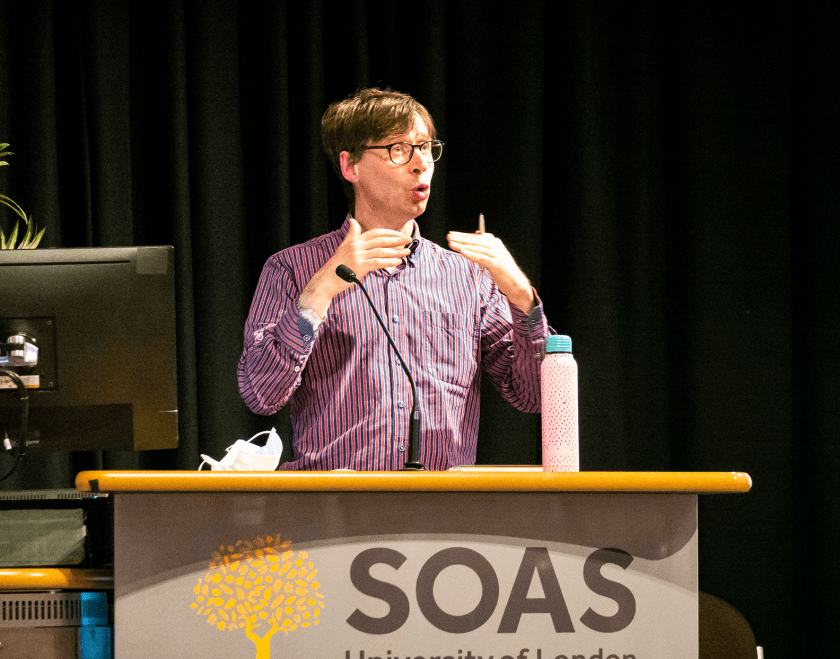
Image credit: provided by the interviewee.
Over the past two decades, Taiwan Studies has emerged in Europe as a rigorous and independent field. Once a marginal subfield of China Studies, it now stands alongside China, Korea, and Japan Studies, with dedicated university programs across Europe, a continent-wide scholarly association, an academic journal, and multiple book series and publications.
The prominence which Taiwan Studies has gained today is particularly unique, especially when compared with the rise of its neighbours — China Studies, Japan Studies, and Korea Studies. As regards Taiwan’s international influence, Taiwan is much more structurally constrained. Despite these constraints, how has the field developed to its present state today?
Examining the experiences of the field’s most influential scholars offers valuable insight. Taiwan Studies was highly niche when they started out: reflecting on their experiences from when the field was still emerging till today helps clarify both the field’s current state and what it takes to enter it today.
In the first article of this special issue, we will be looking at the career of Professor Dafydd Fell. Dafydd is one of the founders of the European Association of Taiwan Studies, the director of the Taiwan Studies Centre, and the chair of the master’s programme in Taiwan Studies at SOAS.
The Tiananmen incident, a very violent Chinese political crackdown that marked the end of China’s democratic social movements, was a turning point for Dafydd’s career: if before he was committed to becoming a China scholar, this event set him on the road to becoming a Taiwan scholar.
When Dafydd started his academic career, his focus was entirely on China. His father, having studied Chinese, and his experience of living in China for a couple of years when he was eleven (due to a teaching position of his father at a Chinese university) sparked a deep interest in the Chinese language and the PRC more generally. Dafydd chose a Chinese Studies bachelor’s, and was looking forward to an exchange year in China, but, not long before his exchange was to start, the Tiananmen incident happened and upset all his study plans.
The Tiananmen incident was a big shock to many UK universities that taught Chinese studies and made an exchange year in the PRC no longer viable. This incident put Taiwan on the ‘academic radar’ in the UK, and many students who were initially China-focused went to Taiwan for what was supposed to be their ‘China experience’ instead.
The pivot of many universities to Taiwan in the wake of the Tiananmen incident gave rise to many of the most prominent Taiwan studies researchers today – besides Dafydd Fell, others such as Shelley Rigger, Melissa Brown and Christopher Hughes ended up devoting their academic careers to Taiwan, not the PRC. The irony of such an outcome is notable. While the PRC was cracking down on democratic freedoms in Beijing, it was inadvertently supporting the development of Taiwan Studies and eventually raising the awareness of a Taiwan that is different from China.
Defining Experiences in Taiwan
Once Dafydd’s university switched to Taiwan, he had to quickly adjust to top-down events that were outside of his control. He arrived in Taiwan in 1989 with very little preparation:
(Going to Taiwan) wasn’t really my decision. It was just out of my hands. So that meant I was there for the next year, really scrambling to learn about Taiwan and change my Chinese accent, which was one of the first things that I remember people thinking was very funny when I arrived.
Besides the difference in how Mandarin was spoken, what also left a deep impression was how vibrant Taiwanese political culture was. The freedom that surrounded politics made it invariably clear to him how starkly different Taiwan was from China:
Student politics were also really exciting at that point in time. There was the build-up to the Wild Lily student movement. (..) I kind of knew what was going on, but I didn’t realise at the time how important it actually was. So I took some photographs as they were packing up the occupation zone. But I should have gotten there earlier. It’s just one of those things that you don’t realise that you’re in the midst of something historical (that) you’re going to be teaching your students about 30 years later.
Besides political freedom, the non-stop 24-hour city-life, the sea of motorcycles, and perhaps a little more negatively, the amount of pollution also linger as some of his first memories. In any case, any lingering disappointment at not being able to study in China was quickly replaced by a fascination with Taiwan’s chaotic, yet unique idiosyncrasies, especially in the political realm.
After a year in Taiwan, Dafydd returned to the UK. He realised that his experience in Taiwan had converted him from an aspiring China scholar to an aspiring Taiwan scholar. He took to learning about the island with a newfound fervour:
I started reading about Taiwan’s history after I got back, finding everything I could find in Leeds University Library about Taiwan in English, reading Taiwanese press, and sometimes even coming down to SOAS to use the library and find books I couldn’t find in Leeds. I had a real Taiwan focus. I was also probably thinking: can I do something in Taiwan after I graduate as well?
There was a three-year gap before Dafydd decided to go to Taiwan again, this time for seven years, from 1992 to 1999. Initially, there was no specific study plan that motivated his return – it was more of an open fascination, a willingness to get to know the country better by living there for a while.
During these seven years, Dafydd found clarity for his future research direction in part due to his conversations with his students (he was an English language teacher for a while) and in part due to becoming involved in academic circles studying Taiwan. Importantly, intellectual development was not the only theme of these seven years. He also got married, had a child, and discovered an interest in Taiwan’s sugar industry, railways in particular. Dafydd’s connection with Taiwan became much more personal.
The seven years Dafydd spent in Taiwan gave him the regional, on-the-ground experience that enabled him to see the gap between how research about Taiwan was presenting political realities, such as elections, and what they actually looked like. He observed how previous research overlooked the perhaps most unique aspects of elections in Taiwan:
It’s that experience of observing elections that was so different from European elections – the festival nature of them, the noise, the colours, the smells, the endless election advertisements. I saw a gap in which so much of the political science literature on political parties in Taiwan was very dry and dull, and statistically based. But it seemed to me that this was so interesting. There’s so much colour there, but the literature is missing it. So, that was what kind of drove me to look at political parties from a different angle.
It was the discovery of this gap that led to Dafydd’s first book, ‘Party Politics.’ The novelty of Dafydd’s angle meant that researching the topic required a novel approach. Dafydd’s fieldwork involved everything from news analysis to in-depth interviews. He notes how the time spent doing fieldwork for the project was perhaps the most satisfying time of his career:
I was using things like election advertisements and doing content analysis of those over 10 years, looking at media coverage, what people were saying in speeches, and then interviewing politicians. I was using a mixture of data, but it was very human, very colourful. I remember being based in the National Central Library, which is opposite the Chang Kai-Shek Memorial Hall. I would send out faxes, letters, and emails, and then just do as many interviews as I could in the final months of my fieldwork. So, I really loved that experience, talking to politicians, often very experienced politicians, such as former Prime Minister Hau Pei-tsun, and Lee Teng-hui, as well as former dissidents.
Such a novel approach was not without its challenges. Contacting sources, especially politicians who are holding or have held high positions, and then preparing for interviews entirely in Mandarin Chinese, is more difficult than sticking to news analysis. Dafydd also notes how it was more challenging to access KMT politicians compared to their DPP counterparts, who were very forthcoming. Additionally, given that many senior KMT politicians were mainlanders, there was the additional obstacle of decoding thick, regional accents (Hau Pei-tsun was the most challenging). He also notes how a sense of awe for some of the politicians, such as Lee Teng-Hui, worked against him – the interviewees would often try to change the topic of conversation to what they wanted to talk about and not what Dafydd was there to discuss.
The experience Dafydd gained from living in Taiwan for almost a decade, and from in-depth, pioneering research on Taiwanese politics, were instrumental in the next steps of his career. He returned to Europe, where, along with Professor Chang Bi-yu and others, he would go on to establish the first European Association of Taiwan Studies (EATS), develop the only English-language master’s programme on Taiwan outside of Taiwan and expand one of the most rigorous Taiwan study centres in Europe at SOAS. But more on that in the next article.
Aleksandrs Gross is a freelance journalist focusing on the grassroots development of Taiwanese identity. He is particularly interested in the development of Taiwanese civic society, especially social movements, and how younger generations of Taiwanese respond to the unique political, identity-related and economic challenges of Taiwan. Find more of his writing on New Bloom and his Substack Identity Island.
This article was published as part of a special issue on ‘Taiwan Studies Interviews: What can we learn?’.
 Taiwan Insight