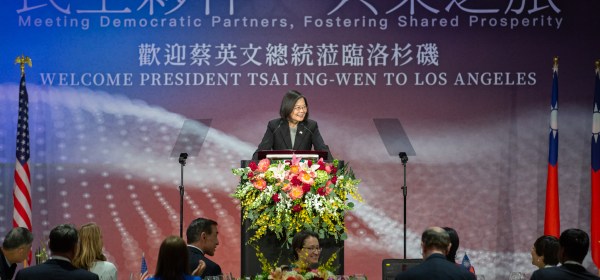
President Tsai Ing-wen’s successful travels, in spite of a Chinese headwind: Solidifying Central American and US relations

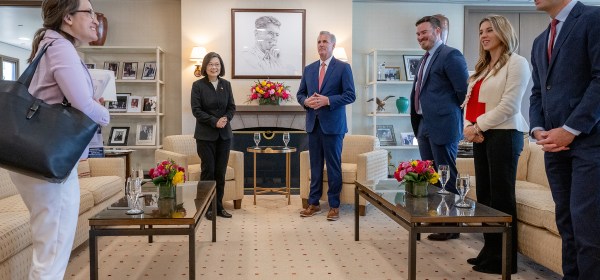
Written by Gerrit van der Wees. From late March through early April 2023, Taiwan’s President Tsai Ing-wen made her seventh foreign trip since becoming President in May 2016. The destinations were the Central American countries Guatemala and Belize, with stopovers in New York (on the way out) and Los Angeles (on the way back). The 10-day trip was her first foreign travel after Covid-19 made it sheer impossible to make such trips during the period 2020 – 2022. This trip became headline news because the CCP government in Beijing voiced major objections, particularly against a planned meeting with US House of Representatives Speaker Kevin McCarthy in Los Angeles. The objections are a continuation of the protests by Beijing against the August 2022 visit to Taiwan by McCarthy’s Democratic predecessor, Nancy Pelosi.

Three Musketeers against Mis/disinformation: Assessing Citizen-led Fact-checking Practices in Taiwan 

Written by Chiaoning Su and Wei-Ping Li. From sophisticated disinformation campaigns to patriotic trolling and clickbait, the flood of mis/disinformation has become a global phenomenon. Studies have shown that Taiwan’s young democracy ranks as one of the countries most exposed to misleading viewpoints or false information from foreign forces, especially China. These campaigns often seek to demonise high-profile Taiwanese politicians and divide Taiwanese society. They also aim to steer Taiwan away from anti-China policies or international alliances, notably with the United States.  

Who are the Allies of the Chinese Communist Party (CCP)? Neologisms, Netizens, and Nationalisms 

Written by Hsin-I Sydney Yueh. Recently, Taiwan’s Ministry of National Defense rejected a Japanese news report suggesting a widespread tendency among retired Taiwanese military officials to “sell out” their country. Wu Sz-Huai, a retired lieutenant general and incumbent opposition KMT party legislator, was among those who denounced this allegation.  

“Are we Chinese spies (共諜)?” Wu angrily asked this rhetorical question during a session of the National Defense Committee at Taiwan’s Legislative Yuan on March 2, 2023. While Wu denied being a Chinese spy, Taiwanese netizens teased him by sharing a photo of Wu and other retired Taiwanese military officials attending a CCP-hosted event, where they had sat attentively and listened respectfully to China’s leader Xi Jinping in 2016. Wu’s use of the term “Chinese spies” reminds us of another similar expression in Mandarin Chinese: “allies of the CCP” (中共同路人). This expression has recently gone viral in Taiwan’s online communities, used for self-mockery and as an attacking label.

“Governing by Memes”: COVID-19, Conspiracy, and Digital Democracy in Taiwan 

Written by Wen Liu and Hsin-I Sydney Yueh. The COVID-19 pandemic has significantly rearranged our social relations and affective connections. Amid disinformation and virus-origin conspiracy theories circulating across the social landscape, governmental responses to the pandemic have included various public health measures, such as lockdowns and mask mandates, and political measures, such as escalating geopolitical conflicts between the United States and China. Around the world, fear has been one of the most prominent affective responses to the pandemic, as driven by disinformation practices, intensified geopolitics, and our raw psychic fear about the unknown.

Freedom Fighting: Taiwan’s Resistance against China’s Ethnonationalism   

Written by Hsin-I Cheng. In the past decade, the world has heard the resisting voices of dissidents across Asia. From the 2014 Sunflower Movement to the Occupied Central Movement in Hong Kong later in the same year, citizens peacefully held their governments accountable. Since then, we have witnessed mass protests for freedom and transparency in nations. These challenges against authoritarianism generated transnational synergy, as demonstrated in the “#Milk Tea Alliance.” This movement started in 2020 when young Thai netizens fought cyberattacks against two Thai celebrities who expressed support for Taiwan and Hong Kong’s autonomy. Shockingly, two years later, the world witnessed Russia’s further invasion of Ukraine—it is a less militarily powerful neighbouring nation. Against these backdrops, we launched the book: Resistance in the Era of Nationalisms: Performing Identities in Taiwan and Hong Kong.

Innovating Tradition: The Interdisciplinary Practice of “Bodehi” Glove Puppetry Theatre in Taiwan 

Written by Chih-Ching Chester Tsai. Bodehi, Budaixi, or literal translation cloth sack theatre​ (布袋戲), is a form of traditional puppetry theatre in Taiwan. It was brought to Taiwan by early immigrants from southeast provinces of China during the Qing Dynasty. It has since developed into a unique form of theatre infused with local style and would later grow into one of the unofficial symbols of Taiwanese culture.​ 

Taiwanese Theatre as a Keyword: Publications in 2022 

Written by Yuning Liu. “Taiwanese drama/theatre/performance” as a keyword is unfortunately not a prevalent term in Anglophonic academic circles. However, 2022 can indeed be considered a fruitful year in Taiwan’s play translation and theatre research. In this article, I review the research focusing on Taiwanese drama/theatre/performance published in 2022. As a theatre scholar, my goal is not only to raise awareness of Taiwanese theatre studies but, more importantly, to consider how to take Taiwanese theatre research beyond the framework of regional theatrical studies and find more possibilities for dialogue with global audiences and theatre studies scholars.  

The Intercultural Resonance between Taiwan and Q: A Night at the Kabuki (2022) 

Written by An-Ru Chu. In the second half of 2022, when Taiwan was gradually relieved from the waves of omicron subvariant-induced outbreak, the country experienced an unprecedentedly large quantity of theatrical productions and cultural events since many of them should have been presented earlier but rescheduled because of the pandemic. Meanwhile, a Japanese staged play, ​Q: A Night at the Kabuki, broke National Theatre (NT) box office record in Taipei. NT sold 12,000 tickets in merely twenty minutes for the first time in thirty-five years. When applauding the artistic achievement of the play per se, most posts also mentioned the following two aspects: first, the strong emotions evoked by seeing one of the leading actresses, ​​​​Takako Matsu, in person, which echoes how the show had extensively grabbed the media’s attention since last May.

2022 Taiwan Theatre Report: Coronavirus, Chaos, Challenges, and Changes

Written by Yi-Ping Wu. How would people of the future think of the theatre of Taiwan in 2022? A year haunted by the Coronavirus pandemic? A year in which the international situation was overshadowed by the Russian-Ukranian war? What are some lessons we learned in the past year? Undeniably, 2022 was a rapidly changing and challenging year for the Taiwanese. As to the field of theatre, 2022, in my perspective, could be recognised as the year of “change” due to the following characteristics. 

Artists and the Unruly Bodies: Performances in 1980s Taiwan 

Written by Chee-Hann Wu. 2023 marks the 40th anniversary of the Taipei Fine Arts Museum (TFAM). Founded in 1983, the museum has witnessed the vicissitudes of Taiwanese society and its democratisation since the 1980s. The Wild Eighties: Dawn of a Transdisciplinary Taiwan, the first curated exhibition celebrating the Museum’s 40th anniversary, reconfigures the socio-political environment of the 1980s in conversation with the cultural scenes. Opening in December 2022, 25 years after the lifting of martial law, The Wild Eighties shows how the political transition inspired artists and creators to experiment with new forms of artistic expression grounded in rebellion and revolution and reimagined the meaning and relationship between art and society.  

An Unlimited Future: How Do We Get There? 

Written by JhuCin Rita Jhang. The year 2022 marked the 20th anniversary of the pride parade in Taiwan. It is a feat worth celebrating, and its theme, “An Unlimited Future,” adumbrates directions we are, or ought to be, heading toward.        

The host of the pride parade, Taiwan Rainbow Civil Action Association, explained, “this year’s theme, An Unlimited Future, heralds our long-term goal—to liberate all oppressions against sex and all stereotypes, allowing endless possibilities for everyone’s identity. The ultimate goal is that one day, no one needs to announce their identity in any way but can be anyone they want without judgment.” However, to arrive at the future depicted in this statement, we need first to understand what were, are, and may remain the limits, who put these limits and on whom, what are the consequences of the limits, and more importantly, the results of removal of these limits.

Tainan Police Murder: A Chance for Total Reform of Police Use of Force Training

Written by Wei-An Tsai. ​​In August 2022, the brutal murder of two police officers on duty in Tainan city sent shock waves through Taiwanese society. The two officers, Tu Ming-cheng (凃明誠) and Tsao Jui-chieh (曹瑞傑), were tipped about a stolen motorcycle and set out to investigate. However, they were later ambushed and killed by the suspect shortly after arriving at the scene, which was in an unpopulated area.​  
The two officers suffered fatal stab wounds, despite one carrying a gun. The issue of the timing to use firearms quickly became the centre of public debate. In apprehending the suspect on the run, the Interior Minister, Hsu Kuo-yung (徐國勇), instructed police officers “not to hesitate to open fire when faced with resistance.”

1 11 12 13 14