The Digital Evolution in Taiwan and Japan: Implications for Political Communication

Written by Tommy Hall and Margaret Siu. The digital era has revolutionised political communication, with profound effects in Asian democracies, notably Japan and Taiwan. This exploration delves into the intricacies of how political entities in these countries harness digital platforms. It aims to unpack the varied strategies they employ, the challenges they confront, and the opportunities they seize within the digital realm. Our analysis will not only highlight the distinct tactics and responses shaped by each country’s unique cultural, legal, and historical contexts but also examine the broader implications these digital transformations hold for political engagement and democratic discourse in the region.

It’s Time for the Ghost Month! 

Written by Chee-Hann Wu. Beliefs in the afterlife and in spirits are universal and exist in different cultures and societies. Naturally, ritual practices, ceremonies, festivals, and customs arise, such as Halloween in Western countries and Día de Muertos in Mexico. Similarly, in Taiwan, the year’s seventh month in the lunar calendar is dedicated to ghosts and the deceased. The Gate of the Ghosts opens on the first day of Ghost Month and closes on the last day, during which the spirits enter through the gate and wander the world of the living.

Wave Makers on Netflix: A Vision of Taiwanese Politics Not ‘Amid Tensions’  

Written by Chieh-Ting Yeh. “Wave Makers” (2023; ​人選之人-造浪者​) is a new drama on Netflix about political staffers trying to win a presidential election in the last few months of the campaign. This may sound like the premise of many television shows in the political intrigue genre, but it is the first of its kind from Taiwan to be available to a worldwide audience. The drama addresses various political issues relevant to contemporary Taiwan, including environmental concerns, energy policies, and workplace sexual harassment, reflecting the ongoing public debates on these topics. But it is glaring in what it is missing: Taiwan-China relations.

Three Musketeers against Mis/disinformation: Assessing Citizen-led Fact-checking Practices in Taiwan 

Written by Chiaoning Su and Wei-Ping Li. From sophisticated disinformation campaigns to patriotic trolling and clickbait, the flood of mis/disinformation has become a global phenomenon. Studies have shown that Taiwan’s young democracy ranks as one of the countries most exposed to misleading viewpoints or false information from foreign forces, especially China. These campaigns often seek to demonise high-profile Taiwanese politicians and divide Taiwanese society. They also aim to steer Taiwan away from anti-China policies or international alliances, notably with the United States.  

Who are the Allies of the Chinese Communist Party (CCP)? Neologisms, Netizens, and Nationalisms 

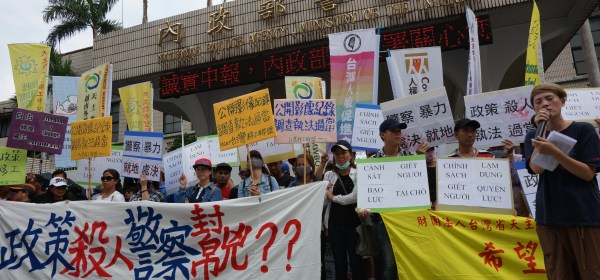
Written by Hsin-I Sydney Yueh. Recently, Taiwan’s Ministry of National Defense rejected a Japanese news report suggesting a widespread tendency among retired Taiwanese military officials to “sell out” their country. Wu Sz-Huai, a retired lieutenant general and incumbent opposition KMT party legislator, was among those who denounced this allegation.  

“Are we Chinese spies (共諜)?” Wu angrily asked this rhetorical question during a session of the National Defense Committee at Taiwan’s Legislative Yuan on March 2, 2023. While Wu denied being a Chinese spy, Taiwanese netizens teased him by sharing a photo of Wu and other retired Taiwanese military officials attending a CCP-hosted event, where they had sat attentively and listened respectfully to China’s leader Xi Jinping in 2016. Wu’s use of the term “Chinese spies” reminds us of another similar expression in Mandarin Chinese: “allies of the CCP” (中共同路人). This expression has recently gone viral in Taiwan’s online communities, used for self-mockery and as an attacking label.

“Governing by Memes”: COVID-19, Conspiracy, and Digital Democracy in Taiwan 

Written by Wen Liu and Hsin-I Sydney Yueh. The COVID-19 pandemic has significantly rearranged our social relations and affective connections. Amid disinformation and virus-origin conspiracy theories circulating across the social landscape, governmental responses to the pandemic have included various public health measures, such as lockdowns and mask mandates, and political measures, such as escalating geopolitical conflicts between the United States and China. Around the world, fear has been one of the most prominent affective responses to the pandemic, as driven by disinformation practices, intensified geopolitics, and our raw psychic fear about the unknown.

Small Step from You, A Great Leap for Migrant Workers: Documentary, ‘Civil Society’ and ‘And Miles to Go Before I Sleep’ (2022) 

Written by Hsin-Chin Evelyn Hsieh. The award for the best documentary feature at the 59th Golden Horse Awards held in November 2022 in Taipei, Taiwan, went to And Miles to Go Before I Sleep (2022), directed by Tsung-Lung Tsai. At the ceremony, film producer Kim Hong Nguyen, dressed in the Vietnamese traditional garment áo dài, read out a message from Quoc Phi Nguyen’s family expressing their grief and hopes. It was the first time a documentary on migrant workers was presented with the Golden Horse Award, thereby creating a platform for voiceless migrants and drawing attention to the related issues in mainstream society. 

Her journey to the Best Actor award: Taiwanese Opera performer Chen Ya-Lan made the history 

Written by Jasmine Yu-Hsing Chen. October 22, 2022, outside the Sun Yat-sen Memorial Hall in Taipei, ​Taiwanese Opera performer Chen Ya-Lan (陳亞蘭) astonished audience members on the red carpet for the ​57th Golden Bell Awards (GBA). This annual award honours excellence in television and radio programs created in Taiwan. As a female performer, Chen broke records with her Best Leading Actor Award nomination.

1 2 3 4 5