Artists and the Unruly Bodies: Performances in 1980s Taiwan 

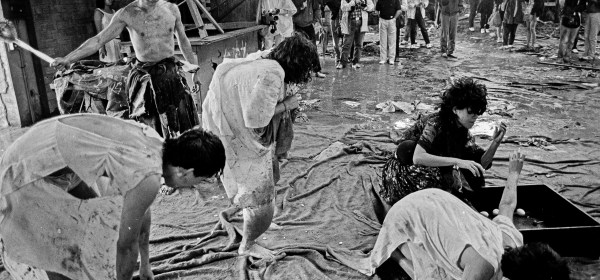
Written by Chee-Hann Wu. 2023 marks the 40th anniversary of the Taipei Fine Arts Museum (TFAM). Founded in 1983, the museum has witnessed the vicissitudes of Taiwanese society and its democratisation since the 1980s. The Wild Eighties: Dawn of a Transdisciplinary Taiwan, the first curated exhibition celebrating the Museum’s 40th anniversary, reconfigures the socio-political environment of the 1980s in conversation with the cultural scenes. Opening in December 2022, 25 years after the lifting of martial law, The Wild Eighties shows how the political transition inspired artists and creators to experiment with new forms of artistic expression grounded in rebellion and revolution and reimagined the meaning and relationship between art and society.  

Revitalising Indigenous Weaving Cultures Across Borders: Conversations and Collaborations between Taiwan and the Philippines

Written by Shau-lou Young. Weaving is a significant material culture in Indigenous Peoples’ society in Taiwan and the Philippines. In the past, hand-made textiles were necessities in their daily lives. However, with the introduction of fabrics into their society, only a few women continued to weave. Today, Atayal weavers in Taiwan and Ifugao weavers in the Philippines are working hard to revive their weaving culture. They brought back and conserved disappearing weaving techniques and knowledge and remade some long-lost textiles.

When You Weave, You Are Planting Seeds on the Land: An Indigenous Weaving Practitioner’s Experience

Written by Ipiq Matay. My name is Ipiq, which means “tiny” in Truku, and I am an Indigenous person from the Truku community of Taiwan. Despite my lack of height, I have a big heart. As a weaver in my community, I’d like to share ‘mhuma’, a Truku weaving skill which translates to “be planting”. This weaving technique can be seen in diamond-shaped patterns on women’s traditional clothing. Learning how to weave and create this pattern began my journey of connecting to my family history and the people of my community.

Tminun: Weaving from My Heart as an Indigenous Male

By Peydang Siyu (Chu, Hao-jie); translated by Huang, Hsing-hua. I am a member of the Truku people; the twelfth officially recognised Indigenous nation in Taiwan. We believe in our ancestors’ spirits (utux rudan) and adhere to their teachings (gaya) throughout our entire lives. Cloth weaving (tminun), similar to facial tattooing (ptasan), is a significant part of Truku culture, and many of our customs are related to it. For example, there is a strict gender division of labour in traditional Truku society, with men hunting and women weaving. Men were prohibited from learning how to weave or even touching the tools. As a male, it wasn’t until 2018 did I dare to learn it. But once I began, I never stopped. It was definitely a dream-come-true journey that I would forever remember.

Weave for an Identity: Learning Indigenous Weaving as a Han Person

Written by Nai-Wen Chang. It all started from my experience representing Taiwan at an international youth forum in 2010. A section required every participant to introduce one’s country, offering a chance to engage in cultural interactions. It was our turn to present after India, Russia, Germany, the United States, and China. Everything went smoothly until an Indian participant in a dazzling sari raised a question. The Indian representative, out of pure curiosity, asked, “What does your traditional dress look like?” A moment of embarrassed silence filled the air. My senior, the eldest of us, eventually replied, “We don’t wear traditional dress much, but we do have cheongsams.” A Chinese participant immediately countered, “Cheongsam is Chinese dress, not Taiwanese.”

Encountering Ancestors Along the Path of Weaving

Written by Langus Lavalian. Ibu is currently the youngest weaver in Haitutuan Township. When she was learning to weave with our grandmother, she had a dream in which she met a silent elderly female who requested Ibu to watch her weaving process. Traditionally, outsiders are not allowed to watch or learn the weaving process. However, this old lady appeared to be weaving purposely for Ibu and instructing her step by step. Since taisah, which refers to dream, is vital to the Bunun, Ibu believes that this is the path guided by our ancestors. 

Return to the Land and People: Contemporary Indigenous Knowledge System Project in Taiwan

Written by Yi-tze Lee. Following the Construction of the Taiwanese Indigenous Knowledge System (hereafter IKS) Project initiated by the Council of Indigenous Affairs (原住民族委員會), the establishment of the regional Indigenous Knowledge System Center is booming in 2022. The commissioned project results from a long fight for the indigenous cultural right, an example of autonomy in indigenous studies, and efforts on identity awakening. This article will explain the background of the IKS project, discuss the expectation, and reveal some critiques of the project in general. 

The Procrastinating Progress of Transnational Same-Sex Marriage Rights in Taiwan

Written by Annie Huang. One historical human rights progress Taiwan made happened in 2019 when the government legalised same-sex marriage. It was a rainy morning, and hundreds of LGBTI groups and activists were standing outside the Legislative Yuan waiting for results. When the president of the Legislative Yuan announced the legalisation of same-sex marriage, the rain stopped, and a rainbow appeared in the sky. People hugged and wept with joy for this historical first in Asia. However, at the same time and in the same plaza, a group of Taiwanese same-sex people burst into tears not because of happiness but because of sadness and discrimination. Transnational same-sex couples are left out of the legalisation content in the same-sex marriage bill without much reasonable reason.

An Unlimited Future: How Do We Get There? 

Written by JhuCin Rita Jhang. The year 2022 marked the 20th anniversary of the pride parade in Taiwan. It is a feat worth celebrating, and its theme, “An Unlimited Future,” adumbrates directions we are, or ought to be, heading toward.        

The host of the pride parade, Taiwan Rainbow Civil Action Association, explained, “this year’s theme, An Unlimited Future, heralds our long-term goal—to liberate all oppressions against sex and all stereotypes, allowing endless possibilities for everyone’s identity. The ultimate goal is that one day, no one needs to announce their identity in any way but can be anyone they want without judgment.” However, to arrive at the future depicted in this statement, we need first to understand what were, are, and may remain the limits, who put these limits and on whom, what are the consequences of the limits, and more importantly, the results of removal of these limits.

Tainan Police Murder: A Chance for Total Reform of Police Use of Force Training

Written by Wei-An Tsai. ​​In August 2022, the brutal murder of two police officers on duty in Tainan city sent shock waves through Taiwanese society. The two officers, Tu Ming-cheng (凃明誠) and Tsao Jui-chieh (曹瑞傑), were tipped about a stolen motorcycle and set out to investigate. However, they were later ambushed and killed by the suspect shortly after arriving at the scene, which was in an unpopulated area.​  
The two officers suffered fatal stab wounds, despite one carrying a gun. The issue of the timing to use firearms quickly became the centre of public debate. In apprehending the suspect on the run, the Interior Minister, Hsu Kuo-yung (徐國勇), instructed police officers “not to hesitate to open fire when faced with resistance.”

Police’s Right to Use Firearms? Lessons from the Murder of Two Police Officers in Taiwan

Written by Ting-Yi Bai. In August 2020, the murder of two police officers shocked Taiwanese society. The police officers, Tu Ming-Cheng, and Cao Ruei-Jie, investigated larceny after receiving a report that a stolen motor had been seen near Chikan Tower in Tainan. While searching for the suspect separately, Tu Ming-Cheng was suddenly attacked by the inmate Lin Xin-Wu, who had escaped from Mingde Minimum-Security Prison. Cao Ruei-Jie was also stabbed after failing to halt the culprit. Both died in the end.

Small Step from You, A Great Leap for Migrant Workers: Documentary, ‘Civil Society’ and ‘And Miles to Go Before I Sleep’ (2022) 

Written by Hsin-Chin Evelyn Hsieh. The award for the best documentary feature at the 59th Golden Horse Awards held in November 2022 in Taipei, Taiwan, went to And Miles to Go Before I Sleep (2022), directed by Tsung-Lung Tsai. At the ceremony, film producer Kim Hong Nguyen, dressed in the Vietnamese traditional garment áo dài, read out a message from Quoc Phi Nguyen’s family expressing their grief and hopes. It was the first time a documentary on migrant workers was presented with the Golden Horse Award, thereby creating a platform for voiceless migrants and drawing attention to the related issues in mainstream society. 

1 20 21 22 23 24 55