Navigating data sovereignty: lessons for Taiwan

Written by Zach Meyers. The concept of data sovereignty presents challenges for Taiwan, which relies heavily on open digital trade. While Taiwan’s Personal Data Protection Act allows cross-border data transfers with some restrictions, it still faces difficulties in asserting its standards due to its smaller market size and reliance on larger economies. To navigate these challenges, Taiwan may benefit from supporting multilateral data standards and strengthening its role as a key tech partner globally.

Taiwan’s Internet Governance: A Democratic Framework for Multistakeholder Participation and Global Connectivity 

Written by Anthony Lee. This article explores Taiwan’s Internet governance model, underlining its commitment to democratic principles and multistakeholder participation. Taiwan’s success in this area will depend on confronting challenges such as adapting to emerging technologies, ensuring privacy protection, and navigating geopolitical pressures while upholding democratic values and fostering international partnerships.

The Most Critical Resilience Questions of Them All: Taiwan’s Undersea Cables  

Written by Charles Mok and Dr Kenny Huang. This article examines Taiwan’s critical reliance on its undersea cable system for digital resilience in the face of potential blockades and disruptions. It emphasises the need for Taiwan to enhance its strategy by expanding partnerships to position itself as a regional “transfer station” for digital traffic while fostering investment and cross-sector collaboration to strengthen its connectivity infrastructure.

Taiwan’s Semiconductor Industry in the “Chip Wars” Era 

Written by Gunter Schubert. Taiwan’s security is largely determined by the government’s ability to promote the resilience of Taiwan’s high-tech industries, especially semiconductors, to ensure their international competitiveness and crisis resilience. Based on this fact, this article raises two subsequent questions: what strategies are the Taiwanese semiconductor industry pursuing to secure its technological edge and markets in the new global power constellation? And what is the Taiwanese government doing to strengthen the country’s economic security, which arguably depends essentially on maintaining Taiwan’s leading position in the global high-tech industry over the long term? 

Taiwan and Artificial Intelligence

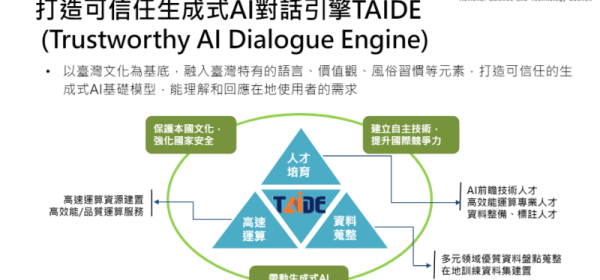
Written by Hon-min Yau. This article examines Taiwan’s recent development and regulation of artificial intelligence (AI). Sensing the incoming grand trend of AI development, Taiwan’s “Year 0” for AI came in 2017. At the time, AI-enabled devices such as smart speakers or smart TVs have been the focus of the consumer market, but other emerging AI-enabled services in fields such as object recognition, medical diagnosis, customer service, and vehicle self-driving were seen by Taiwan as new economic opportunities for Taiwan’s development.

Mastering Science, Technology and Society: Developing Taitung’s Perspective 

Written by Eric Siu-kei Cheng. Science and Technology Studies (STS) is an interdisciplinary field that explores the co-production between technology and society. Taiwanese scholars adopt the lens of STS to explore diverse topics and provide critical insights to public policies and social activism. The upcoming 2024 annual meeting of the Taiwan STS Association, to be held in Taitung City, will focus on the theme of “rhythm,” exploring the role of time, temporality, and timing in the context of STS.

A Short History of Semiconductor Technology in Taiwan during the 1970s and the 1980s

Written by Ling-Ming Huang. Taiwan’s semiconductor industry grew significantly in the 1970s and 1980s, driven by important government-led strategies aimed at developing manufacturing capabilities for integrated circuit (IC) products in Taiwan. These initiatives laid the foundation for Taiwan’s global dominance in the semiconductor sector and facilitated the establishment of key corporations like TSMC.

Digital Archiving for Just Transitions  

Written by Tim Schütz. This article explores the Kaohsiung Asthma Files Archive. This public-facing research archive gathers a diverse range of data to tell multi-faceted stories of Kaohsiung’s industrial sites and their transformations. It is also part of the global environmental justice data initiative, which fosters learning and knowledge sharing across locations through digital exchanges.

1 2 3 4 7