
As Taiwan approaches the thirty-ninth anniversary of the lifting of martial law, questions of historical responsibility and transitional justice remain far from settled. A recent controversy over an exposed film adaptation of the Lin family murders in the 1980s, that is, one of the many unresolved violences of the White Terror period, has brought these political repressions back into public memory. What began as a dispute over a single film project has quickly expanded into a broader argument about an attempt to whitewash Taiwan’s history, the attenuation of accountability, the reclaiming of ethical narration, and the shifting boundaries of creative freedom and cultural production when transitional justice is strangled by authoritarian spectral violence.
Nearly four decades on, many truths remain partial, erased, or irretrievably uncertain. Yet these absences do not simply mark the limits of history; they actively shape how memories and living generations are sustained, negotiated, and mobilised in the present. The afterlives of the White Terror now circulate across a wide range of economic, cultural and political arenas—from films and television dramas to museums, memorial landscapes, archival projects, and ordinary initiatives.
Taking the recent controversy as a point of departure, this special issue brings together discussions that ask: what forms of social, cultural, and political life emerge and are compromised when the truth can no longer be fully known? Who is entitled to speak, perform and interpret, and under what conditions does transitional justice land—or fail to land—on the shore?
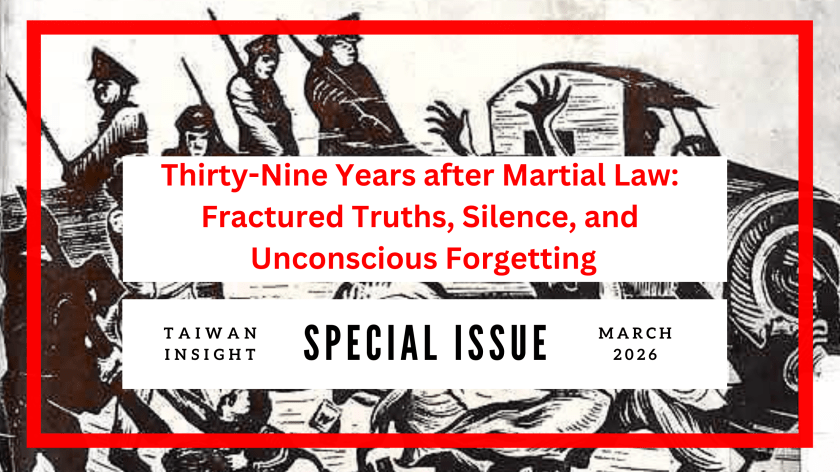
Image credit: Provided by Dean-e Mei (梅丁衍). The stark tension of black and white and the dynamic interplay of carved lines create a vivid sense of motion: from the sinister expressions of military police to civilians attempting a final, faint resistance before being forced to the ground; from cigarette packs and bodies scattered across the street to military trucks advancing through the scene. It is currently the only known visual record that realistically captures the moment of the February 28 Incident (1947) as it unfolded. This work, titled “The Terrifying Inspection”, was created by Huang Rong-can (黃榮燦), a Chinese woodcut artist who later became one of the political victims of the February 28 Incident.
In 1975, a Hong Kong publication titled “Commentaries on the Taiwan February 28 Incident” used a clear reproduction of the woodcut “The Terrifying Inspection” on its cover. This high-resolution version was taken from the catalogue of the Chinese Woodblock Print Exhibition held at the Kanagawa Museum of Modern Art in Japan in 1975. The speed with which the Hong Kong publisher obtained and reproduced the image suggests that the magazine acted with remarkable efficiency to secure its publication. At the time, press restrictions in Taiwan had not yet been lifted. As a result, many opposition (dangwai 黨外) publications that circulated images of the February 28 Incident relied on blurred reproductions that had been repeatedly copied from earlier prints.
From White Terror to Green Overreach: Taiwan’s Democracy Under Pressure Written by Meng Kit Tang.
The Hidden Prison: How Taiwanese Comics Expose the White Terror’s Quiet Scars Written by Meng Kit Tang.
Not All Stories Are Yours To Tell – A Reflection on The Century Bloodshed Part I Written by Chee-Hann Wu
 Taiwan Insight