Why Taiwan’s Family Businesses Still Rule and Why It Matters

Written by Zong-Rong Lee. As part of the Taiwan Insight–IJTS special issue on the Topical Section “Transitions and Challenges in Taiwan’s Economy and Society,” this article presents Zong-Rong Lee’s study on Taiwan’s enduring family capitalism. It traces how political patronage, kinship networks, and market reforms sustained family dominance, raising concerns about competition and long-term adaptability.

Trump’s Liberation Day Tariffs and Potential Impacts on Taiwan

Written by Dr Chieh-chi Hsieh. This article asks the question of whether Trump’s tariffs on Taiwan signal a potential divergence of his foreign policy on cross-Strait relations. It argues that although the country needs to remain cautious, the long-term impact might be less severe than one expects. Recent developments suggest that the Trump administration has not altered its foreign policy.

Will Trump’s Tariffs Hamper the Taiwan-US Trade Relationship

Written by Yun-Chieh Wang. This article analyses the potential impact of Trump’s reciprocal tariffs on the Taiwanese sectors with high value of export to the US, and the impact on the Taiwan-US trade relationship. With the strong economic ties between Taiwan and the United States, it is undeniable that the additional tariff imposed by the Trump administration would affect Taiwanese exports negatively.

The Impact of Trump’s Tariff Policy on Global Trade and Its Geopolitical Ramifications

Written by Peter C.Y. Chow. This article assesses the impact of Trump’s tariffs from a global trade perspective. It argues that the effects of tariffs in reducing trade deficit remain indeterminate. Applying it to all trading partners will affect US relations with its allies, including Taiwan, and challenge the rules-based trade system that the US nurtured since the end of World War II. 

TSMC: The Enduring Silicon Shield of Taiwan’s Economy

Written by Min-Hua Chiang. This article argues that the TSMC will continue to be Taiwan’s silicon shield, despite its US$100 billion investment pledge in the US, as most of the more advanced chips will be fabricated in Taiwan. That is also why Taiwan faces challenges from the US tariff threat in the near term. TSMC remains Taiwan’s best chip in its negotiations with the US.

The Expansion of Taiwanese Firms and the US-China Trade War: The Subcontractors’ Dilemma in Global Supply Chain Competition 

Written by Lin, Thung-Hong. This article introduces the 2023 IJTS Open Access Award-winning paper, “Subcontractors’ Dilemma: The Expansion of Taiwanese Firms 2002–2015”, and discusses a follow-up study examining how China’s autocratisation under Xi Jinping has impacted Taiwanese firms operating in China through 2022. Together, these studies provide a comprehensive view of the challenges Taiwanese businesses face amid globalisation and shifting geopolitics, offering crucial insights into corporate strategies and government policies.

Taiwan’s Trade Dynamics in 2023: Challenges and Partners Shifting 

Written by Yun-Chieh Wang. In 2023, Taiwan’s international trade experienced a decline in growth because of global economic challenges, with a notable dependency on semiconductor exports. Despite this downturn, Taiwan’s trade gap widened positively, attributed to the reshoring of Taiwanese enterprises, and increasing foreign investment. Meanwhile, the Taiwanese government is actively diversifying its trade partners, reducing its reliance on China and forging ties with the U.S. and U.K. through trade agreements.

What Does Taiwan’s Presidential Election Outcome Tell Us About Its Economic Prospects?

Written by Min-Hua Chiang. William Lai (Lai Ching-te) of the Democratic Progressive Party (DPP) secured his election as Taiwan’s 16th president on January 13, 2024. As the DPP extends its rule for another four years, the administration is likely to maintain President Tsai Ing-wen’s economic policies, notably diversifying the economy away from China. Navigating Taiwan’s export-oriented economy through the evolving US-China relationship will pose the most significant challenge for the new administration. 

US-Taiwan Trade Agreement: It is More of Politics than Economic

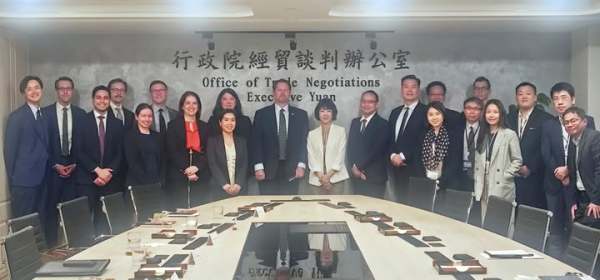
Written by Raian Hossain. Taiwan has severe military security concerns, and the island has over-trade and investment dependency towards the PRC, which raises the question of economic security. As of 2022, the PRC accounted for 25% of Taiwan’s exports and 20% of its imports, making Beijing still the largest trading partner of Taipei. However, Taiwan made significant progress in growing trade by 25% with the U.S. in 2021 and expanded its trade volume with New South Bound countries under President Tsai Ing-wen. After a year of negotiations aimed at diversifying trade and commerce, the U.S. and Taiwan signed the first part of the US-Taiwan Initiative on 21st Century Trade. Meanwhile, the second round of negotiations has already started.

Taiwan-US Trade Initiative: A good start, but the beginning of a long road

Written by Chieh-Ting Yeh. In 2005, I understood the FTA to be an aspirational long-shot—something that we can press for but not something we should expect to see in the foreseeable future. Recent developments such as the 21st Century Trade Initiative are milestones for sure, but milestones to mark just the beginning of a long road for a true free trade agreement with the US, as well as meaningful participation in regional trade blocs.

1 2 3 5