TACPS Cultural Petition to the 2024 Presidential Election: The Sustainability of Culture and Democratic Governance in Taiwan

People are the mainstay of Taiwan’s culture, and “freedom” is at the centre of people’s thoughts and creations. Since the early 2000s, Taiwan has undergone a series of citizen-led cultural reforms, including a series of citizens’ cultural movements from 2000 to 2010 (such as the advocacy for community development and multicultural policies), the establishment of the Ministry of Culture in 2012, the National Cultural Conference in 2017/2022, and the White Paper on Cultural Policy in 2018. With the promotion of the Cultural Fundamental Act in 2019, Taiwan has, on the one hand, established the prototype of the country’s “cultural governance” system and civic and cultural awareness, and on the other hand, demonstrated its uniqueness in practising sustainable cultural democracy and participatory cultural governance among the global society.

An Unconventional Networking Workshop: Self-care, Wellness and Community 

Written by Yung-Ying Chang. In 2021, amid the global pandemic and the sheer transformation of lives that followed, the North American Taiwan Studies Association’s (NATSA) annual conference launched its first-ever mental health-centred networking session, “Networking? Or Working on Your Net: Care Companions & Love Objects for Mental Health.” The unconventional session invited participants to use the time during an academic conference to work on something that was not purely academic: participants shared their life setbacks and frustrations not only in academia as scholars but also in life as the various roles they have assumed in response to various expectations.

Indigenous Taiwan through Critical Lenses: Comparative and Place-Based Perspectives 

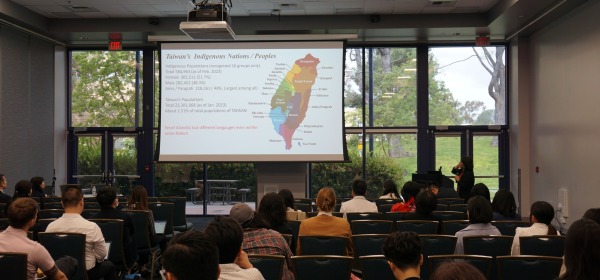
Written by Yi-Yang Cheng, Ssu-Chieh Jessica Fan and Susan Hou. Centring on Indigeneity in Taiwan, the interdisciplinary roundtable “Indigenous Taiwan through Critical Lenses: Comparative and Place-Based Perspectives” conceptualized Taiwan as a grounding point for multiple geographical perspectives. Instead of positioning Taiwan as a boundary object between the East and the West, it prompted a fresh envisioning and repositioning of Taiwan as a liminal space of unbounded and interconnected possibilities. Put differently, the roundtable discussions explored alternative ways of positioning Taiwan in/and the world, including perspectives which might have previously been marginalized or eluded consideration.

Beyond Books: Taiwanese Stories in the World

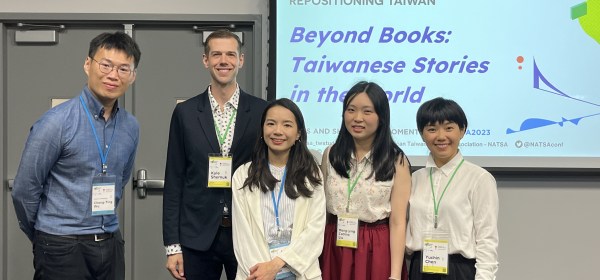
Written by Ssu-Chieh Jessica Fan and Cheng-Ting Wu. In recent years, Taiwan literature has experienced a surge in visibility and recognition within the global cultural community. To explore the border-crossing potential of Taiwanese stories, the planning team of the NATSA 2023 conference organized a special event, creating a lively platform for discussing the circulation and reception of Taiwanese fiction and non-fiction works in the international book market and academia.

Taiwanese American as an Aesthetic/Academic/Activist Concern 

Organized by I-Lin Liu. Taiwanese American is not a given status but a process of becoming. For first and second-generation Taiwanese Americans, the experience of living in a foreign land and becoming a member of an ethnic minority group often creates occasions for rethinking or reconceptualizing the meanings of being Taiwanese or Taiwanese American. This article focuses on the meaning(s) of Taiwanese American identity, community building, and the future of the Taiwanese American identity.

NATSA: Repositioning Taiwan

Written by Chee-Hann Wu. The North American Taiwan Studies Association (NATSA) is a registered nonprofit organization and the largest scholarly association dedicated to Taiwan Studies in the United States and Canada. It was founded in 1994 when Taiwan Studies became a booming field of research that attracted international attention during the 1990s, a period of rapid political, economic, social, and cultural change in Taiwan. The growing academic interest in Taiwan called for a regular and interdisciplinary academic forum. To establish such a forum, the North American Taiwan Studies Association’s constitution was drafted and ratified at the first annual conference at Yale University in June 1994.

In memory of Prof. Ian Inkster

Written by Chun-yi Lee. The deep sorrow of never receiving another book proposal from Ian is everlasting. But I know in my heart that his influence will continue: his thoughts will inspire further contributions to Taiwan-related studies. Thank you, Ian. We learned so much from you when you were with us, both in person and through email communications, and we will keep learning from your writings every time we read your publications. And yes, I always, always give you my positive vibes!

Reflections on the Twentieth Anniversary of the European Association of Taiwan Studies

Written by Dafydd Fell. It was a special moment to open the 2023 European Association of Taiwan Studies (EATS) Conference back at SOAS twenty years after we started planning the first conference. The venue for the opening in June 2023 was even the same as the first 2004 conference in the SOAS University of London’s Khalili Lecture Theatre. It was also wonderful to see many people at this year’s conference who had also been involved in the early history of the association. Reflecting back over the last twenty years, it is remarkable how European Taiwan Studies has developed, and EATS has played a critical role in this Taiwan Studies miracle.

Taiwanese Horror Games and the Ghosts from the Past

Written by Chee-Hann Wu. Taiwanese horror (taishi kongbu) is a rising genre that has claimed an important space in Taiwanese popular culture, particularly in the video game industry since the debut of Detention in 2017. These video games often incorporate elements of Taiwan’s local religions, ritual practices, and mythologies, especially the ones associated with ghosts and other supernatural beings. Although mostly implicit, many Taiwanese horror games contain hints of historical references to the 228 Incident and the White Terror under Martial Law. Malevolent monsters and ghosts become physical incarnations of state-sanctioned violence by perpetrators and accomplices and the suffering of those who were arrested, executed, or silenced. 

How Much Money Could Ghosts Make? A Case Study on the Most Ferocious Female Ghost of Taiwan – Chen Shou Niang  

Written by Yi-Ping Wu. Staying at home, not going to the beach, or climbing mountains, and not even opening an umbrella indoors are just a few taboos everyone must remember when Ghost Month 鬼月 arrives. Although the origin of the concept of Ghost Month is uncertain, the Taiwanese still emphasize the rituals that must be practised and the taboos that must be prohibited during this period. What attracts our attention most is the colossal amount of money that the Taiwanese pay for the rituals, offerings, and joss paper (paper money) to honour their ancestors because their past loved ones could return to the world of living since the gate of the underworld would open on the first day of July on the lunar calendar. The huge income that the cultural concept of Ghost Month contributes reminds us of an interesting question to think about thoroughly: How much money the “ghosts” could make?

The Month of Wild Ghosts: Phenomenon and Thoughts on Pudu in Taiwan’s Government Organizations

Written by Liang Ting-Yu. Homeless ghosts are also known as “good brothers.” In Taiwan’s civil society, they are not Youying gong​ (有應公) who are sacrificed in ghost temples, but rather a kind of wandering spirits who do not have or appear on memorial tablets, tombstones, or graves, and who are not worshipped by anyone; there are no temples or shrines to which they can return, and no place in which they can take shelter. On the half of the seventh lunar month, commonly known as the “Ghost Month,” local families, stores and companies, temples and Wanshan shrines(萬善祠) offer sacrifices to homeless ghosts in the form of ​Zhongyuan Pudu​(中元普渡)ceremonies and ​Chaodu​ devotions(超渡法會), which are rituals that free ghosts from suffering and reincarnation.

It’s Time for the Ghost Month! 

Written by Chee-Hann Wu. Beliefs in the afterlife and in spirits are universal and exist in different cultures and societies. Naturally, ritual practices, ceremonies, festivals, and customs arise, such as Halloween in Western countries and Día de Muertos in Mexico. Similarly, in Taiwan, the year’s seventh month in the lunar calendar is dedicated to ghosts and the deceased. The Gate of the Ghosts opens on the first day of Ghost Month and closes on the last day, during which the spirits enter through the gate and wander the world of the living.

1 11 12 13 14 15 40