Tell a Taiwan Story to an American: A Recap at the Creative and Collaborative Workshop

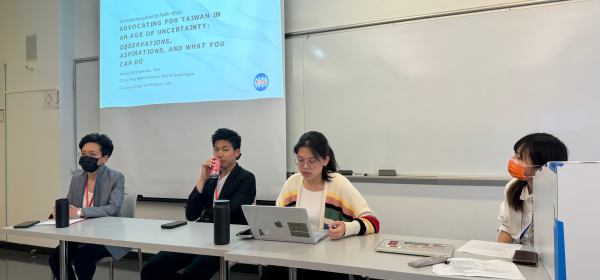
Written by Dah-Wei (David) Yih. This article describes a workshop hosted at the NATSA conference that aimed to empower participants to communicate Taiwan’s significance to American audiences. The workshop emphasised Taiwan’s multifaceted importance to the United States, ranging from economic and geopolitical ties to shared democratic values and technological cooperation. It used interactive activities and facilitated discussions to help attendees understand why Taiwan matters and how to communicate this understanding to others effectively.

Asian Migrants and Taiwanese Americans: A Dialogue on Identity, Activism, and History

Written by Panchen Lo, Pei-Chen Cheng, and Ssu-chieh Jessica Fan (University of Texas, Austin). This article details a panel discussion at the NATSA conference featuring three scholars who discussed the experiences and identities of Taiwanese Americans. The panel focused on the intersection of Cold War geopolitics, class, and the complicated process of identity formation. It critically examined how historical context, class, and racial narratives have shaped the lives and experiences of Taiwanese Americans.

Doing Taiwanese Indigenous Studies in North America: Politics of the Frontier(s)

Written by Aaron Su and Chao-Kai Huang. This article highlights the need to move beyond simply representing Indigenous voices and towards a transformative approach that centres Indigenous perspectives and experiences. It focuses on a roundtable discussion featuring three Taiwanese Indigenous scholars who share their experiences navigating Indigenous studies in both Taiwan and North America. The speakers emphasised the importance of building relationships and solidarity across disciplines and beyond institutions, advocating for a more equitable and comprehensive understanding of Indigenous peoples and histories.

(Re)Writing Taiwan Studies History​

Written by Yu-Han Huang and Li-Ting Chang. This article is about the 30th NATSA Conference’s closing forum, which discussed the historical development of Taiwan Studies as a field, particularly emphasizing its interdisciplinary nature and growing significance in global scholarship. The forum featured four experts who presented their perspectives on Taiwan studies, exploring its evolution through various disciplines such as history, anthropology, ethnomusicology, and medical history. It highlighted the increasing importance of understanding Taiwan within a global context, emphasizing the need to connect its history and experiences with broader international dialogues and discussions.

Is it the End for Taiwan and Pacific Regionalism? Controversy at the 53rd Pacific Islands Forum (PIF) Leaders Meeting in Tonga

Written by Jess Marinaccio. This article examines the 53rd Leaders Meeting of the Pacific Islands Forum, taking place from 26 to 30 August 2024. It highlights the several controversies that Taiwan was embroiled in during the Meeting, particularly in regard to Taiwan’s position as a PIF “development partner” despite objections from China.

A Time of Extinction: Dedicated to Whom? Exploring Sustainability through the Lens of Theater, Let’s Be Consciously Wasteful

Written by Charles Lee. This article raises fundamental questions about theatre sustainability. It focuses on theatre venues and infrastructure in Taiwan by critically examining productions that attempt to respond to the concerns through distinct approaches. The author also investigates the unique dynamics Taiwanese The author also explores the unique dynamics that Taiwanese audiences have with the “aesthetics of Anthropocene theatre”.

Taiwan’s Semiconductor Industry in the “Chip Wars” Era 

Written by Gunter Schubert. Taiwan’s security is largely determined by the government’s ability to promote the resilience of Taiwan’s high-tech industries, especially semiconductors, to ensure their international competitiveness and crisis resilience. Based on this fact, this article raises two subsequent questions: what strategies are the Taiwanese semiconductor industry pursuing to secure its technological edge and markets in the new global power constellation? And what is the Taiwanese government doing to strengthen the country’s economic security, which arguably depends essentially on maintaining Taiwan’s leading position in the global high-tech industry over the long term? 

The New AI (Artificial Indigeneity): The Rise of Speculative Indigenous Fiction in Taiwan

Written by Ti-han Chang. This article explores a literary landscape where unique Austronesian cultural references blend with fantastical narratives of speculative realism which has given rise to a groundbreaking subgenre in eco-literature, Speculative Indigenous Fiction, in Taiwan. The author calls the new wave of fictional writing the new AI—‘Artificial Indigeneity’.

Taiwan and Artificial Intelligence

Written by Hon-min Yau. This article examines Taiwan’s recent development and regulation of artificial intelligence (AI). Sensing the incoming grand trend of AI development, Taiwan’s “Year 0” for AI came in 2017. At the time, AI-enabled devices such as smart speakers or smart TVs have been the focus of the consumer market, but other emerging AI-enabled services in fields such as object recognition, medical diagnosis, customer service, and vehicle self-driving were seen by Taiwan as new economic opportunities for Taiwan’s development.

1 5 6 7 8 9 39