
Written by Jonathan Sullivan.
Image credit: 柯文哲/ Facebook.
Although the main parties have nominated their Presidential candidates, the composition of the field remains fluid and unsettled. On the DPP side, current VP Lai Ching-te long ago locked down the nomination unopposed, and as a continuity candidate enjoying the benefits of incumbency, his campaigning thus far has been relatively smooth. However, Lai’s responsibility for answering any gripes with government policy over the last eight years and the stubborn ceiling to his poll numbers over the last few months suggest substantial challenges to come. But for now, the main uncertainties and drama are on the opposing side of the fence.
Many possible permutations remain with all the attendant backstage machinations and frenzied media speculation. Such is the uncertain state of the race that, with varying probabilities, Lai Ching-te could end up facing any of the following scenarios: A two-horse race with a consolidated opposition ticket of Hou You-yi/Ko Wen-je; A three-horse race against Hou You-yi and Ko Wen-je/Guo Tai-ming (or Guo/Ko); a three-horse race against Hou You-yi/Guo Tai-ming and Ko; a four-horse race against Hou You-yi, Ko Wen-je and Guo Tai-ming running as independent. There is even a [slight] possibility that Lai will face a different KMT candidate than Hou You-yi, should Hou’s poll numbers plummet through the summer. The biggest danger to Lai is a consolidated opposition that harnesses the KMT’s organisational advantages, Ko’s appeal to youth, and Guo’s appeal to the economy and to deep blues. In that scenario, it is possible that Hou could become President, but we are very far from that as it stands on June 7th.
The first uncertainty relates to the intentions of Honhai [Foxconn] founder Guo Tai-ming, who lost the KMT nomination to Hou You-yi. The KMT’s seemingly predestined and yet ham-fisted nomination of Hou You-yi left the party with a scorned billionaire problem that it seems unable to address or control. Guo threw his hat in the ring late in the day for a second try-out for the KMT presidential nomination, four years after losing out to Han Kuo-yu. This time around, Guo was afforded a short audition to make his case for the nomination through charming KMT politicians and demonstrating the strength of his appeal in the polls. This would supposedly be factored into the decision-making of the KMT Central Committee led by Chair Chu Li-lun. Guo’s business acumen, his help procuring vaccines for Taiwan during a perilous moment in the Covid pandemic, and his pledge to restore stability in relations with China, where he has significant experience and investments, generated a fair amount of buzz, especially among deep blue voters. Not a formal member of the KMT, Guo demonstrated his sincerity and seriousness by embarking on an outreach tour to local politicians, officials and power-brokers in the South. His poll numbers rose to within a few points of Hou and were on an upward trajectory when Chu pulled the rug from under Guo’s feet by announcing Hou as the KMT’s nominee for President.
Guo was reportedly taken unawares, believing right to the end that he was favoured to secure the nomination. Led up the garden path by Chu, the billionaire entrepreneur was shown up as a political naïf, becoming a figure of fun and leaving his supporters furiously venting online. Adding insult to injury, Chu [or more likely, KMT Secretary General Huang Chien-ting] pointed to Guo’s outreach to the ‘demons and monsters’ (牛鬼蛇神) of southern Taiwanese local politics as the reason his poll numbers failed to catch Hou. This extraordinary language – recalling Cultural Revolution era Mao– reveals a lot about the KMT elites’ prejudices and a cavalier attitude to local faction leaders’ contribution to electoral mobilisation (both in terms of vote broking and zaoshi 造勢activities). Given that Guo believed himself to be acting on Chu’s advice to reach out to these actors, this statement put a lot of noses out of joint.
After Hou was announced, Guo played a straight bat and departed on a short overseas trip, leaving Taiwan’s media to excitedly speculate about what it would mean for the contest. Would the scorned Guo pack up his toys and go home, never to enter the brutal world of politics again? Would he swallow his pride and campaign wholeheartedly for Hou, either from the side-lines or as part of the ticket? Or would he seek to avenge his humiliation by running as an independent or joining forces with Ko Wen-je? All options are on the table for Guo due to his significant appeal to deep blue voters and others who think a seasoned CEO with substantial experience dealing with China could manage the economy and cross-Strait relations. Guo’s appearance this week at a religious event in Kinmen [attended by Lai and Ko but not Hou, who was busy at his day job in Xinbei] generated an astonishing outpouring of passionate support for him. Kinmen is a uniquely deep blue constituency, but if such scenes are replicated elsewhere during Guo’s thank you tour (感恩之路), it will strengthen his hand for his next move.
Guo wants to be President, but the only realistic path to that went through the KMT nomination. Guo’s appeal is powerful within a limited segment of the electorate, but he could not win as an independent [even if he made the September deadline for collecting the requisite number of signatures to register as a candidate]. As a result, Guo lost his chance to be President when Chu Li-lun announced Hou. However, significant political prizes, including even the President of the Legislative Yuan, are still within Guo’s grasp, reachable via the KMT’s party list vote. A tech billionaire with a bruised ego is an unpredictable thing, but with sufficient bridge-building from Chu and KMT elders, of which there has been surprisingly little sign thus far, Guo will likely make good on his previous pledge to support Hou if he won the nomination.
Some KMT voters would like to see Guo join the Hou ticket, as the candidate for VP [or even at the top of the ticket, which is improbable]. Guo’s deep blue bona fides would help mollify KMT voters who have not forgiven Hou’s lack of support for their favourite, Han Kuo-yu, in 2020. In a hypothetical Hou-Guo ticket, Guo would lend credibility in high-level economics to the city mayor, who appears out of his depth on the issue. The KMT would like to attack Lai on the outgoing administration’s economic record, but Hou is not renowned for his grasp of complex economic policy. A possible VP candidate for Hou, Kuan Chong-ming, a Minister under Ma and President of National Taiwan University, where he holds a Chair in Finance, has already ruled himself out of contention. Moreover, the idea of a Hou-Guo pairing neglects the other big factor in the race: Ko Wen-je, former Taipei City Mayor and founder-leader of the Taiwan People’s Party.
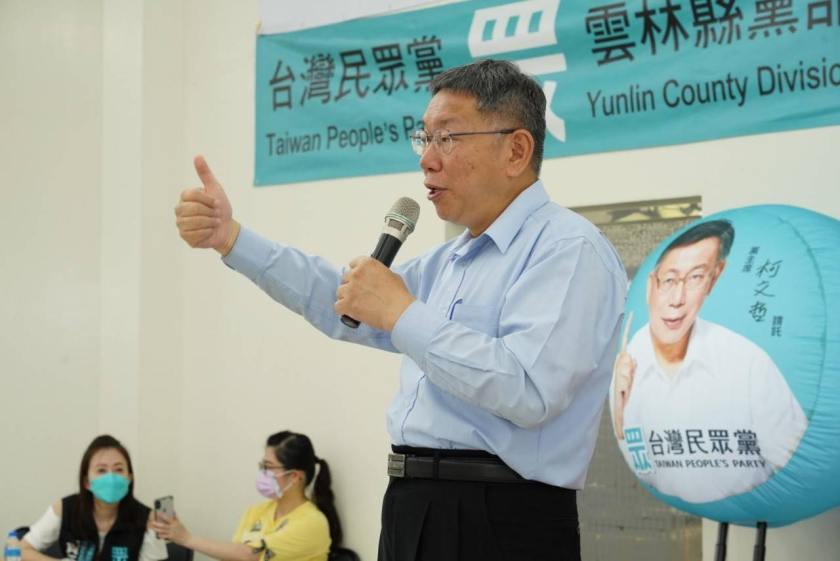
Ko is a Marmite figure prone to vacillating policy positions and verbal faux pas. He is also unique in appealing to partisans on either side of the political spectrum and for his savant-like connection with young people. His ‘insurgent’ campaign nine years ago for Taipei mayor, as a then-independent with zero political experience, harnessed digital media and a grassroots community effort. Progressive policies, a radically transparent campaign, and a penchant for unfiltered communication generated huge excitement among young supporters. As a known quantity, Ko does not have quite the same buzz, but he has consistently polled at 20% for many months and is a serious player in the election. Ko has already directed overtures towards Guo, and a Ko-Guo ticket has the potential to seriously erode support for Hou. Though they lack the KMT’s organisational advantages for mobilising the vote – neither have Legislators in their camp – Ko and Guo both have personalities that can excite greater passions than Hou [and indeed Lai]. Ko’s party benefits from a lot of young talent, and Guo does not lack private funds. This hypothetical pairing would outflank Hou from the blue side of the spectrum, but whether they would actually run to the end or join forces with Hou from a position of power to negotiate positions in a hypothetical KMT government is the question. Ko and Guo likely discussed ‘cooperation’ during a sideling meeting in Kinmen, but there are many forms that ‘cooperation’ might take.
Ultimately, a three-horse race reduces the chance of an opposition victory, so we must consider the likelihood of Hou and Ko joining forces later in the campaign. There are obstacles to such a union, but all parties know that a consolidated opposition ticket has a greater chance of defeating Lai. An uninspired Hou cannot win without Ko, whose consistent poll numbers among young people have bought him an entry ticket to the race. But the divisive Ko cannot win on his own, among other things held back by the endorsement of pro-China rhetoric like ‘one family on either side of the Strait’ (兩岸一家親). Neither can Ko win with Guo, the latter a political neophyte and endorser of the unpopular “1992 Consensus”. Rational and pragmatic thinking dictates a consolidation of Hou and Ko, with a significant role for Guo. With Guo’s deep blue appeal and credibility on economic issues, Ko’s substantial advantages with young voters [assuming they would survive his cooperation with the KMT] and the KMT’s extensive institutional advantages would represent the biggest threat to a third term for the DPP. The current manoeuvring and strategic dynamics will determine how much the KMT must offer to reach the point of consolidation. Notwithstanding his third place in the polls and murmurs about being switched out as KMT nominee, the beleaguered Hou thus still has a realistic chance of becoming ROC President.
Jonathan Sullivan is Assoc Prof in Politics & IR at the University of Nottingham. His book (with Lev Nachman) Taiwan: Contested democracy under threat (London: Agenda) comes out in November 2023.
This article was published as part of a special issue on Will Lai or Hou (or Ko) V.S. Xi?.
 Taiwan Insight