
Written by Jonathan Sullivan.
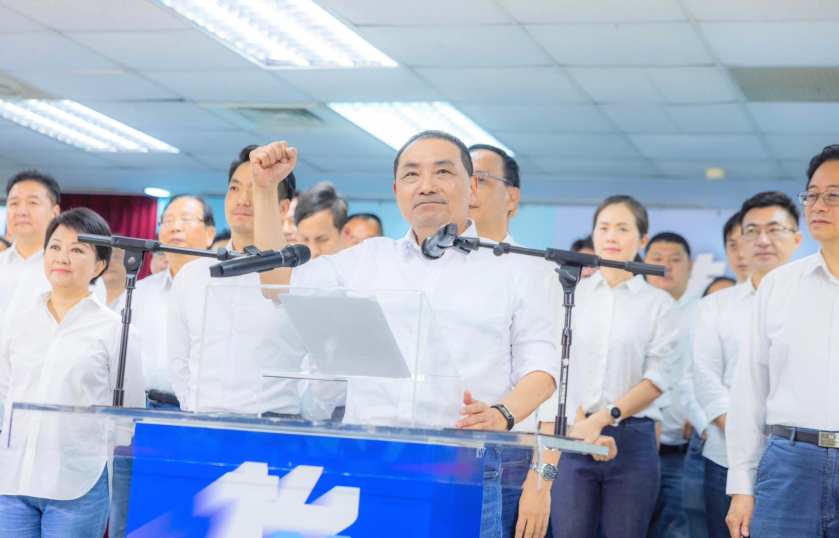
Image credit: 侯友宜/ Facebook.
The KMT’s stellar showing in local elections last November had many in the party dreaming of a return to power in the January 2024 national elections. As has happened in every previous election following a two-term president in Taiwan, a change of party in power (政黨輪替) looked a likely outcome as the DPP haemorrhaged city mayorships and town council seats. In hypothetical polling match-ups at the time, re-elected Xinbei Mayor Hou You-yi handily beat VP Lai Ching-te. Those two and former Taipei Mayor Ko Wen-je have now been formally nominated by their parties to compete for the ROC presidency.
Although the DPP lost big to the KMT in local elections, those results have not mapped seamlessly onto national polling as attention turns to 2024. Into her eighth and final year as President, Tsai Ing-wen’s approval numbers are mixed but remain relatively high by historical comparison. Lai’s candidacy must face up to economic headwinds and a raft of cost-of-living issues, including housing, youth employment and mobility, but the DPP government that he is part of does not give the feeling of being exhausted and broken like the Chen Shui-bian or Ma Ying-jeou administrations did at the same point in their cycles.
Nevertheless, the DPP has an eight-year record to defend – a period during which Taiwan has faced (and weathered) unprecedented pressures and threats – and the KMT’s optimism seven months ago was not inherently misplaced. Despite Tsai’s numerous successes, her policies are not unanimously popular, and the most appropriate approach to handling relations with China is subject to greater debate within Taiwan than is generally appreciated outside. Tsai’s robust approach (decried by her critics as ‘opposing China to protect Taiwan’ 抗中保台) has its adherents in Taiwan – and more in the US – yet the KMT’s (and Ko’s) call for a return to greater accommodation and less antagonism in cross-Strait relations also has its appeal. Given the PRC’s tangible escalation of military threats to Taiwan’s security, this is a legitimate debate for Taiwanese parties and voters to have.
Unfortunately for the KMT, early optimism has taken a substantial hit with the presidential campaign barely past its preliminary stage, the parties’ nomination of candidates. Far from receiving a nomination bounce in the polls, Hou You-yi has dropped behind Ko Wen-je into third place in some polls. At this point, polls are highly volatile and difficult to interpret, but they are clear that Hou is not doing well. Long seen as the presumptive KMT candidate, Hou handily secured re-election last year as Mayor of Taiwan’s biggest special municipality by population. A former top cop with a record of governance in the metropolitan north, Hou’s relative moderation (for a KMT candidate) and his bensheng heritage were figured to have cross-cutting appeal. Right now, with well-defined candidates on either side, it looks more like an inability to appeal to either green or blue (不藍不綠). Hou’s campaign faces multiple vulnerabilities.
Juggling two full-time jobs
Hou is the third laopao (落跑) mayor in a row to represent the KMT in a presidential election after Chu Li-lun and Han Kuo-yu ran out of their elected local offices to campaign for the top job. Both Chu and Han faced criticism for abandoning the post for which they were elected and lost their presidential tilts by substantial margins. For Hou, juggling the day-to-day needs of running Taiwan’s biggest metro and campaigning for president – both 24-hour-a-day jobs – raises questions about the division of labour and funds. As a presidential candidate, one can never be just a mayor, so can he really deliver for the people who voted for him to do a job for them while campaigning for a different job? Are Xinbei taxpayer-funded staff doing a job for the mayor’s office or helping his campaign as the KMT’s presidential nominee? This week, an example of these tensions surfaced when Hou came out in favour of nuclear power. There are incentives for this position on the national level, but this is a highly sensitive issue for constituents in Xinbei, where three of four nuclear power plants are located. This far out from the election Hou cannot yet take a leave of absence in good faith, but waiting until a more political 3 or 4 months out from election day will cede space to his competitors.
Lack of political vision and issues
Hou is a reticent political communicator. A reputation for caution and reserve may serve well in the Police and City Hall, but a presidential candidate needs to provide a vision for the nation’s future direction and inspire people to buy into it. Hou has made ‘change the party in power’ (政黨輪替) his rallying call without providing a compelling (or any) case for voters to heed it. Hou’s political vision is presently, to put it euphemistically, under-developed. For sure, there are no prizes and great risks involved with showing one’s hand (表態) at this early stage. But Hou’s inarticulateness and a shaky grasp of policy detail concerning the economy, national security, foreign affairs and cross-Strait relations could become a liability.
Furthermore, Hou can no longer hide behind his status as mayor. A city official can, as Hou has, shrug off questions about the PRC’s military threats or the intricacies of foreign and economic policy. A presidential candidate does not have that liberty. As it is, Hou already faces an uphill task to address the KMT’s progressive drift from the median voter position on national identity and estrangement from Taiwan’s youth vote. The issue that Hou hopes to own is law and order, where the KMT has attacked the DPP government on the proliferation of scams, fraud and cybercrime and continuing connections between politics and crime (黑金). Unfortunately for Hou, there has been a recent uptick in gun violence in Xinbei, undermining both his claim to good governance and his ownership of law and order. One thing in Hou’s favour is his staunch favour of the death penalty. This position enjoys overwhelming public support (albeit at odds with increasingly progressive attitudes in other areas of Taiwanese society).
Hou’s personality does not excite anyone – let alone young people
In an election where many major issues are likely to be fought in the centre, the candidates’ personalities will increase in importance. This does not play to Hou’s strengths. He has none of the quixotic appeal of Han Kuo-yu, the entertaining idiosyncrasies of Ko or the popular resonance of Guo. Lai does not excel on many personality metrics either, but he at least has more of a presidential bearing. Personality is not the be-all-and-all; Tsai Ing-wen won handily twice, despite eschewing barnstorming speeches or emotional appeals in favour of rational policy discussion, often delivered deadpan in painstaking detail. However, in an election where more voters than ever are expected to eschew party identification to ‘shop around’, image and communication are elevated. Hou’s appeal to young voters, a decisive cohort, is unpromising. Asked to describe Hou You-yi shortly after the nomination, young respondents said he resembled a ‘man on the street’ (路人), a regular Joe lacking presence (存在感) and charisma (魅力). Neither did these young people know much about Hou’s claim to fame as a cop, the capture of fugitive criminal Chen Jin-shing, one of the most dramatic domestic events of the early 2000s. Given Hou’s starting position, one would expect him to seize every opportunity to connect with young voters, which makes his team’s decision not to attend the ‘meet the candidates’ event at National Taiwan University last weekend a headscratcher; until you remember that the politics students there are the sharpest in Taiwan and Hou’s policy positions and ability to articulate a vision are acutely under-developed.
KMT and blue voters are unconvinced
While Hou’s poor poll numbers may reflect disgruntled Guo Tai-ming supporters, and KMT voters will rally round later in the campaign, the fact remains that Hou has failed to inspire. There are several reasons for this. One is that he is not Guo Tai-ming, whose outsider status allowed him to make big claims and promises that resonated with deep blue voters. As a presumptive candidate, Hou has been more cautious, consistently avoiding any mention of the “1992 consensus,” a position associated with Ma Ying-jeou that is popular among the deepest blue voters but no one else. The broad-based appeal that Hou promised would likely fail to survive an early endorsement of the 1992 Consensus, and his avoidance of it is explicable. But it has become a source of suspicion among KMT blues, for whom Hou’s bensheng heritage already reminds them of former KMT President Lee Teng-hui. Compared to a polished figure like Ma, Hou is coarse and uncultivated and, revealing all kinds of prejudice, ‘local’ (本土). For a strand of the KMT, Hou possesses neither the lineage (Hou is not a princeling or scion) nor the bearing of a KMT presidential candidate. One of Hou’s first tasks has been to secure the support of party grandees, who have not rushed to demonstrate their support. Neither is Hou familiar or well-connected with the ‘local wing’ of the KMT, which was demonstrated in his visit last week to Kaohsiung to meet with Wang Jin-pyng. It doesn’t help Hou with some KMT voters that as head of the Criminal Investigation Bureau, he handled the investigation into the shooting of Chen Shui-bian on the stump on election eve in 2004, something some people believe was a ruse to help Chen win re-election.
The race is passing him by
Taiwanese polls come thick and fast and are of questionable reliability and utility, especially at this early stage. However, the polls feed into Taiwan’s incessant media coverage of the election and can establish frames and narratives that can become self-fuelling and hard to shake. Right now, the story is that Hou is falling like a stone in the polls. Not only is he trailing Lai by a significant margin, but he has even fallen behind Ko in some polls. In a more placid campaign environment, Hou would take time to establish his policy platform, mobilise his surrogates and campaign staff and roll out his campaign in his own time. Taiwanese elections do not provide such luxury. Instead, there is constant speculation about Guo Tai-ming entering the race, the possible permutations involving Hou, Ko and Guo, and even the possibility of a KMT switcheroo as happened in 2016. Hou is not a disastrous candidate like Hong Xiu-chu, and he can get his campaign rolling, but the narrative of his flailing and floundering has already been established. Such narratives can then be reflected in subsequent polls, which concretise negative momentum, making supporters and legislative candidates nervous. Hence, if Hou cannot quickly turn it around, his position will become increasingly difficult. In turn, this will affect Hou’s position when it comes to negotiating possible cooperation with other candidates, whether Ko or Guo. It can also affect the choices of voters. Indeed, If they determine that Hou cannot defeat Lai, they will defect from Hou to Ko.
What to do?
Hou You-yi did not become a bad candidate overnight. As much as Chu Li-lun might be tempted to make a change or instal himself, Hou is the KMT’s best candidate. That in itself says something about the electoral talent available to the party, but Hou has his political achievements (政績) and the possibility of replicating his performance in Xinbei elections. But national elections are very different to a special municipality, and for the first time, Hou is in a race in which he is behind. It is, therefore, imperative to act quickly. Clearly, campaigning for president is incompatible with running a major metro. It has not worked before, and Hou will lose if he does not run full-time. Giving up the ‘insurance’ of Xinbei Mayor would demonstrate his confidence in his presidential candidacy, even if it loses him votes from disaffected Xinbei citizens. Hou is, fairly or not, acquiring a reputation for passivity and ducking events. That is partly because he has a day job that prevents full commitment to the campaign trail. Hou cannot allow the other candidates to dominate the campaign while he attends to city business. But if he is to increase his activity, he needs to quickly establish what his political vision actually is and to get a better handle on all areas of national policy. He must make a positive case for ‘changing the party in power’: what would Taiwan under Hou look like, and how would it differ from the DPP? Critics may say that KMT policies are unpopular, so he is better off staying quiet, but it is up to Hou to demonstrate what people are voting for if they choose him. He needs to deliver on his call for party unity (團結) – grandees, KMT legislative candidates, local politicians derided as ‘demons and monsters’ (牛鬼蛇神) and Guo Tai-ming. These efforts are necessary if Hou is going to achieve a key strategic goal: to establish a decisive and consistent advantage over Ko Wen-je in the polls, since parity or relegation to a third wheel (小三) significantly reduces Hou’s chances and the KMT’s strategic options. And then the real contest against Lai begins.
Jonathan Sullivan is Assoc Prof in Politics & IR at the University of Nottingham. His book (with Lev Nachman) Taiwan: Contested democracy under threat (London: Agenda) comes out in November 2023.
This article was published as part of a special issue on Will Lai or Hou (or Ko) V.S. Xi?.
 Taiwan Insight