
Written by Charlie Smith.
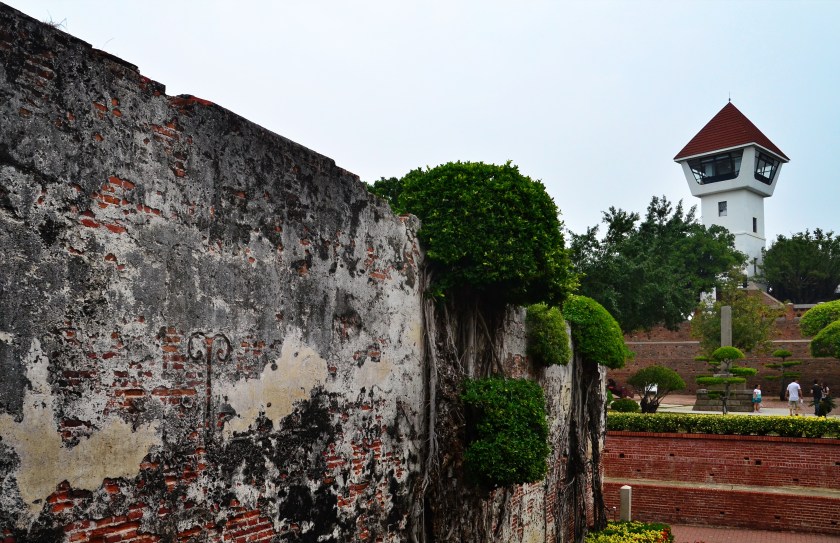
Image credit: Fort Zeelandia, Anping District, Tainan City (Taiwan) by Malcolm Koo/ Wikimedia, license: CC BY-SA 4.0.
From 2016 to 2020, a Vancouver father and daughter chronicled an amazing family tale of survival. Irwin Oostindie, a director of the Dutch Cultural Association of B.C., and his daughter, Inessa, created an experimental documentary about Oostindie’s father, Dirk. In 1945, Dirk travelled 200 kilometres from Amsterdam in the midst of a horrific famine. Thousands starved because Nazi occupiers prevented food from reaching the western part of the country. The Nazis did this to retaliate against an exiled Dutch government supporting the Allies. On his 17th birthday and suffering from diphtheria, Dirk was saved by Canadian soldiers who had come to liberate the Netherlands. Oostindie, Dirk’s son, describes it as a heroic story. And it reinforces the view of Canadians as the good guys in the Second World War.
But Oostindie emphasizes that it is an incomplete history: “We honour these Canadian soldiers liberating the Netherlands, but we don’t tell the story that 3,000 of the Canadian soldiers liberating Western Europe came back to Canada as second-class citizens because they were Indigenous. Nor do we tell the story that when the Netherlands was liberated, the Netherlands killed tens of thousands of Indonesians fighting for their liberation.”
The Dutch Cultural Association of B.C. is trying to tell a more nuanced and complete story of the Netherlands, including the experiences of those who lived under Dutch colonial rule. Moreover, the association’s goal is to provide a richer understanding of how Dutch descendants should act as visitors on the unceded lands of Indigenous nations in Canada’s westernmost province. Oostindie believes that this has set his organization up well for a collaboration with this year’s TAIWANfest in Vancouver and Toronto. In this partnership, the Dutch Cultural Association of B.C. will present authors, lectures, film screenings, and DJ performances. As well, there will be a joint Dutch-Taiwanese street fair at TAIWANfest in downtown Vancouver. All of this comes before the 400th anniversary of the Dutch colonization of Taiwan, which lasted from 1624 to 1662. Oostinde discusses how Taiwan, the Netherlands and Canada can “have heartfelt discussions that bring these hidden histories forward. And we can learn about what it means for contemporary politics, how we work together, and how we consider democracies.”
In fact, TAIWANfest, a festival that originally focused on celebrating Taiwanese culture, has gone beyond the borders for transnational collaborations and has been hosting dialogues with other parts of Asia for several years. It kicked things off in 2016 with Hong Kong, showcasing cultural connections and other similarities between Taiwan and the southern Chinese commercial centre. It came two years after Hong Kong and Taiwan students had each led struggles for freedom and political change—the Umbrella Movement in Hong Kong and the Sunflower Movement in Taiwan. In 2017, TAIWANfest explored the historic connections between Japan and Taiwan. As part of this festival, speakers focused on the impact of 50 years of Japanese occupation on the Taiwanese national identity. In subsequent years, TAIWANfest conducted dialogues with the Philippines, Vietnam, South Korea, Indonesia and Malaysia, highlighting cultural, economic, and historic ties to Taiwan.
This year will mark the first time that TAIWANfest will hold a dialogue with a European country. Festival organizer Charlie Wu, managing director of the Asian-Canadian Special Events Association, points out that the government of the Netherlands is preparing to issue a formal apology for slavery. He thinks that Asian countries can learn from the Dutch willingness to acknowledge historical wrongs.
Moreover, Wu says that newcomers from Asia need to understand that when they move to Canada, there is already a process of reconciliation underway with Indigenous peoples. Wu explains, “If you ask a lot of people who came—the first generation—about decolonization and you ask them about reconciliation, they have nothing to tell you. It’s important we have people from the Dutch Cultural Association [of B.C.], like Irwin, to share their perspective.” He further notes that a greater understanding of reconciliation and decolonization can open up pathways for discussion between first-generation immigrants and their Canadian-born kids. And having someone like Oostindie involved in TAIWANfest can expose Asian newcomers to a person who recognizes how being white might have advantaged his family’s settlement in Canada.
Irwin Oostindie, in addition to being the director of the Dutch Cultural Association of B.C., is also the research lead, strategy, and business lead of Voor Urban Labs, which engages in complex urban planning, particularly for urban Indigenous communities across Canada. It pursues the Dutch polder model, a consensus-based policymaking model in which everyone is given a voice. The Dutch learned centuries ago that they had to work together to protect the dike system so the North Sea didn’t flood their country. Oostindie points out that this gave birth to the polder system, which parallels the non-hierarchical Indigenous governance systems in Canada. By gathering people together, the community can participate in the co-design and building of creative solutions to complex social challenges.
They will be participating in a lecture at TAIWANfest, where issues of urbanization of Indigenous people and the erasure of their experience will be discussed. Furthermore, he says that in both Taiwan and Canada, there has been an emergence of services for urban Indigenous people and greater recognition of Indigenous language rights. But he also sees huge policy gaps concerning urban Indigenous peoples. Oostindie believes that the Dutch polder model can also bring insights to Taiwan and potentially help bridge the gaps.
In addition to history and policymaking, there will also be uplifting stories and other comparative discussions between Taiwan, the Netherlands and Canada. For example, “Culturally, there are interesting parallels between Coast Salish canoe carvers [on Canada’s West Coast] and Indigenous Taiwanese canoe carvers. That’s a story people will access at TAIWANfest and make linkages between Indigenous people from Vancouver and Indigenous people from Taiwan,” says Oostindie.
Oostindie’s first language is Dutch, which enables him to delve further into his family background and reflect on his identity in conversation with the world history of colonialism. That includes its connection to Taiwan as well as Canada. His Dutch grandparents were activists, handing out underground newspapers in the Netherlands. His father devoted tremendous attention to developing the park system in B.C. “When you’re raised in unceded Coast Salish lands, and you have an understanding of history, then you ask questions about what happened here,” Oostindie says. “And that quickly opens the door to understanding genocide. You need to have settler denial to have genocide. Genocide requires settler denial. So once you break the bubble of settler denial in your life, then you understand and empathize with the victims of genocide.”
Lastly, Oostindie’s surname was the “O” in VOC, which was the abbreviation for the Dutch East India Company. It was the first joint-stock company in the world, established in 1602 with a monopoly on trade with Asia. VOC administered Taiwan on the king’s behalf when it was a Dutch colony.
“When you have a kind of historical name, you think about histories,” Oostindie says.
Charlie Smith is the editor of Pancouver. He has more than three decades of experience in the Vancouver media. Charlie spent 13 years in radio and television with the Canadian Broadcasting Corporation and 17 years as editor of the Georgia Straight. He has won a community builder award from the Vancouver Asian Heritage Month Society and TAIWANfest, anti-racism awards from Radical Desi and Spice Radio, and a “Friend of Taiwan” medallion from the Government of Taiwan, in addition to two Western Canada Magazine Awards for business writing. Charlie taught journalism at Kwantlen University College (now Kwantlen Polytechnic University) for seven years.
This special issue on Taiwanese Canadians and TAIWANfest’s dialogue with the Netherlands was created in partnership with Pancouver, an online arts and culture media by The Society of We Are Canadians Too, with a slight revision to enhance readability in the Taiwan Insight.
 Taiwan Insight