
Written by Charlie Smith.
Image Credit: Asian-Canadian Special Events Association and Taiwan Canada Society.
The King’s Field is a famous Japanese video game series created in the 1990s. But nearly 400 years ago, there was another King’s Field—the entire island nation of Taiwan. For 38 years in the 17th century, Taiwan was a colony of the Dutch Republic under the administration of the Dutch East India Company. And the Dutch king was the largest shareholder.
“The Han people pioneers cleared the land, but the land they cleared was stolen from them, and they were forced to turn their labors toward tilling the so-called ‘king’s fields’,” wrote historian Su Beng in Taiwan’s 400 Year History. “Moreover, most of what they achieved was given over, in the form of rent or taxes, called ‘king’s field rent contributions,’ for the use and enjoyment of the Dutch.”
Nowadays, there’s little evidence of the Dutch colonization of Taiwan. Joshua Wang (王家軒), content director of the Asian-Canadian Special Events Association, says that the most visible remnant is Fort Zeelandia, which the Dutch established in the southern city of Tainan in 1624. Yet, it is certainly not the only thing left by the Dutch. Wang explains that many things we see or use daily have Dutch influence: “There’s a kind of cabbage—it’s a vegetable we eat everyday—and its name comes from the Dutch language, according to one historian’s study. But not many people are aware of that.” In addition, there are also contemporary connections between the two countries. That includes a significant number of Taiwanese students who obtained graduate degrees in the Netherlands. Some of them are participating in a series of lectures that Wang curated from May 20 to June 10 in Taipei.
What Can Taiwan Learn from the Netherlands?
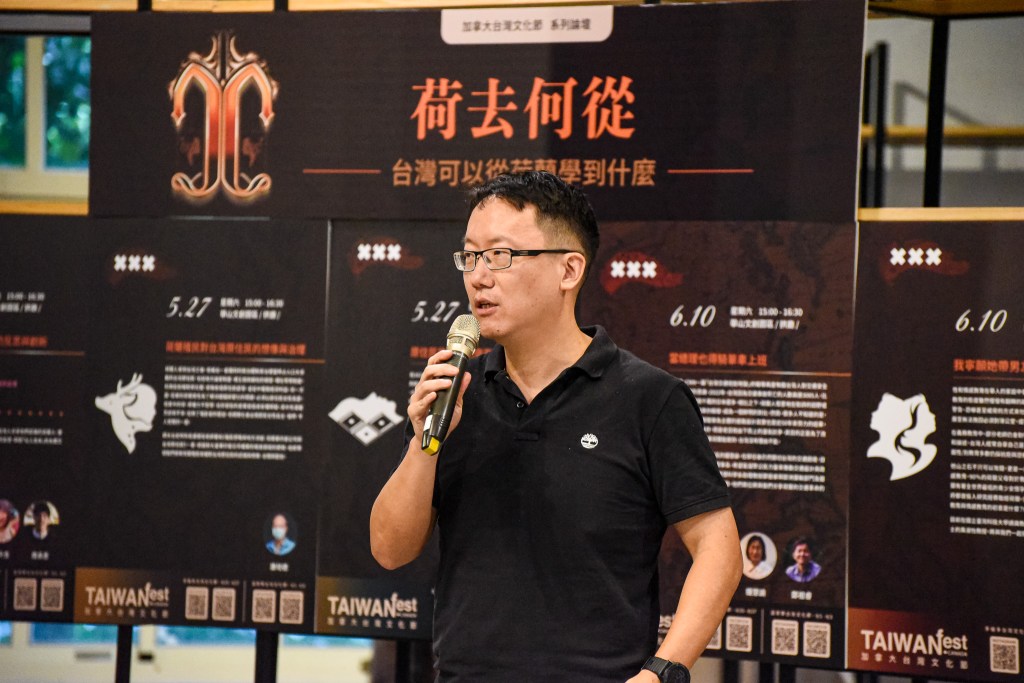
The Taiwan Canada Society created the forum entitled “The Lesson of Dutch Formosa: What Can Taiwan Learn from the Netherlands?”. The forum also features comparative discussions on the impacts of colonialism and the takes on decolonization in Taiwan and Canada.
“The Dutch did actually control Taiwan, but not in a really dominant way,” Wang says. “Sometimes, they were defeated by the Aboriginal people. And sometimes, the Aboriginal people pretended they were obeying the Dutch, but they were not.”
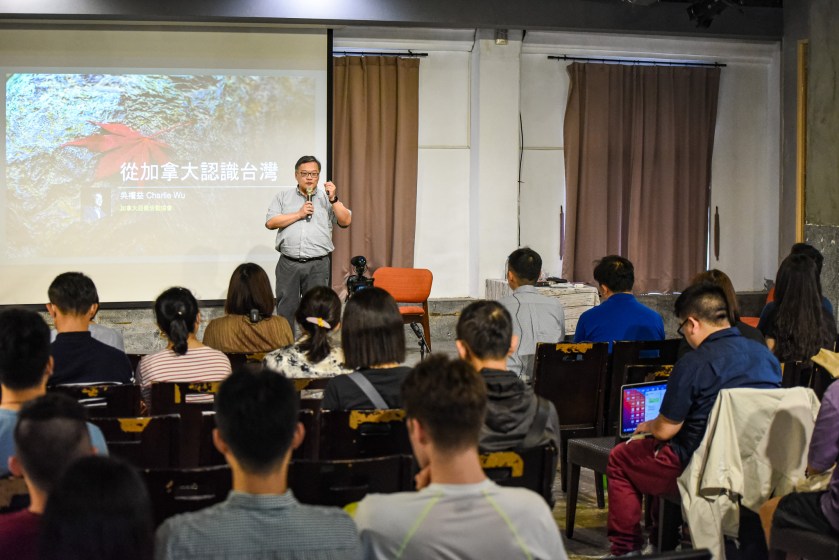
On May 20, the forum opened with a speech by Charlie Wu (吳權益), who heads the Asian-Canadian Special Events Association. He believes that few Taiwanese people actually understand the impact of Dutch colonization on their country. Wu expressed that “a lot of things have been talked about, but on a very superficial level,” and it was the goal of these talks to take the discussions deeper and make them more interesting. In his speech, Wu discussed his association’s curation of annual TAIWANfest events in Toronto and Vancouver, which promote understanding of different countries. Later this year, TAIWANfest will host a dialogue with the Netherlands. The content from the lecture series in Taipei will likely be included in the festival, and discussions be expanded.
Following Wu’s presentation, four former Taiwanese graduate students in the Netherlands: Liang-Yu Chen (陳亮宇), David Chou (周承彥), Dominique Wong (王曉朗), and Senhan Wang (王升含) were introduced. As the moderator of this event, Wang said that he appreciates the Dutch people’s way of holding in-depth discussions on public issues. On May 20, the four Taiwanese former graduate students talked about the Dutch polder model of consensus-based political decision-making, the bicycle revolution in the Netherlands, the past history of colonization, and the Dutch government’s public apology over slavery, and how these experiences could potentially apply to the case of Taiwan and Canada.
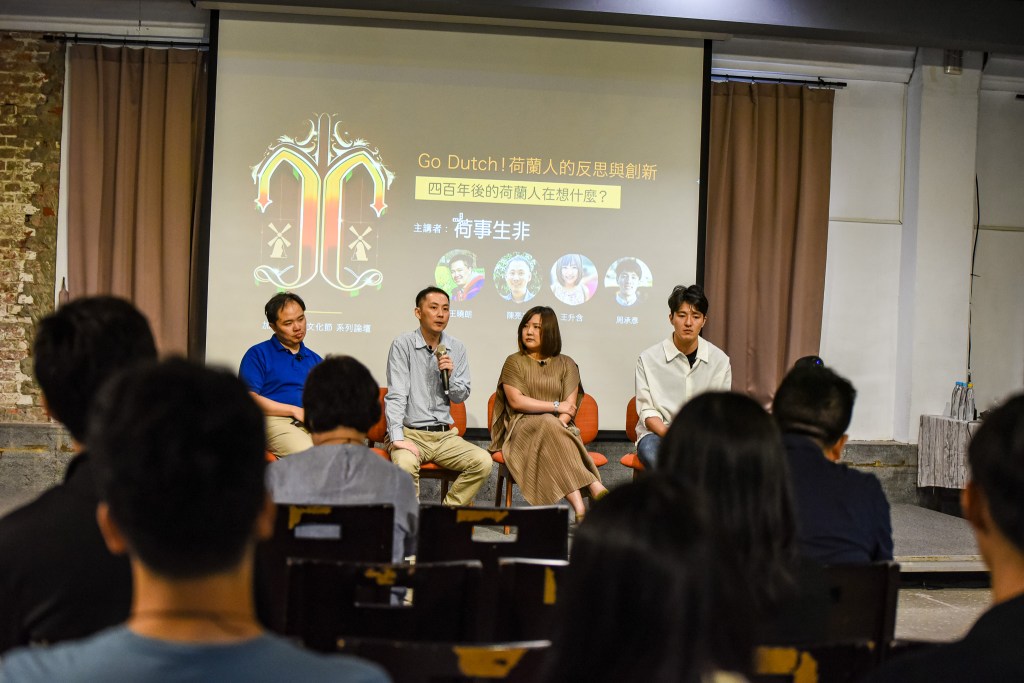
Meanwhile, some may feel that the Dutch approach of talking through problems is inefficient, especially in the case of consensus-based policymaking, but Wang pointed out in a conversation with the four speakers that people in the Netherlands can have complete and comprehensive discussions. And this has led to some surprisingly innovative public policies in connection with the climate crisis, gender and sex education in schools, and transportation, among other areas.
The series’ second-week event featured Peter Kang (康培德), professor and director of the Graduate Institute of Taiwan History at the National Taiwan Normal University. Kang is a leading expert on the relationship between the Dutch colonial regime and Taiwan’s Indigenous peoples. One of the Dutch East India Company’s challenges in Taiwan was a shortage of Dutch women to marry Dutch soldiers and sailors. According to Wang and Kang, the Dutch government believed that if these settlers married, they would be more likely to remain, enabling the company to thrive. “So, in the end, they needed to persuade Aboriginal women to marry those Dutch settlers,” Wang says. Much of this has come to light due to diligent research into historical records housed in the Netherlands. As the documents are translated into the Chinese language now, a lot of scholars—not only from Taiwan but from Japan and China, are now able to access this part of history.
Following the discussion on Indigenous people in Taiwan during the Dutch colonization, Wang moderated a second presentation by Jolan Hsieh (謝若蘭), who is a professor at the Department of Ethnic Relations and Cultures at National Dong Hwa University in Taiwan. Hsieh, a Siraya activist and scholar, discussed how past colonial regimes have harmed Indigenous peoples. She further explained what can be done to remedy past injustices.
In addition to comparative discussions of the history and cultural exchanges between the three countries, the lecture series broadened the subject matter to include discussions of education and transportation design from a Dutch perspective to provide further insights into the ongoing dialogues between Taiwan and Canada. The final talk of the series took place on June 10, moderated by Asian-Canadian Special Events Association staff member Ann Cheng (鄭宛純) and featuring Shu-Yi Huang (黃淑怡), who has researched gender education at Utrecht University. Huang discussed how gender and sex education are designed and addressed in the Netherlands, which has the lowest teenage pregnancy rate and the lowest proportion of sexually transmitted infections in Europe.
Huang’s talk was preceded by a presentation by Anne Chung (鍾慧諭), former director of the Taipei City Government Department of Transportation. Chung, also a professor at Feng Chia University, was joined by a faculty colleague, Tsu-Jui Cheng (鄭祖睿), in a talk on mobility protests and how social movements supported sustainable transportation innovation in the 1970s Netherlands. They described how Dutch citizens transformed their transportation system by focusing on the movement of people rather than the movement of motor vehicles. As a result, the Dutch have highly efficient rapid-transit, street car, and cycling networks.
During the discussion on the transportation system, Wang added that Taiwan is notorious for its high traffic-fatality rate, which is five times the rate of Japan’s. Meanwhile, Wu pointed out that the Taiwanese can learn from the Dutch example: “People say the best thing about Taiwan is its people,” Wu says. “But when they get on a bicycle, they get on a motorcycle, or they get in a car, they become a different animal. They don’t see pedestrians the same way.” Much-needed reform of traffic rules and road conditions has been the subject of heated debate in Taiwan recently, with a nationwide traffic enforcement campaign launched last month. Reducing the number of traffic accidents and improving pedestrian safety has been an urgent task for the nation, especially as the summer travel season approaches. This special discussion on the Dutch experience with innovative traffic solutions was certainly timely and beneficial for Taiwanese society.
The Canadian House of Commons Special Committee on the Canada-People’s Republic of China Relationship released a report entitled Canada and Taiwan: A Strong Relationship in Turbulent Times earlier this year on March 30. In addition to emphasizing the mutual commitment of geopolitical security and economic ties, the report also includes recommendations for maintaining the friendship between Taiwan and Canada in various areas such as diplomacy, technology and Indigenous affairs. Meanwhile, the dedication to building ties between the two countries is not limited to the governmental level, but also extends to the local communities. This special issue revealed many of the connections mentioned in the report. For instance, Kanatal’s tour in Canada inspired audiences and the musicians themselves to rethink the common struggles of Indigenous peoples in both countries. The time-travel conversation between Emily Carr and Chen Cheng-po offers a glimpse into a nation’s colonial history. The special issue shows how cultural and artistic exchanges can create meaningful dialogues between people in both countries and further strengthen ties through everyday practices. Finally, the transnational collaborations between Taiwan, Canada and the Netherlands invite communities to engage in the collective process of relearning and reimagining the culture and history of different countries.
**The Lecture Series “The Lesson of Dutch Formosa: What Can Taiwan Learn from the Netherlands?” was hosted by the Taiwan Canada Society at Huashan 1914 Creative Park on May 20, May 27 and June 10. More information can be found here: https://www.facebook.com/TaiwanCanadaSociety.
Charlie Smith is the editor of Pancouver. He has more than three decades of experience in the Vancouver media. Charlie spent 13 years in radio and television with the Canadian Broadcasting Corporation and 17 years as editor of the Georgia Straight. He has won a community builder award from the Vancouver Asian Heritage Month Society and TAIWANfest, anti-racism awards from Radical Desi and Spice Radio, and a “Friend of Taiwan” medallion from the Government of Taiwan, in addition to two Western Canada Magazine Awards for business writing. Charlie taught journalism at Kwantlen University College (now Kwantlen Polytechnic University) for seven years.
This special issue on Taiwanese Canadians and TAIWANfest’s dialogue with the Netherlands was created in partnership with Pancouver, an online arts and culture media by The Society of We Are Canadians Too, with a slight revision to enhance readability in the Taiwan Insight.
 Taiwan Insight