
Written by Zsuzsa Anna Ferenczy.
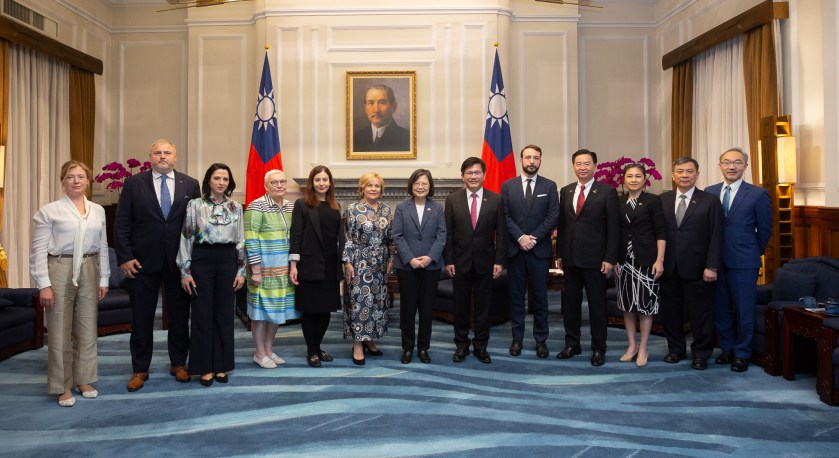
Image credit: 06.21 總統接見「歐洲議會跨黨派友我議員訪問團」by 總統府/ Flickr, license: CC BY 2.0.
“Taiwan and the European Union are like-minded partners that share the values of freedom and democracy, and we are working together to safeguard our way of life”, said President of Taiwan Tsai Ing-wen as she welcomed a delegation of European Parliament legislators in December 2022.
In January 2024, Taiwan will elect a new president. Facing an existential threat from China, for Taiwan cooperation with the EU as a partner is essential to strengthen its democratic resilience. To expand the partnership however, a better understanding of the complex nature of the EU and developing a greater sense of clarity about what Taiwan wants will be indispensable.
Taiwan’s next president can’t afford to lose the recent momentum within EU-Taiwan relations. Designing an ambitious and proactive strategy to guide Taiwan’s future relationship with its European partners will be necessary to keep China at bay and Europe close. At the same time, defending its democracy at home will be critical for Taiwan to safeguard its “way of life” and sustain its continued internationalization. In a world dominated by power politics where authoritarian regimes conveniently deny the agency of democracies, Taiwan must learn to better use its agency and position itself as a partner for Europe in its own right.
Europe’s Taiwan momentum
With the EU in the process of de-risking its cooperation with China, the EU and Taiwan both seized the opportunity to reconceptualize their bilateral cooperation. Over the past three years, the breadth of dynamic in EU-Taiwan exchange has demonstrated that the foundation of joint cooperation has been solidified. In October 2021, for the first time the European Parliament adopted a stand-alone resolution on Taiwan, urging the EU to intensify bilateral political relations and pursue a comprehensive and enhanced partnership under the guidance of the EU’s One China Policy.
This historic initiative – passed with the support of 580 to 26 votes – set a new precedent in shaping European perceptions of Taiwan as a partner. It also signaled to Taiwan — and laterally Beijing — readiness to engage with Taipei on its own merit, rather than in the context of EU-China relations. Yet, inconsistencies across the bloc continue to challenge a common approach to Taiwan.
In November 2021, the European Parliament’s special committee on Foreign Interference and Disinformation (INGE) visited Taiwan and explored ways to jointly address information manipulation, an issue that both sides identified as a threat to democracy. It was also in 2021 that Lithuania-Taiwan relations reached new heights. In May, Vilnius left China’s “17+1” cooperation framework, and in November Taiwan opened a representative office in Lithuania. Moves by Vilnius to adopt a principled stand on China was of strategic importance for Lithuania’s voice in the EU, aimed to enhance its power within the bloc. It also helped Taiwan to better position itself on the European agenda.
Vilnius’ pivot toward Taiwan and away from China was, in essence, a pivot toward democracy and toward a partnership based on values — and trust. A joint embrace of principles and a shared sense of anxiety about the security implications of Beijing’s false sovereignty claims over the Taiwan Strait are the pillars of EU-Taiwan relations. Taiwan’s next leader must build on these.
Embracing of the Indo-Pacific
With over 40 percent of its trade passing through the Taiwan Strait, in September 2021 the EU anchored Taiwan at the heart of its strategy for the Indo-Pacific. China’s rhetorical alignment with Russia after its renewed aggression against Ukraine in 2022 amplified Europe’s awareness that the security of the Euro-Atlantic and the security of the Indo-Pacific are closely linked – and essentially entwined.
In response, Taiwan’s Ministry of Foreign Affairs said that as a like-minded partner sharing the values of freedom, democracy, respect for human rights and the rule of law, Taiwan is committed to working with the EU to enhance cooperation in strategic sectors including digital economy, green energy, post-pandemic economic recovery and supply chain restructuring. Given its vulnerability due to its close economic ties with China, Taiwan’s new president should work towards this commitment and push for further diversification away from China, and toward Europe.
As EP resolutions, statements by the European Commission, the Council and the EU High Representative continue to reveal, the EU institutions see Taiwan as a reliable partner, in contrast with an opaque, domestically repressive and globally assertive China. The EU as a whole is reassessing the risks of doing business with Beijing, through the lens of economic security.
Yet, what kind of relationship the EU wants with China going forward remains a question – or better said, a conundrum, which continues to jeopardize the momentum currently enjoyed within EU-Taiwan relations. The recent failure of French President Emmanuel Macron and Commission President Ursula von der Leyen to present a united European front in Beijing is a good example of Europe’s internal struggles.
A new strategy for EU-Taiwan ties
Such inconsistencies remind Taipei of the need to carefully navigate Europe’s complex — and all too often — fragmented structures and decision-making processes. On paper, Taiwan remains at the core of the EU’s Indo-Pacific strategy. At the same time, cooperation with Taiwan must be conducted within the framework of the EU’s one China policy. Yet, while this means limits, it has not hindered the development of bilateral cooperation. After all, the EU remains the largest investor on the island.
These interests are now further reinforced via the annual EU-Taiwan Investment Forum, the expansion of cooperation across several sectors, and the modernization of trade and investment dialogue through its elevation to the ministerial level. While discussions on a Bilateral Investment Agreement (BIA) have not progressed, both sides have gradually begun to refocus their attention away from a BIA towards sectoral cooperation, which the European Parliament has supported.
EU member states diverge in what they seek to achieve through cooperation with China. No amount of de-risking will make these divergences disappear; unless they have the political will to go beyond their differences and act together. Taiwan’s next leader should therefore cultivate ties with member states on a bilateral basis while all the time remaining mindful of Europe’s regional realities, and continuously working with the EU institutions and keeping the bloc as a whole in mind.
The Baltic countries’ growing embrace of Taiwan through sectoral cooperation and through parliamentary diplomacy — which was driven by a shared anxiety caused by their authoritarian neighbors — has helped to link bilateral and regional cooperation. Reinforcing these exchanges ultimately contributes to strengthening EU-Taiwan relations. Taiwan’s next leader should therefore guide the development of a proactive EU strategy that builds EU-Taiwan relations up from bilateral-, through regional-, to EU-level cooperation.
Democratic resilience in the Indo-Pacific
Taiwan’s political identity, the depth of its internationalization, its relations with China, and how these factors have shaped Taiwan from within are all relevant, though divisive questions that have shaped Taiwan’s international image. Taiwan is already a vibrant democracy, with intense debates on contentious domestic issues such as youth employment, housing or energy.
While Taiwanese people are divided on their opinions regarding future relations with China, there is little divergence concerning the centrality of democracy to their political identity. An overwhelming majority endorse democratic values and reject authoritarianism. Civic action has played a pivotal role in Taiwan’s democratization and remains the driving force behind every progressive initiative. Key problems however, such as transitional justice or the rights of migrant workers, continue to undermine the quality of its democracy.
A failure to consolidate democracy from within risks undermining Taiwan’s resilience and limits the next leader’s ability to contribute to the resilience of the Indo-Pacific. Taiwan must therefore ensure that its own democracy remains robust. In addition to its tech prowess vital to the global economy, democracy is its biggest strength. Access to key strategic markets globally — and its image as a robust democracy — secure Taiwan’s agency, and remain vital to its survival.
Taiwan’s new leadership must therefore seek to better connect the collective’s political identity rooted in the embrace of democracy, with Europe’s own efforts to pursue a normative agenda. With the defence of democracy as a common conviction, both are investing in a more pragmatic foreign policy, driven by the fear of authoritarian threats, particularly through information manipulation where Russia and China have strengthened cooperation.
Building on the 2021 INGE visit, the EU and Taiwan should institutionalize cooperation to counter disinformation, including by establishing an annual EU-Taiwan dialogue on the defence of democracy, which would benefit both sides, in the words of two times Lithuania’s Prime Minister Andrius Kubilius, member of the INGE visit.
Taiwan currently enjoys a prominent position within Europe’s strategic geopolitical calculus. In order to secure this place for the long-term, it cannot afford to divest from its relationship with the European Union — instead it must aim to enhance this and work together with its European partners in pursuit of the defence of democracy.
Zsuzsa Anna Ferenczy is a Ministry of Science and Technology Postdoctoral Fellow in Taiwan, Non-Resident Fellow at Taiwan NextGen Foundation, Head of Associates Network at 9Dashline, and former political advisor in the European Parliament (2008-2020). She tweets @zsuzsettte.
This article is featured in a series of op-eds presented by CommonWealth English. For more insights and perspectives on the aspirations and recommendations for the future president of Taiwan, please click the link below: https://cw.com.tw/feature/topic/dearpresidenten.
 Taiwan Insight