
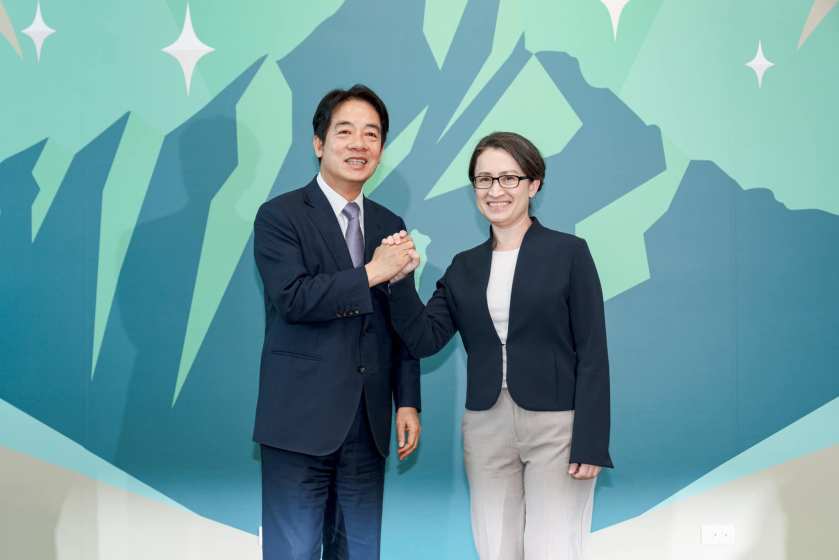
Frontrunner Lai picks US Representative Hsiao Bi-khim as running mate and the Blue-White coalition falls apart
Written by Gerrit van der Wees.
Image credit: 蕭美琴 Bi-khim Hsiao/ Facebook.
Taiwan’s presidential and legislative elections are to be held on Saturday, 13 January 2024. As the date of the election is approaching, the campaign is heating up and drawing more international attention.
The campaign for the presidency had been going on since early Summer, when the two major parties, DPP and KMT, declared their candidates: for the DPP current Vice President Lai Ching-te, and the KMT current Taipei County Magistrate Hou Yu-ih.
But politics in Taiwan never knows a dull moment, and later in the Summer, former mayor of Taipei, Mr Ko Wen-je – who leads his own Taiwan Peoples’ Party (TPP) party, and former Foxconn CEO Terry Gou also declared their candidacy for the presidency.
From mid-August to mid-November 2023, the picture was pretty stable, with the DPP’s Lai Ching-te clearly the front-runner with around 35% in most polls, and Messrs. Hou Yu-ih and Ko Wen-je battling it out for second place, with each ranging from 18 to 24% in the polls. Mr. Terry Gou was trailing a distant fourth, with his poll number sagging from 7 to 4%. Some 20% of the respondents had not made up their minds yet.
Then, in mid-November 2023, two developments suddenly accelerated the campaigns. First, front-runner William Lai (colour-coded Green in Taiwan’s political system) picked Taiwan’s representative in the US, Hsiao Bi-khim as his running mate. Secondly, on 15 November 2023, the KMT’s Hou Yu-ih (colour-coded Blue) and the TPP’s Ko Wen-je (colour-coded White) announced the formation of a coalition, but it fell apart almost immediately.
Hsiao Bi-khim, VP candidate
On Monday, 20 November 2023, frontrunner Lai Ching-te announced that Taiwan’s representative to the US, Ms. Hsiao Bi-khim, had accepted his invitation to be his Vice-Presidential running mate.
Ms. Hsiao, who flew back to Taiwan for the occasion, stated during a press conference in Taipei “I’m back. It’s my duty to support Taiwan. For the sake of our country, I will dedicate myself wholeheartedly.”
She has described herself as a “cat warrior” as she pushed back against Beijing’s aggressive moves, threats, and intimidations during her term as Taiwan’s de facto ambassador in Washington.
In an article earlier this year, the New York Times described her as “one of the most influential” foreign envoys in Washington despite the absence of diplomatic relations between the US and Taiwan.
Hsiao has a long experience in elections in Taiwan, as she served in the Legislative Yuan, first from 2001 to 2008 as a representative for overseas constituencies, and then from 2012 to 2020, first on a proportional representation seat, and later representing Hualien County, generally viewed as a strong pan-blue seat. She is thus seen as a strong addition to the ticket, not only because of her international experience.
Blue-White opposition falls apart
Mid-November 2023 was also seen as a major turning point in the elections because of the attempt by the KMT and Mr Ko Wen-je’s TPP to agree to cooperate and move towards a joint ticket. This would be decided by a weighted average of six opinion polls and announced on Saturday, 18 November 2023, just in time for the 24 November deadline for registration for the presidential elections. But the move fell apart over disagreements on the results of the polls and the margins of error.
The move towards a joint ticket was surprising, as both Hou Yu-ih and Ko Wen-je have big egos, and neither would want to be number two. But apparently, there were greater pressures, such as former President Ma Ying-jeou or even the PRC: for some time, reports had been circulating in Taiwan that Beijing favoured a joint ticket. After the joint ticket had been announced, Mr Ko Wen-je even let it slip that the American Institute in Taiwan had called him and asked to what extent the PRC had influenced the move.
It is also clear that this deal led to great disenchantment in Mr Ko Wen-je’s support base: they were for him because he represented a third choice – away from the established KMT and DPP. Ko throwing in his lot with the KMT negated the whole raison d’etre for their support of Ko. Particularly, the young people would flock back to the DPP, while many others would just stay home.
But in any case, on Saturday, 18 November 2023, the deal fell apart over who would lead the joint ticket, and over the next few days, an acrimonious debate erupted over who was at fault.
On Thursday, 23 November 2023, a last-minute attempt to reconcile the three opposition groups was made by Foxconn’s Terry Gou, who convened a meeting at the Grand Hyatt luxury hotel in Taipei, but the meeting ended in furious accusations back and forth between the three sides, broadcast on live television.
The candidates register
So, on Friday, 24 November 2023 — the deadline for registration — the warring factions each submitted their registrations separately. The DPP candidates, Mr Lai Ching-te and Ms Hsiao Bi-khim had already registered earlier in the week, right after Ms. Hsiao’s return from the United States and the announcement of her candidacy for the Vice-Presidential position.
Dr Ko Wen-je registered in the morning, together with his running mate, Mrs. “Cynthia” Wu Hsin-ying, a member of a wealthy business family associated with the Shin Kong Insurance Group. She was educated in the US and the UK, and has served as an at-large legislator for the TPP.
And a bit later the same morning, the KMT’s Mr Hou Yu-ih registered, together with his – totally unexpected — choice for running mate: Mr Jaw Shaw-kong, a radio and TV programme host who is known for his far right-wing pro-China views.
The KMT party also announced that former Kaohsiung City mayor and KMT legislator Han Kuo-yu would be leading the KMT’s legislative slate for the proportional seats in the Legislative Yuan (LY). Mr Han is also known as an extreme right-wing pro-unificationist. He was the KMT’s candidate in the 2020 presidential elections, which he badly lost against current president Tsai Ing-wen.
The choice of Jaw as VP candidate and Han Kuo-yu as leader of the LY slate is an indication that the Kuomintang is desperately trying to shore up its deep-Blue base of old mainlanders. These were already unhappy with the Taiwanese Hou Yu-ih, and for a while – when the Blue-White merger discussions were taking place – were even faced with an even less attractive face of another Taiwanese, the very erratic populist Mr. Ko Wen-je.
The Jaw/Han additions will certainly solidify the KMT’s position among the extreme right of the political spectrum but will, at the same time, drive away the more moderate, centre-of-the-road supporters in the so-called light-Blue segment of the political spectrum. They may move to support Mr. Ko Wen-je or even vote strategically in favour of Mr. Lai Chin-te in order to prevent a deep-Blue victory.
Oh, and Mr. Terry Gou of Foxconn fame? He dropped out of the race.
The Legislative Yuan elections
A few more words about the Legislative Yuan elections, to be held concurrently, are also in place. In the present legislature, the DPP has an absolute majority of 61 out of 113 seats. The KMT has 38 seats, while Mr. Ko Wen-je’s TPP has five seats. There are two other smaller parties – both leaning towards the DPP – with three (New Power Party) and one (Taiwan Statebuilding Party) seats, respectively.
The main question is whether the DPP will be able to retain its majority. Current expectations are that it might drop below the 50% (57 seats) mark, which would give Mr. Ko Wen-je ‘s TPP an important role as “Kingmaker”, siding with either the KMT or DPP depending on the issue.
Not all are related to cross-Strait relations
One other point is that outside observers often tend to see Taiwan’s elections through the prism of how it relates to relations with China: is Taiwan moving closer to China or not?
However, for voters in Taiwan, that is not always the case. Like in other countries around the world, the bread-and-butter issues of the day are often equally or more important. In Taiwan, particularly for the younger generation, the issue of wages for recent college graduates and housing affordability are front and centre.
Many of them seem to feel that the DPP has not done enough to resolve these persistent issues and had started to flock to Ko Wen-je, who was seen as an attractive third choice on many of these issues. However, Ko’s failed move to join forces with the KMT and his eagerness for political power at all costs are now turning many of these young voters away.
Conclusions
Mid-November has thus fundamentally changed the picture of the campaign. The addition of Hsiao Bi-khim as VP candidate has reinvigorated Lai Ching-te’s campaign, while on the Blue-White side, the move to attempt a merger of the tickets had backfired and set bad blood. With Hou Yu-ih and Ko Wen-je running separate campaigns, the differences are now becoming increasingly clear.
The DPP’s ticket represents a continuation of the steady policies of President Tsai Ing-wen, on the one hand emphasising Taiwan’s freedom and democracy, and on the other, working closely with the US and other allies in the region such as Japan to provide deterrence against any untoward moves by the PRC.
With the KMT’s ticket of Mr Hou Yu-ih and Jaw Shaw-kong, one can expect a lurch to the right and a much more strident and vicious pro-unification stance. Mr Hou Yu-ih himself – who has little experience at the national level, let alone the international level – will have relatively little say over the direction of the campaign, which will be controlled by forces behind the scenes, such as Mr Ma Ying-jeou, and influenced by disinformation from across the Strait.
Where Mr Ko Wen-je’s campaign will go is up in the air: he will be losing part of his support among the young voters, disillusioned at his attempt to join with the KMT, but he does still occupy the middle ground between the DPP and KMT and will attract voters from both the light-Blue and light-Green side of the political spectrum.
In Taiwan, the colours Green, White or Blue will have a special meaning around Christmas and the New Year.
Gerrit van der Wees is a former Dutch diplomat who currently teaches the history of Taiwan at George Mason University in Fairfax, Virginia, and US relations with East Asia at the George Washington University Elliott School for International Affairs in Washington, DC.
This article was published as part of a special issue on Presidential Candidates.
 Taiwan Insight