
Written by Brian Hioe.
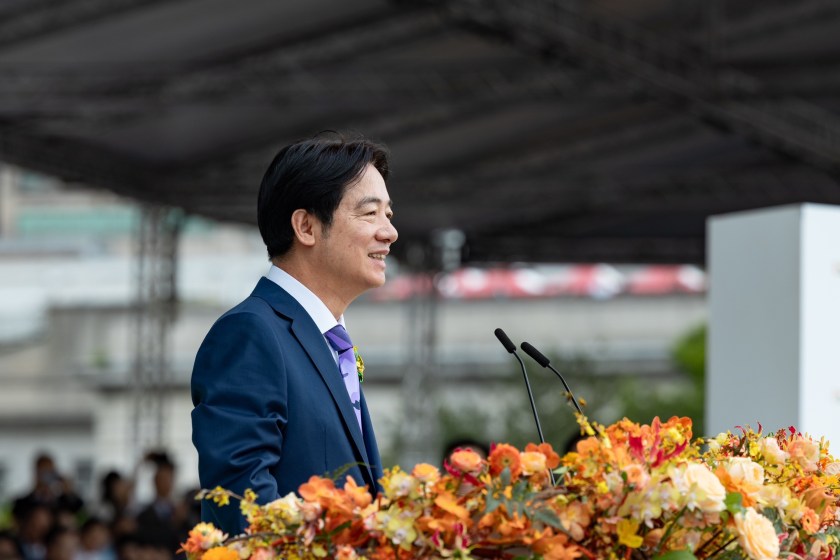
Image credit: 05.20 總統出席「就職慶祝大會」並發表就職演說 by 總統府/ Flickr, license: CC BY 2.0 DEED.
The Lai inauguration did not see any major surprises in terms of Lai’s comments during his inaugural address.
Particularly regarding cross-strait relations, it was not expected that there would be any major curveballs by Lai. After all, Lai has gone out of his way to emphasise that his foreign policy would represent continuity rather than a departure from that of his predecessor, Tsai Ing-wen.
In his early months, Lai will especially be expected to keep his head down on this front. Lai is all too aware of international caution regarding his past history of pro-independence statements, such as his claim to be a “pragmatic worker for Taiwanese independence” when he was Tainan mayor.
It is not surprising, however, that China’s Taiwan Affairs Office reacted to the Lai inauguration by immediately framing Lai as a Taiwanese independence advocate. This reflects how Lai’s past statements will likely be used as ammunition against him for the rest of his presidency so as to undercut the strengthened international relations that developed between Taiwan and other countries under Tsai. But this also reflects to what extent that, as a figure with a long history in the pan-Green camp, Lai’s views were understood by China as already known, while there was more ambiguity on what Tsai would say once in office given that she was historically a late entrant to the DPP before becoming the party chair.
To maintain such ties, Lai’s moves will more broadly be aimed at depicting him as a Tsai 2.0 rather than in the mould of his other predecessor as DPP president of Taiwan, Chen Shui-bian. This extends to domestic policy.
Consequently, though Lai was historically more associated with the conservative wing of the DPP that sought to oust Tsai as DPP presidential candidate ahead of the 2020 elections and replace her with Lai, Lai will also frame himself as a political progressive in the mould of Tsai. One signal of this was, for example, Lai’s reference to Taiwan legalising gay marriage in the inaugural address as an accomplishment of his predecessor and his visit to the annual Taipei pride parade last October as the first presidential candidate to do so in Taiwanese history. Lai was seeking to ameliorate the fact that the conservatives he had previously aligned himself with were known for their opposition to gay marriage.
Indeed, the framing of the inauguration ceremony was very much along such lines, in referencing Taiwan’s cultural pluralism through the choice of performances and even the dishes chosen for the presidential banquet. This proves a way in which international optics can highly influence domestic political alignments between progressive and conservative elements. This is also a way in which the legacy of Tsai casts a long shadow over the Lai administration, at least in its initial stages.
During his speech, Lai did not mention the “National Project of Hope” that was used during the election as his preferred framing for his domestic political platform. But the Lai administration has signaled several major domestic policy initiatives.
In particular, in his address, Lai referenced Tainan, where he once served as mayor, as the historic site where Taiwan’s ties with the international world developed. The inaugural presidential banquet also took place in Tainan for the first time in history. Lai would be signalling, then, a desire by his administration to emphasise development for southern Taiwan at a time in which there has been some pushback against the DPP over the resource disparity between southern and northern Taiwan in a manner that has led the KMT to try and make inroads into what has historically been the DPP’s heartland.
Lai’s references to efforts to assist reconstruction in Hualien after the earthquakes that have taken place there in the past weeks may also be intended to signal that the DPP intends to address the economic disparity between eastern Taiwan and other parts of Taiwan. This would very likely also have the aim of targeting the KMT at a time that freeway and high-speed rail extensions proposed by the KMT have been controversial and Hualien legislator Fu Kun-chi, long a notorious figure in the KMT, has taken on a prominent role in the party as its party caucus convener.
To this extent, Lai brought up his history as a doctor very early on in the speech, suggesting that his desire to save lives was what led to his later desire to enter politics so as to help the nation. Although Lai is, in fact, formerly a doctor, this previously did not come up very often in presidential campaigning–it was more often than Ko Wen-je of the TPP leaned into his reputation as a doctor. However, the Lai administration has emphasised efforts to improve the long-term healthcare system in Taiwan, particularly to fight leading causes of death such as cancer.
A recurring theme in Taiwanese politics in past election cycles is that candidates largely agree on the social ills facing Taiwan but do not have distinctive programmes to address such ills. As such, candidates end up primarily differing on the basis of their cross-strait stance. But with the backlash against the DPP in past election cycles for its perceived failings on domestic policy, the Lai administration is likely to try and brand itself as having specific and distinctive programmes that it can later tout as successes.
Still, many uncertainties are ahead for the Lai administration. For example, the US presidential elections in November could perhaps put former US President Donald Trump back in power. If this takes place, it is hard to tell what could occur with cross-strait relations, given Trump’s unpredictable behaviour. If Biden ends up being a one-term president, this will also disrupt the historic alignment of US presidential elections and Taiwanese presidential elections by which if US presidents serve two terms and Taiwanese presidents serve two terms, both countries see changes of political power in around the same timeframe.
Likewise, a political storm is on the horizon with regard to the pan-Blue camp’s efforts to grant the legislature new prosecutorial powers that allow legislators to summon individuals for questioning and hold them in contempt of the legislature if they do not answer, with such laws allowing for individuals to be questioned over trade secrets, confidential government negotiations, and other matters. Under these new laws, which are pushed for by the KMT and TPP, contempt of the legislature will be a criminal charge with up to a three-year jail sentence.
Protests are planned against these changes, with some terming the political crisis to be possibly a recurrence of the 2014 Sunflower Movement. This, too, is uncharted political territory in that protest movements such as occurred under the Ma administration generally declined under the Tsai administration, with the DPP in control of the presidency and holding the majority in the legislature. This proves similar to how civil society protests declined during the Chen Shui-bian administration, with many civil society actors joining the administration, but also reflects how mass collective action on the scale of the Sunflower Movement did not take place under the Tsai administration because there was not a sense of threat that served to galvanise the public into the streets. But with the KMT in control of the legislature, even with the DPP in control of the executive branch of government, it is to be seen whether this is a sufficient sense of threat for the outbreak of another social movement.
As such, it is to be seen if the first few days of the Lai administration will see its first political crisis. How the Lai administration handles this will set the early tone for his presidency, as well as for interactions between the DPP and KMT during a term in which the DPP controls the executive branch of government but does not hold the majority in the legislature. A deft handling of the events could buoy Lai, or if the opposite happens, the early Lai administration will see a setback.
Brian Hioe is one of the founding editors of New Bloom. He is a freelance journalist, as well as a translator. A New York native and Taiwanese-American, he has an MA in East Asian Languages and Cultures from Columbia University. He graduated from New York University with majors in History, East Asian Studies, and English Literature. He was a Democracy and Human Rights Service Fellow at the Taiwan Foundation for Democracy from 2017 to 2018. He is currently a non-resident fellow at the University of Nottingham’s Taiwan Research Hub.
This article was published as part of a special issue on ‘Presidential Inauguration‘.
 Taiwan Insight