
Written by Sheng-Hui Tseng.
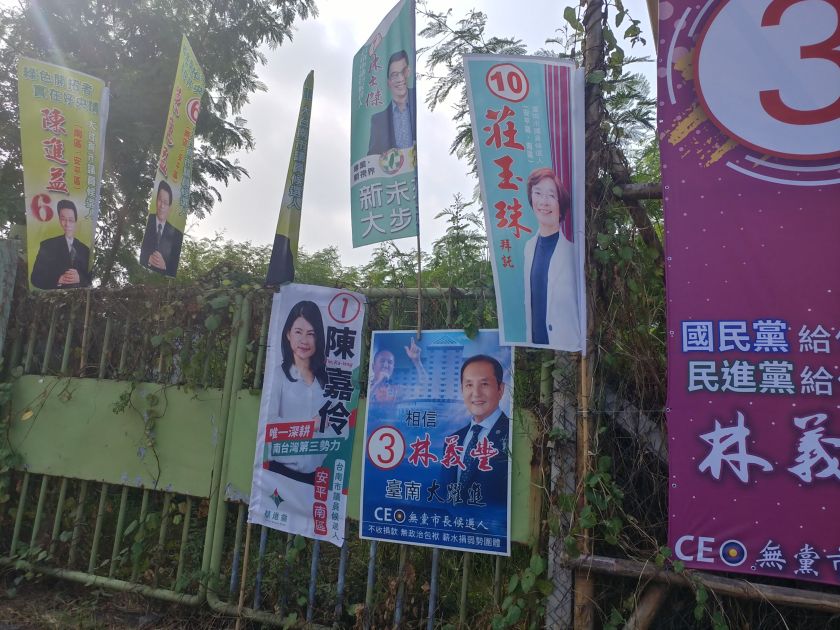
Image credit: 各種議員候選人選舉旗幟 by 六都春秋 編輯室 / Flickr, license: CC BY 2.0.
The characteristics of the workplace of politics have created a hostile work environment for women. The workplace culture of silence and cover-up makes it extremely difficult to victims seek help or speak up against sexual harassment. Before the #MeToo Movement, sexual harassment in politics was mostly portrayed as individual incidents in news media, and most cases were those between politicians. However, as shown by the #MeToo allegations and my interview data, sexual harassment is prevalent in politics, affecting both women politicians and women political staffers.
For women political workers, the fear of becoming “the problem” was one of the primary reasons why they didn’t reach out to their supervisors or employers after experiencing sexual harassment at work, given the rule-of-man nature of politics. Victims who decide to file a complaint or simply report it to their supervisor or employer might be treated as troublemakers and thus face retaliation or bullying, sometimes from the harasser, or lose their jobs.
Victims who are thinking about seeking institutional assistance might be discouraged by the practically inaccessible grievance and complaint scheme, and some might be dissuaded from filing a formal complaint by their supervisor or employer. Some of my interviewees mentioned that their supervisors or employers asked them to tolerate it (忍一下) because “making a scene” can damage their reputation in the circle and reveal their experiences to the media, even when the harasser is not the employer or supervisor, can ruin the reputation of politicians or parties they worked for or negatively affect the results of elections. Victims were often told that they should “think about the big picture and prioritize the collective (以大局為重),” while the harassers or enablers were barely punished or judged by the same standard.
The experience of women politicians was hardly visible in the wave of #MeToo allegations. Taipei City councilwoman Pei-Chun Chung was one of few women politicians who publicly spoke about being sexually harassed by an acquaintance at work. When mentioning sexual harassment perpetrated by colleagues, local government officials, and (potential) sponsors or resource providers in the interviews, most women politicians expressed concerns about the incidents being politicalized, which stopped them from making public accusations or seeking institutional assistance. Some were also worried that revealing such experiences would lead voters to think that they are not capable of protecting the rights or welfare of the constituents because they are unable to protect themselves. Further, women politicians might hesitate to react immediately when being sexually harassed by voters because Taiwanese politicians are expected to be friendly and approachable, and “offending” the constituency is taboo.
To break such a culture of silence and cover-up in politics and ensure the effective implementation of the amended Gender Equality in Employment Act requires the efforts of not only politicians and political parties but also the public. A major focus of the amendment to the Gender Equality in Employment Act was the emphasis and increase on employers’ duty to sexual harassment prevention. However, politicians and political parties tend to be unaware of this duty they have as employers, which was manifested in the plenty of unreported and mishandled sexual harassment incidents revealed by the #MeToo allegations and my interviewees. The amended law now extends the window for filing a complaint of mishandled or unaddressed sexual harassment case to the local competent authority, which might encourage the victim to seek institutional assistance; nonetheless, the effectiveness of this institutional response needs further observation, for the power imbalance between politicians or parties and their employees is likely to deter the latter from reaching out to competent authority.
Additionally, political parties should lay down internal sexual harassment zero-tolerance policies, especially those regarding candidate nomination and disciplinary measures. While some parties have incorporated anti-sexual harassment clauses into their internal regulations, these rules tend to be tolerant of politicians who have committed sexual harassment. For parties that were represented in the Legislative Yuan at the time of the #MeToo Movement, members generally become ineligible for nomination as candidates for public office if they have been convicted of sexual assault or child and youth sexual exploitation. However, sexual harassment zero-tolerance clauses were not incorporated into internal disciplinary rules or candidate nomination guidelines. Consequently, sexual harassment by politicians, including those running for and representing parties in elections, remains largely unregulated by the parties.
The Kuomintang (KMT), for instance, still nominated legislator Hsueh-Sheng Cheng (陳雪生) to run for re-election in the 2024 legislative election when the court ruled that Chen sexually harassed DPP legislator Yun Fan (范雲) during a physical legislative disruption in 2020. While the DPP introduced internal reforms in response to the sexual harassment accusations, under the new rules, members are ineligible to be nominated as candidates for public offices when they have been convicted of or prosecuted for sexual assault or child and youth sexual exploitation. However, filing a lawsuit is costly and collecting evidence can be difficult; thus, not all sexual harassment victims will take legal action against the harasser. A former assistant of Hsiang-Ling Lai, then-legislator of Taiwan People’s Party (TPP), accused Chen-Yuan Chiu, also a then-TPP legislator, of physical sexual harassment during the #MeToo Movement. Chiu denied the claim and later filed a lawsuit against the accuser, and Lai condemned her former employee for “weaponizing sexual harassment” and politically attacking Chiu in a Facebook post. Political parties shall acknowledge that they also have an obligation to prevent sexual harassment in politics, and they have the resources and capacity to investigate and address sexual harassment allegations against their members who are public figures, as they are already required to do so, as employers, by the Gender Equality in Employment Act.
Lastly, Taiwanese voters have a crucial role in changing the workplace culture of politics by influencing the broader political landscape we are in. A former legislative aide of Hung-An Kao, the current Mayor of Hsinchu City and then-TPP legislator, accused the chief of staff of Kao’s office of sexual harassment and Kao mishandling the case during the campaign of 2022 local elections. The victim reached out to a social media personality, Yu Liu (四叉貓), and revealed her experiences on Facebook with the help of Liu. She decided to release the recordings of conversations she had with a female supervisor, in which the supervisor explicitly told her she must leave because she was the subordinate, as well as conversations she had with Kao, in which Kao was pressuring and attempting to silence her and warned that she didn’t want to hear anything about this case anymore.
While some people raged at how Kao handled this incident, some commented on Liu’s posts and questioned the intentions of the victim, accusing her of triggering negative campaigning. Kao and the TPP never formally addressed these issues. Nevertheless, Kao managed to win the Hsinchu mayoral election while being accused of mishandling sexual harassment complaints, workplace bullying, and corruption. I thought this case might have sparked conversations about sexual harassment in politics, but it didn’t. In contrast, pressure from supporters and that the public sided with the survivors of sexual harassment were key factors driving DPP to respond promptly to the #MeToo allegations. How Taiwanese society sees and reacts to sexual harassment in the workplace of politics decides whether victims will be willing to seek help, as well as whether we will continue to allow perpetrators or enablers to stay close to power.
The belated #MeToo Movement pushed the public and those in power to rethink and re-evaluate gender equality in Taiwan. For politics, whether and how the institutional changes in the Gender Equality in Employment Act will challenge and shake the workplace culture and unequal gender power structure in politics remain unclear. However, it will certainly take more than institutional changes to break the culture of silence and cover-up in the workplace of politics. The public’s attitude toward whether, how, and to what extent perpetrators and enablers of sexual harassment should be held accountable determines the practical effectiveness of anti-sexual harassment law. Taiwanese society has taken the first step to change by standing by the survivors during the #MeToo Movement. A demand for accountability for perpetrators and enablers of sexual harassment will be the next crucial step for making the change possible.
Sheng-Hui Tseng is a PhD student of Political Science and Women’s, Gender, and Sexuality Studies at the Pennsylvania State University. Her research interests include comparative politics and gender politics, with a focus on women’s political representation and participation in East Asian democracies. She can be reached at sqt5667@psu.edu.
This article was published as part of a special issue on ‘The #MeToo Movement One Year On.’
 Taiwan Insight