
Written by Andrew Yeh.
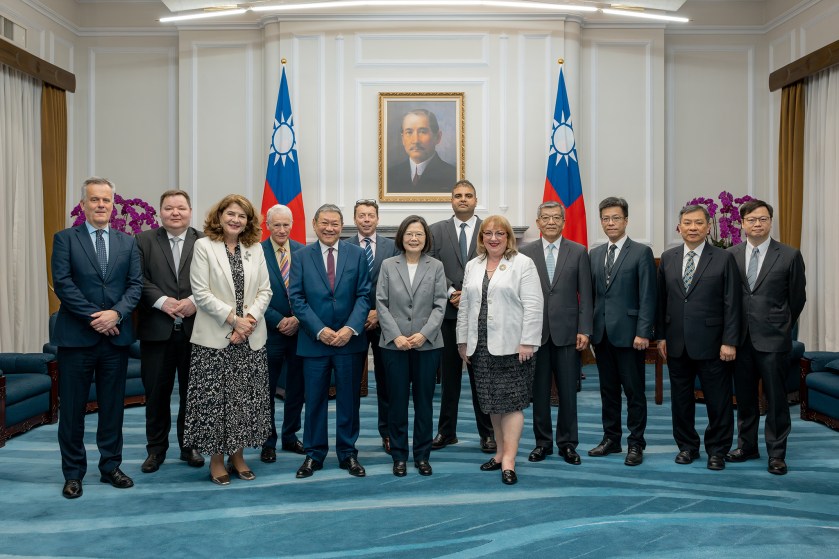
Image credit: 04.02 總統接見英國工黨國會議員訪團 by 總統府/ Flickr, license: CC BY 2.0.
The UK’s new Foreign Secretary David Lammy has, quite literally, got off to a flying start. Less than a week into his appointment, the Foreign Secretary crisscrossed Europe, visiting three capitals before jetting off to the NATO Summit in Washington DC. While Lammy has been keen to focus attention on talk of a “reset” of the UK’s post-Brexit relationship with Europe, what stance the new Labour government will take towards the UK’s once much-vaunted ‘tilt’ to the Indo-Pacific remains to be seen. Yet, as Beijing continues to escalate its strategy of grey-zone warfare against Taiwan, how the new Foreign Secretary responds to rising cross-strait tensions may yet be the most important question of his tenure.
Those hoping for clarity on the UK’s China policy under the new government may have to be content with waiting a little longer. UK elections are rarely fought on foreign policy issues, and this year’s was no exception. The Labour Party’s manifesto made only brief reference to China, with a commitment to undertake an ‘audit’ to better understand the challenges and opportunities posed by China. While a worthwhile endeavour, the audit effectively functions as a play to buy time before setting out a clearer policy direction. Lammy’s framing of the need to “cooperate, compete and challenge” China is remarkably similar to the previous government’s three-part “align, protect and engage” strategy on China, suggesting that we can expect significant continuity in the meantime.
More interesting to watch has been comments by other Labour figures on the Indo-Pacific more generally, and Taiwan in particular. In an interview shortly before the election, the now Defence Secretary John Healey said that a Labour government would be more realistic about the role Britain can play in the Indo-Pacific, recognising that the UK’s first security obligations lie in Europe. This hint at a rollback of the UK’s Indo-Pacific ambitions may be at odds with a small but growing caucus of Labour MPs who are increasingly vocal on Taiwan. The launch of Labour Friends of Taiwan, an informal grouping of Labour parliamentarians pushing for greater solidarity and exchange between the Labour Party and Taiwan, is a prime example of this. This interest isn’t limited to the backbenches. The congratulations offered by then Shadow Minister for the Indo-Pacific, Catherine West MP, to President Lai on his election earlier this year shows that, at the very least, the Labour Party’s recognition of Taiwan as a like-minded, democratic partner is increasing. While there are no signs of tensions yet, how much weight the new government lends to the UK’s Indo-Pacific ambitions may be a key faultline within the Party’s internal foreign policy debates.
Regardless of whether the Labour Party has made up its mind about Taiwan or not, these issues are likely to quickly come to a head for the new government. The new government would do well to turn its attention to China’s escalating grey zone tactics against Taiwan. From large-scale military drills to cyber-attacks and coercive economic diplomacy, China’s grey zone strategy is designed to slice away at Taiwan’s autonomy, wear down its defensive resources and wage ‘cognitive warfare’ on the Taiwanese people. The China Strategic Risks Institute has set out six scenarios where Beijing could seek to escalate grey zone activities around Taiwan – ranging from a temporary no-fly zone to a partial economic blockade or ‘quarantine’ and the occupation of Taiwan’s sparsely inhabited outlying islands such as Wuqiu and Dongying. It is worth noting that the last time Labour was in government, a considerably less assertive Hu Jintao was in power in Beijing, and a considerably more conciliatory Ma Ying-jeou was in power in Taipei. If the current Labour leadership relies too heavily on the foreign policy insights of the Labour grandees of the previous era, they may be designing policy for a world that no longer exists.
China has warned the UK and its allies to avoid involvement in Taiwan, calling it an ‘internal affair.’ This appears to be a message well received by French President Emmanuel Macron, who has previously expressed fears of being drawn into a US-China conflict over Taiwan, and one wonders how much this concern is shared by policymakers in Westminster. However, the UK, Europe and its allies have distinct strategic interests in Taiwan and the broader region that these perspectives overlook. The most significant threat to the UK from the PRC’s grey zone tactics is the risk of escalation into open conflict. Grey zone aggressions are unpredictable and can spiral into larger conflicts due to miscalculations. A conflict between the PRC and the US over Taiwan could have catastrophic humanitarian consequences and severely impact the global economy, with potential losses estimated at $2.5 trillion annually before the effects of any economic sanctions.
Even short of open conflict, China’s grey zone tactics undermine the UK’s stated foreign policy interests on several levels. First, the UK’s 2023 Integrated Review Refresh emphasises maintaining a ‘free and open Indo-Pacific’ and a ‘regional balance of power’. China’s coercive actions against Taiwan challenge these principles and threaten regional stability. Second, the UK must consider the risks to international trade from disruptions to one of the world’s critical trade routes. Taiwan produces around 70% of the world’s semiconductors, and almost half of the world’s container ships passed through the Taiwan Strait in 2022, a vital route for goods from East Asia to Europe. Finally, China’s military presence in the Taiwan Strait and South China Sea directly challenges international law. Beijing’s claim that the Taiwan Strait is part of its Exclusive Economic Zone and that it has a right to regulate maritime activity in this area contradicts the norms and rules set by the UN Convention on the Law of the Sea.
So, what could a more proactive UK policy on Taiwan look like? By definition, grey zone activities are designed to be difficult to respond to, falling just below the threshold of open conflict. Policymakers are understandably hesitant about getting caught up in an escalatory cycle that could spiral out of control. However, the incremental, progressive logic of Beijing’s grey zone escalations means that interventions at the earlier ‘light grey’ stage are more effective and less risky than interventions at the ‘dark grey’ stage. Timely interventions to prevent China from escalating aggressions is a far less risky conflict prevention strategy than waiting until Taiwan’s red lines are on the verge of being crossed.
A UK and allied anti-grey zone strategy would need to be set around three pillars. Firstly, the UK must raise the cost of the PRC’s grey zone aggressions. By raising the diplomatic and economic costs of grey zone coercions, the UK and its allies can help shift the cost-benefit calculus to Beijing of maintaining and escalating such actions. This could be achieved through public statements drawing light on grey zone activities or limited and proportionate sanctions on PRC military companies. Restricting investment into China’s military-industrial complex through proposals for an outbound investment screening regime would also be a way to achieve this. Secondly, the UK must act now to strengthen Taiwan’s resilience to grey zone coercion. By deepening trade cooperation and sharing expertise on renewable energy and cybersecurity, the UK can help Taiwan minimise the impact of China’s activities. With many of these recommendations operating outside of the military domain, these actions are also less overtly provocative towards Beijing. Examples include launching a cyber-security dialogue with Taiwan modelled on the existing UK-Singapore dialogue or supporting Taiwan’s efforts to join the Comprehensive and Progressive Agreement for Trans-Pacific Partnership (CPTPP). Such policies would fall well within the limits of the UK’s longstanding economic engagement with Taiwan. Thirdly, the UK should work with its allies to reaffirm the rules, norms and structures of the international rules-based order, the UK can reaffirm the foundations of a free and open Indo-Pacific. Actions such as freedom of navigation missions and opposing China’s claims to regulate traffic through its Exclusive Economic Zone help to protect the UK’s interests not just in the Taiwan Strait but across the region.
Importantly, the UK should reassure the PRC that a more forthright response to Beijing’s grey zone tactics against Taiwan does not constitute a change in the UK’s ‘One China’ policy, nor does it reflect support for Taiwan’s independence. Opposing the PRC’s escalations against Taiwan is in line with the UK’s longstanding policy on the issue, which has always emphasised its desire for a peaceful resolution of cross-strait differences through dialogue – not through threats, intimidation and coercion.
Andrew Yeh is the Executive Director of the China Strategic Risks Institute. He is the Co-Founder of Labour Friends of Taiwan (UK) and previously served as Secretariat Manager at the Inter-Parliamentary Alliance on China (IPAC).
This article was published as part of a special issue on ‘Taiwan-UK relations: continuity or change?.’
 Taiwan Insight