
Written by Helen Hai-Ning Huang.
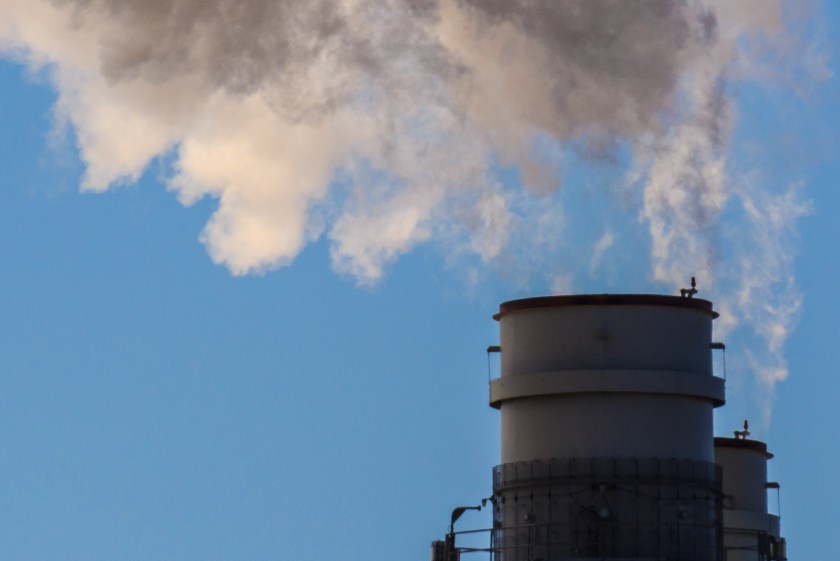
Image credit: smoke_stacks by David J / Flickr, license: CC BY-SA 2.0.
Although Taiwan is not a contracting party to any environmental or climate conventions, nor is it able to voice in conferences or negotiations associated with those conventions, its climate law regime has been evolving along with the forefront development of international law. This join-the-rank traction led to the enactment of the Greenhouse Gas Reduction and Management Act (GGRMA) in 2015 following the Paris Agreement and the birth of the Climate Change Response Act (CCRA) in 2023 — an overhaul of the GGRMA — following the EU’s Carbon Border Adjustment Mechanism (CBAM) initiative and the momentum of reaching net zero in the Glasgow Climate Pact.
The CCRA is the main pillar of climate legislation in Taiwan and an epitome of how the island’s multi-dimension climate governance is structured, but it is not without controversies. Recently, the constitutionality of CCRA provisions pertaining to the interim regulatory targets by way of setting an emission cap for each phase with an equivalent percentage of emission reduction was challenged and brought to the Constitutional Court for judicial review for the first time. This case caused a sensation in the legal circle about the “constitutional moment” of the climate movement.
Against this backdrop, this article features the key provisions of the CCRA with respect to its design, objectives, and emissions reduction targets. It dissects the historic constitutional climate lawsuit in Taiwan.
CCRA as a Framework Legislation
As an enhanced version of the national climate legislation, the CCRA contains seven chapters covering a spectrum of existing and newly introduced mitigation and adaptation measures, as well as the division of responsibilities among the administrative agencies on climate matters. However, because the CCRA is designed as a “framework legislation”, it only lays out “what should be done” at a high level, whereas “how they should be done” and the details of implementation are largely delegated to the administrative agencies to decide at a later stage.
This mode of legislation that (sort of) embraces the agency’s expert governance is not new in the sphere of environmental and climate lawmaking. However, how the implementation or lack of implementation by administrative agencies can be supervised or rectified remains to be a big question mark in the CCRA. Unlike other environmental regulations, the CCRA fails to include a citizen suit or actio popularis provision. Consequently, individuals or civil groups who would like to challenge the actions or inactions of administrative agencies in terms of the implementation of CCRA will need to resort to a much more complicated route under the administrative law, and the bar to pass the standing requirements is high.
CCRA as an Intergenerational Legislation
In addition to its overarching design, another key feature of the CCRA is its Article 1, which stipulates that the CCRA is made in response to climate change and for the purpose of formulating adaptation strategies, reducing and managing greenhouse gas emissions, carrying out intergenerational justice, environmental justice and just transition, and ensuring the nation’s sustainable development.
This provision is one of the most progressive legislations as, for the first time in Taiwan’s environmental law history, intergenerational justice is incorporated into the objectives of a law. On statutory interpretation, this provision sets the tone for various measures under the CCRA, including their implementation, that they should work not only for the current generation but the future ones.
The Emissions Reduction Targets
The core of the CCRA is to establish the legal basis for Taiwan’s emission reduction targets. Article 4.1 of the CCRA provides that Taiwan’s long-term emission reduction target is to reach net zero by 2050. Article 4.2 provides that the government at all levels, citizens, businesses and organisations should cooperate to reach this goal. Net zero refers to cutting greenhouse gas emissions to a residual amount that can be absorbed and stored by nature or other removal measures durably, leaving zero in the atmosphere, and reaching net zero by 2050 aligns with the international projection to keep 1.5°C alive.
Without setting forth how net zero will be reached by 2050, Article 10.1 of the CCRA provides that the Ministry of Environment (MOE) should, in compliance with the required procedures, set the phase-in regulatory target for every five years. Article 10.4 of the CCRA provides that except for phase 1 (which was announced under the GGRMA), the MOE should propose the regulatory target of the next phase 2 years before its commencement.
The Problematic Phase-In Emissions Reduction Mechanism
Operationally, this means that the cap of greenhouse gas emissions and the equivalent emission reduction percentage for the next five years will not be visible until 1-2 years before the start of that 5-year phase. For example, while Taiwan is approaching phase 3 (2026-2030), the phase 3 regulatory target is not yet available because the MOE holds the view that it is only required to propose the phase 3 target by the end of 2024, namely two years before the commencement of phase 3.
As of now, Taiwanese people and businesses still have no sight of their greenhouse gas emissions reduction responsibilities from 2026 to 2030 and how that might impact their lives, let alone those in the subsequent phases until 2050.
If this “we’ll see” approach is how this framework legislation is designed to operate, it is odd that no one, including the MOE itself, would know how the net zero — the core of this legislation — will be achieved and what the timeline will be. Moreover, if the phase-in emissions reduction mechanism allows the MOE to set a loose target for 2026 to 2030 so that the young generation in this phase bears less burden to reduce greenhouse gas emissions and enjoys more freedom in their lives, does that mean the MOE has to set a stricter target for 2045 to 2050 so as to achieve net zero by 2050? Consequently, would the young generation in the later period have to bear a heavier burden to reduce greenhouse gas emissions and hence are not able to enjoy as much freedom as the young generation does in 2026? If the answer is positive, then the phase-in emissions reduction mechanism is likely to go against the fundamental purpose of the CCRA to carry out intergenerational justice.
In fact, this is a plausible scenario. Taiwan’s National Determined Contribution (NDC), as updated in 2022, is to achieve a greenhouse gas emissions reduction goal by 2030 only at 24±1% of the reference year (2005). To align the overall reduction goal, the updated NDC is also expected to be the phase 3 target under the CCRA. There is so long way to go from 24±1% to net zero, and this is why Article 10 of the CCRA was considered unconstitutional and brought to the Constitutional Court by the Environmental Rights Foundation and a group of individuals who are particularly vulnerable to climate change (farmers, fishermen, indigenous people, and children).
Dawn of the Climate’s Constitutional Moment?
We’ve seen similar facts in a number of climate lawsuits around the globe: the Urgenda case in the Netherlands, the Neubauer case in Germany, and the KlimaSeniorinnen case in the ECtHR, to name a few. In those cases, the government’s failure to set a sufficient medium-term emissions reduction target to achieve the 1.5°C goal has been found unconstitutional or a violation of fundamental human rights because the government bears the duty to protect the people (i.e., an affirmative obligation) from climate change and its adverse effects. These cases also suggest that given the states’ international commitments on the necessity to combat climate change, the margin of appreciation for the government not to set requisite emissions reduction targets is narrow. In other words, there’s limited or no room under the law for the government to argue that it can do it later.
Illuminated by these cases, the petitioners in Taiwan’s climate constitutional lawsuit argue that the government is obligated to forge the legal system to ensure that people’s right to life, right to bodily integrity and health, right to survival, right to housing, right to work, property rights and cultural rights are guaranteed in the context of climate change. While restrictions on rights may be justified in the case where the effects of climate change have become more prevalent, the legislature, being the most appropriate institution, bears an obligation to establish a regulatory framework. This framework should include the determination of the phase-in regulatory targets that allocate the responsibility to reduce greenhouse gas emissions across different generations proportionally. The petitioners also argue that even if the phase-in regulatory targets may be delegated to and determined by the MOE, the 24±1% target for phase 3 falls short of achieving net zero by 2050 and is insufficient for protecting the people’s fundamental rights; instead, based on such target, Taiwan would exhaust its remaining carbon budget for 1.5°C and 1.7°C by 2030.
All in all, the petitioners ask the Constitutional Court to hold that medium-term emissions reduction targets should be put into law rather than in the hands of administrative agencies, and the phase 3 target, in any event, must be determined in line with Taiwan’s carbon budget and the 2050 net zero goal.
Despite many procedural challenges ahead, the arguments made in Taiwan’s climate constitutional lawsuit shed light on the shaping of Taiwan’s climate governance. For lawyers, this case also provides an opportunity for a dialogue between the judicial and political branches on the state’s constitutional duty in an era of global boiling. The most important takeaway, I think, is that we must not forget that despite everything changing, even the climate, the Constitution, as the guardian of people’s fundamental rights, endures, and no climate legislation can cross this line.
Courts that ruled in favour of the petitioners/applicants in the climate lawsuits of other jurisdictions added fuel to the global climate movement but were also criticised for being too proactive or political. How the Constitutional Court would weigh in (or the reasons if it does not) to determine the constitutionality of Article 10 of the CCRA remains to be seen. With this hope in mind, I think we can expect a dawn of the climate’s constitutional moment in Taiwan.
Helen Hai-Ning Huang is a senior associate at Lee and Li, Attorneys-at-Law. She is highly experienced in the electric power sector, and her practice encompasses renewable energy projects, climate law and sustainability. Helen has also assisted a number of organisations in special case projects and the research of key policies and legislations, including climate litigation. Helen can be reached at helenhuang@leeandli.com
This article was published as part of a special issue on ‘Taiwan’s Legal Landscapes for Environmental Justice and Climate Action.’
 Taiwan Insight