
Written by Paul Jobin.
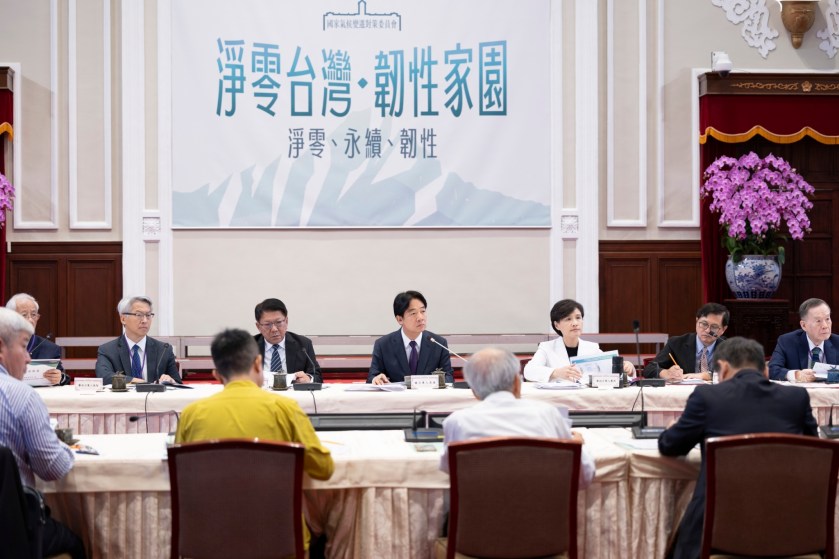
Image credit: 08.08 總統主持「國家氣候變遷對策委員會第1次委員會議」 by 總統府 / Flickr, license: CC BY 2.0.
Given the lack of a majority at the Legislative Yuan for the DPP and the quasi-systematic obstruction conducted by the KMT and the TPP—not to mention their challenge to the very distribution of powers currently examined by the Constitutional Court—the government of William Lai has been compelled to find alternative paths to push for reforms. One answer has consisted in creating three national committees placed directly under his authority at the Presidential Office: the National Climate Change Response Committee, the Whole-of-Society Defense Resilience Committee and the Healthy Taiwan Promotion Committee.
Some critics have pointed out these committees overlap with existing consulting bodies such as the Office of Energy and Carbon Reduction of the Executive Yuan and the Just Transition Committee of the National Development Council. Indeed, the discussions between these advisory platforms will probably be redundant. But Lai has made it clear that the implementation of policies would remain the responsibility of the ministries. By collecting a diversity of opinions, these advisory bodies compensate for the current lack of substantial debate from the Legislative Yuan due to the sabotage of opposition parties.
More significantly, the three committees under the Presidential Office highlight that national priorities for the years ahead are defence, climate change and public health. Or, to put it more explicitly: 1) How should Taiwan accelerate reform of the military and prepare Taiwanese society to deter Beijing from risking an invasion? 2) How to walk the walk of global responses to climate change through energy transition and other environmental policies? 3) How can Taiwan maintain the excellence of its public health system? Actually, the latter two issues can also be seen as instrumental for defence and national security. While the committees on Defense and Public Health haven’t yet announced the list of their members, the climate committee has already held its first meeting, providing an insight into what to expect from the other two committees.
Pro or Against Nuclear Energy?
In addition to Lai standing as convener and three deputy conveners—Deputy Premier Cheng Li-chun, Pegatron Group chairman Tung Tzu-hsien, and Academia Sinica President James Liao—the climate committee gathers 24 members from the government, industries, academics and NGOs. The Minister of Environment, meteorologist Peng Chi-ming, serves as the committee’s executive secretary.
The announcement of its members quickly stirred rumours that the committee would push forward a pro-nuclear agenda through the nomination of nuclear advocates, starting with Tung Tzu-hsien and other members such as Nobel Laureate Lee Yuan-tseh. The polemic was also fueled by contradictory statements from Lai and the government, hesitating between confirmation of the phaseout of old nuclear power plants by 2025 and remaining nonetheless open to “new nuclear” technologies if safety concerns could be fixed, as lip service to opposition parties and industrialists who have called for a stable supply of electricity through nuclear energy. Meanwhile, Cheng Li-chun emphasized the need to address the fundamental problem of nuclear waste before any other consideration.
The committee’s first meeting was held on August 8. In his opening speech, Lai repeated the ambiguity for the sake of an open dialogue: “Energy issues are complex and not simply a black-and-white matter of being for or against nuclear energy.” During the close-door discussion that followed, Lee Yuan-tseh kept quiet on the topic, while Tung Tzu-hsien briefly mentioned that the contribution of nuclear power to mitigate climate change should be carefully considered. Peng Chi-ming oscillated between pro and con statements. He referred to the E.U., which disregards nuclear energy as green electricity but includes it in the sustainable classification guidelines. He then concluded that if there is a technical solution and a social consensus to process nuclear waste, the current policy of a “nuclear-free homeland” could be adjusted.
Apparently, no one mentioned the tremendous risk implied by the already excessive accumulation of high-level nuclear waste (used nuclear fuel rods) in a country exposed to intense seismic activity, as the earthquake that hit Hualien in April reminds us.
Environmental activist Lee Ken-cheng warned the committee from spending too much time discussing nuclear power, which has been controversial in Taiwan for decades, without solving the urgency of climate change or any other environmental problems, only to slow down the development of renewable energies and efforts to curb electricity demand.
Water and Electricity
Lai’s opening speech was followed by two detailed reports, the first one by Peng Chi-ming on the impact of climate change in Taiwan such as the risk of floods and landslides and the increase of cardiovascular diseases as temperatures rise. Regarding carbon reduction, he underlined that although Taiwan has generally improved, efforts have declined when compared with the economic growth rate. As John Liu and Chia-wei Chao explained elsewhere, the exclusion of Taiwan from the U.N. Framework Convention on Climate Change (UNFCC) minimizes the international pressure on Taiwanese corporations to reduce their carbon emissions.
Then, Taipower chairman Tseng Wen-sheng stressed that over the past 15 years, on average, Taiwan’s electricity consumption has grown by a little more than 1% per year. However, in the next decade, it is expected to grow by nearly 3% per year due to the demand from AI and semiconductor industries, expected to account for about 80% of the country’s electricity load growth (of which three-quarters come from semiconductors).
According to The Reporter, the four-hour discussion that followed focused more on industrial development and energy supply than net zero targets or other environmental urgencies such as biodiversity depletion. However, on a positive note, climate change consultant Chao Chia-wei acknowledged that in the past, he participated in many central meetings related to net zero and just transition, but most of these at the deputy minister level and some even lower; instead, this committee is the first place at the highest level of the executive.
Terry Tsao, the head of SEMI, a semiconductor manufacturers’ association, is the committee’s industry representative (along with Paul Peng, the chairman of solar panel maker AUO). Tsao’s presence underlines the economic and geopolitical asset of the semiconductor industry for Taiwan in the “chip wars” era. As demonstrated by the large artificial lake built by TSMC in Hsinchu (Baoshan No. 2 Reservoir), the industry needs a large and stable supply of water. In the spring of 2021, when Taiwan experienced a severe drought, the Hsinchu Science Park and rice production were under pressure until the completion of a waterpipe from the Shihmen Reservoir provided relief. While typhoons used to be mostly seen as a source of disaster, they also carried abundant rains. However, in recent years, their occurrence has become more irregular, leading to greater uncertainty in water availability. Despite this, the industry seems even more concerned about electricity shortage, hence the time allotted to that issue during the first committee meeting.
Synergy with Defense and Health
Peng Chi-ming also expressed that net zero policy, climate change adaptation and disaster prevention form a trinity in order to build a resilient land. This emphasis on disaster resilience presents commonalities with the issues that will probably be discussed at the National Whole-of-Society Resilience Committee, for it is supposed to propose ways to strengthen both Taiwan’s national defence and disaster prevention capabilities. The committee will also deal with the protection of energy resources and other critical infrastructure, the training of civilians, and make sure that Taiwan has sufficient stocks, supplies and shelters.
For the resilience committee, Lai will be seconded by Vice President Hsiao Bi-khim and National Security Council Secretary-General Joseph Wu (former Minister of Foreign Affairs). Meanwhile, it must be noted that Willington Koo, the former National Security Council Secretary-General in Tsai’s government, has now become Minister of Defense. It is rare in Taiwan that a civilian holds this position. Although Koo will probably face resistance from the opposition parties and within the military, from the conservative officers—particularly in the army. But ‘Iron Duke’ Wellington Koo has already acquired solid experience in the state apparel, and his good reputation in Washington will be helpful in implementing substantial and badly needed reforms of the military. In spite of the Legislative Yuan being on a quasi-state of hostage-taking, Iron Duke will find support in the All-out Defense Committee launched last year by DPP lawmakers, with the participation of NGOs such as Kuma Academy, Forward Alliance, Watchout and Academia Formosana, to name just a few of the organizations involved in that initiative of the Legislative Yuan.
Last but not least, the Committee on Public Health will count the former Health Minister Chen Shih-chung as one of its deputy conveners. His experience in tackling Covid-19 will be valuable. But another challenge is ahead as the public health system tends to suffer from a loss of medical staff, restricting available hospital beds.
Paul Jobin is an Associate Research Fellow at the Institute of Sociology, Academia Sinica. Among his recent publications is a journal article on Gaiapolitics, Taiwan and East-Asia (co-authored with Tzung-Wen Chen), a book on Environmental Movements and Politics of the Asian Anthropocene (co-edited with Ming-sho Ho and Hsin-huang Michael Hsiao), and a forthcoming chapter on “Coping with the Climate War and Resurgent Authoritarianism: A View from Taiwan” (forthcoming in Global Rise of Autocracy: Its Threat to Sustainable Future, edited by Barbara Wejnert, Routledge). Paul also teaches at National Chengchi University on Gaiapolitics and War Ecology.
This article was published as part of a special issue on ‘Taiwan’s Legal Landscapes for Environmental Justice and Climate Action.’
 Taiwan Insight