
Written by Yu-Han Huang and Li-Ting Chang.
Image credit: North American Taiwan Studies Association.
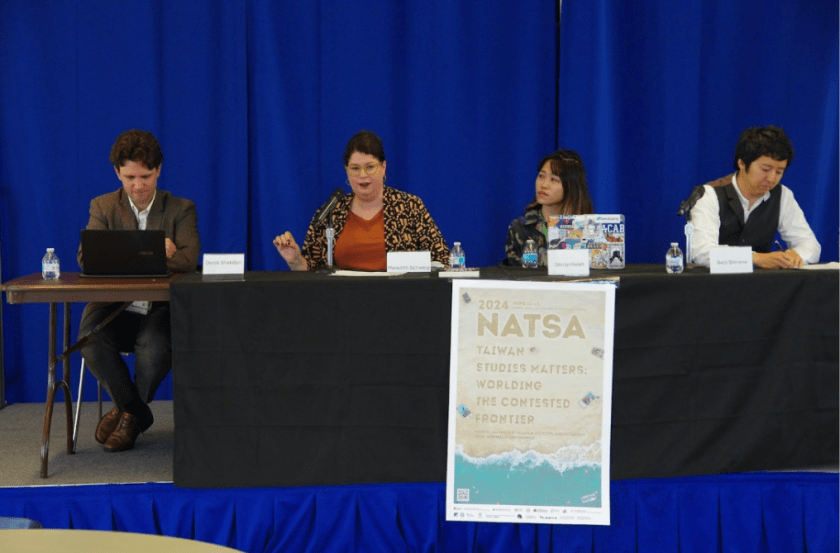
On June 13th in New York City, approximately 80 scholars from diverse humanities and social sciences disciplines gathered for the closing forum of the North American Taiwan Studies Association (NATSA) Annual Conference. Since the first gathering in 1995, NATSA has remained a platform for trans-disciplinary Taiwan researchers to share their latest studies, exchange ideas, and explore the possibilities of the field. In recent years, the blossoming and growing visibilities of Taiwan studies as a field of research have encouraged researchers to rethink the field’s history and future. Corresponding to the conference’s theme, “Taiwan Studies Matters: Worlding the Contested Frontier,” various events explored these issues from diverse perspectives in NATSA 2024. The closing forum, titled “(Re)Writing Taiwan Studies History: Disciplinarity and Knowledge Production of Taiwan,” was not exceptional.
Aiming to historicize the field by tackling how the development of academic disciplines has shaped ways of knowing Taiwan, “(Re)Writing Taiwan Studies History” featured four distinguished experts in Taiwan studies: Seiji Shirane (Department of History, City College of New York (CUNY), Shinyi Hsieh (Hou Family Postdoctoral Fellow in Taiwan Studies, Harvard University), Derek Sheridan (Institute of Ethnology, Academia Sinica), and Meredith Schweig (Department of Music, Emory University). They provided insights into the achievements of existing scholarship and analyzed the main focuses, methodologies, and primary goals of a variety of academic works. Additionally, they identified limitations in the scholarship, critiqued gaps that warrant further investigation, and suggested potential future directions.
Interdisciplinary Taiwan Studies
Seiji Shirane, a historian of modern Japan and colonial Taiwan, delivered a comprehensive overview of Taiwanese history studies over the past thirty years. Shirane first highlighted how Taiwan’s growing prominence has been influenced by postcolonial studies, literary studies, and studies of Taiwanese identity and identity formation since the 1990s. Although Taiwan remained a marginalized subject for mainstream historians in North America, some outstanding dissertations on Taiwan history came out under the fields of China/Japan history in the 2000s and early 2010s. Things changed in 2014 as the increasing significance of Taiwan in Japanese history studies. Meanwhile, he characterized the period from 2014 to the present day as the “honeymoon period” for Taiwan in Chinese history studies as a result of the worsening censorship and decreasing accessibility to primary sources in China. Shirane’s investigation not only showcased the evolution and maturation of Taiwan history studies but also accentuated its interdisciplinary nature through its interactions with an array of fields and subfields.
Specializing in the global history of health and postcolonial feminism, medical historian Shinyi Hsieh’s presentation concentrated on the intertwinement of Taiwan studies and the history of science and medicine. Hsieh introduced fresh perspectives on the practice of solidarity through her research project on the transnational history of trachoma and other scholarly works revolving around colonialism, Indigenous dispossession, Sinophone culture, and more. In her analysis, she observed the connections forged between Native American and Taiwanese children, both marginalized groups suffering from medical exploitation and who have been silenced and forgotten in history. Following her case studies, Hsieh proposed the theoretical concept of “solidarity as a methodological praxis,” arguing that connection, rather than comparison, between historical experiences in different regions helps complicate and rediscover the history of shadowed minorities.
Shirane’s and Hsieh’s discussions about the dialogues between Taiwan studies and other fields reflect a long-time challenge encountered by many Taiwan researchers: to justify the significance of Taiwan. For long, Taiwan is often perceived as too small and consequently too insignificant. Shirane’s presentation underlined the need to demonstrate that Taiwan is compelling, relevant, and worthy of scholarly focus. His personal experiences and observations within his field resonate with the struggles that we, as scholars of Taiwan studies, face. More importantly, it inspired us to consider ways to elevate the importance of local narratives and experiences for global audiences.
If Shirane reinforced the necessity of proving why Taiwan matters, Hsieh’s transpacific framework addresses this by situating Taiwan within a global context and illustrating how it can engage in broader dialogues worldwide. The interconnectedness between Taiwan and communities across the globe lies in their struggles and resistance. Hence, her theory can be interpreted as a productive site to subvert political and medical violence imposed on marginalized groups like the children in Native America and Taiwan. Through this repositioning, what has been unheard and suppressed transforms into part of a collective effort to empower these communities and actualize solidarity in practice.
Studying Taiwan through Anthropology and Ethnomusicology
Derek Sheridan, an anthropologist and veteran NATSA member who mainly focuses on Africa-China relations, elaborated on historical changes in oral history and anthropological research on Taiwan. He called our attention to the factors of institutional promotion and funding opportunities that have impacted Taiwan studies as a discipline. This emphasis encouraged us to recognize knowledge production as something intertwined with political, economic, and social circumstances instead of a self-contained entity.
Sheridan elucidated vital points from a newly published book, Studying Taiwan Before Taiwan Studies: American Anthropologists in Cold War Taiwan, which he co-edited with Wen-Liang Tzeng (Academia Sinica) and Dominic Meng-Hsuan Yang (University of Missouri). Comprised by a series of oral history interviews, this book probes into how American anthropologists perceived Taiwan as a “traditional” Chinese society and interrogates anthropological studies from the 1950s to the 1980s before Taiwan studies emerged as a more established discipline. By introducing the book project and a “prehistory” of Taiwan studies, Sheridan demonstrated how cultural and political contexts could influence knowledge production. Assessing these early anthropologists’ methodologies and pitfalls, Sheridan’s presentation opened a conversation about bridging the gap between two distinct modes of anthropological knowledge production: scientific writing that was prevalent during the Cold War era and the more reflective focus that dominated after the 1980s.
Meredith Schweig, an ethnomusicologist researching the popular music of East Asia in the twentieth and twenty-first centuries, investigated the evolution of ethnomusicology in Taiwan studies. Through her observations of Taiwan studies and related conferences, she indicated the often marginalized role of ethnomusicological studies. To counter this marginalization, she debunked the common misconception that views music and sound solely as aesthetic products, asserting instead that they articulate rich political, economic, and social expressions. Moreover, she reinforced that music, as a form of expression, uniquely transcends boundaries, thereby situating Taiwan within a more fluid, transnational context.
In a broader sense, Schweig argued that ethnomusicological research related to Taiwan challenges the hegemonic, text-centred discourse of ethnography by using sound and music as alternative forms to write ethnography. Ethnomusicologists expand the possibilities for decolonizing existing modes of knowledge production. In this anti-hegemonic vein, such interventions allow for the exploration of more diverse avenues to represent and amplify the voices of marginalized communities within Taiwan and beyond. Both Sheridan and Schweig attempted to offer insights into the field of Taiwan Studies by bringing in diverse sources and emphasizing the importance of contextualizing these sources in the unique times and spaces in which they were generated. Additionally, all four speakers, though using different terms, argued that by (re)positioning Taiwan in a global and transnational context, we would be able to seek connections, foster meaningful dialogues and shed light on the fluidity and resilience of Taiwan as a research subject.
To briefly conclude, Dafydd Fell has declared that we are entering “A Golden Age of Taiwan Studies.” Indeed, scholarly publications about Taiwan have increased in recent years, yet many areas remain understudied and underexplored. Whether the golden age has arrived or is still forthcoming, the speakers—and perhaps also the attendees—of this closing forum reached a consensus: Taiwan’s frontier position does not imply inconsequentiality or triviality; instead, it opens limitless possibilities and invigorates vibrant dialogues.
Yu-Han Huang is a Ph.D. candidate in History at the University of Toronto. His dissertation in progress explores how concrete as a building material and technology reshaped housing and urban landscapes in Cold War Taiwan and South Korea. Yu-Han was a Visiting Ph.D. Candidate to Institute of Taiwan History, Academia Sinica between 2022-23 and am currently a Junior Fellow at the Kyujanggak Institute for Korean Studies, Seoul National University. In 2023-24, Yu-Han served as a Program Commissioner of NATSA.
Li-Ting Chang is a PhD student in East Asian Languages and Cultural Studies at the University of California, Santa Barbara. Her research interests focus on early modern Sinophone literature, print media, affect theories, gender studies, and popular culture. Her dissertation project examines the interplay between the conception of romantic emotions and the love letter as the medium that conveys amorous feelings in Sinophone communities during the early twentieth century. She served as a Program Commissioner of NATSA in 2023-24.
This article was published as part of a special issue on ‘NATSA: Taiwan Studies Matters’.
 Taiwan Insight