
Written by Gerrit van der Wees.
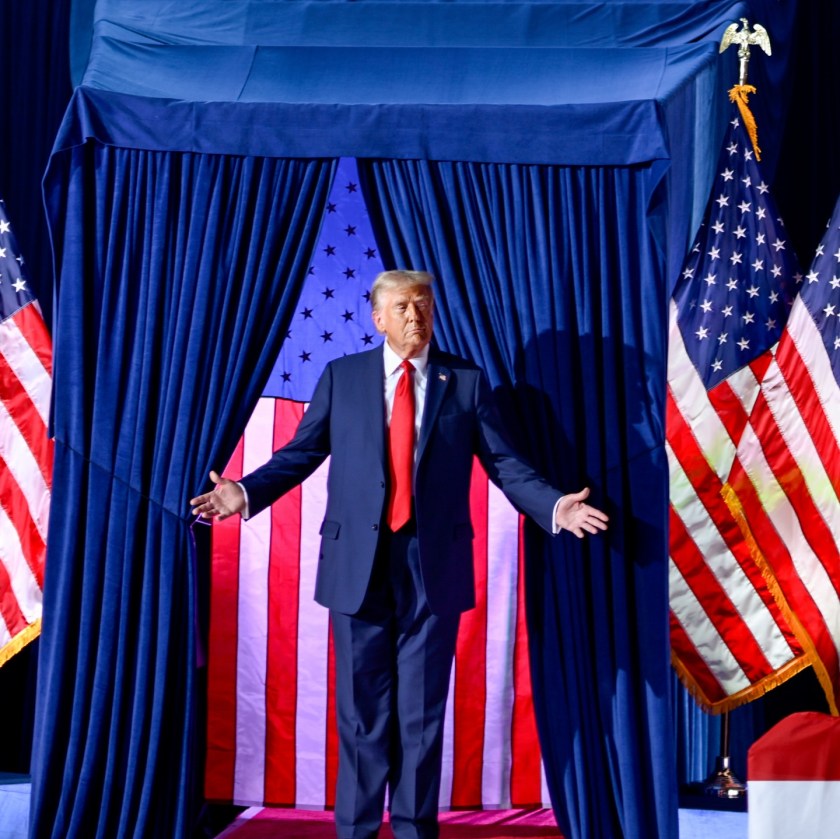
Image credit: Donald J. Trump/ Facebook.
Introduction
It was a nail-biting campaign, putting two very opposite personalities and very different policy choices against each other. Vice President Kamala Harris and her running mate Tim Waltz crisscrossed the so-called Swing States – where a win or loss in even one or two states could determine the Electoral College outcome – while former President Donald Trump and his running mate JD Vance did the same.
It was a very tight campaign, with issues such as immigration, abortion, and the state of the economy dominating the headlines. Foreign policy seldom came up.
Through the evening of November 5, election night, it became increasingly clear that Donald Trump would regain the White House. The early lead that Kamala Harris had built up in the swing states evaporated when the returns from the pro-Trump rural areas came in. At the time of this writing, November 22 2024, Trump had passed the 270 Electoral College threshold with 312 votes, while Harris remained at 226, while for the popular vote, Mr Trump stood at 49.9% versus Mrs Harris’ 48.4%.
In the Senate, the Republicans regained a majority with 53 against 47 for the Democrats, while in the US House of Representatives, the Republicans gained a very thin majority: as of November 22 2024, Republicans had 219 wins, while the Democrats were at 213, with 218 being the necessary number for a majority. Three races are still up for grabs.
The results are highly consequential for Taiwan, its safety and security, and its future. So, what do past pronouncements by Mr. Trump tell us about the policies he might pursue when in office?
What was Trump’s position towards Taiwan during the past few years?
Indeed, Taiwan did quite well under the 2017-2020 Trump administration, with increased arms sales, more high-level visits and enhanced economic relations. The national security and defence team under Trump – people like John Bolton and Matt Poettinger at the NSC, Randy Schriver at DOD, and David Stilwell at State — helped push things in the right direction for Taiwan, in spite of Mr Trump’s own flailing and disturbing antics, and his repeated statements of being such good friends with Mr Xi Jinping.
The problem is that none of these positive views and policies filtered up to Trump himself. As evidence of his state of mind, below are a few quotes from him about Taiwan in the period 2020 until the present, with the most recent pronouncements from an interview with Joe Rogan, only a few days ago.
In an interview with Fox News on August 23 2020, Trump was asked by host Steve Hilton: “If China tries to either invade Taiwan or effectively take control of it and its important industries, would you let them get away with it?”
‘China knows what I’m gonna do. China knows,’ Trump replied. “I think this is an inappropriate way to talk about it. You know. I don’t want to say I am gonna do this or I am not gonna do this. This is just an inappropriate place to talk about it.“
To close observers of US policy towards Taiwan, this does sound like the ultimate form of vague ambiguity.
In an interview with NBC News on September 17 2023, Trump was asked by host Kristen Welker: “… if China were to invade Taiwan, have you madea determination, would you send the U.S. military into Taiwan if President Xi were to invade?” Mr.Trump’s response: “I won’t say. Because if I said, I’m giving away — You know, only stupid people are going to give that … You can’t say that. So, when you ask me that question, I would never say that. Because you give away all your options.”(NBCNews, September 21 2023).
Again, this represents total ambiguity with regard to defending Taiwan. It stands in sharp contrast with the four or even five times President Biden responded with a clear and firm “yes” when asked the same question.
In an interview with Fox News on January 21 2024, Donald Trump was asked by host Maria Bartiromo: “Will, under a hypothetical second Trump presidency, the US protect Taiwan from Chinese aggression even if it meant going to war with China?
Mr Trump declined to give a firm answer but did suggest discontent with Taiwan for allegedly taking semiconductor business away from the US.
The “They are stealing our chip business” meme – which was deemed totally incorrect by prominent experts in the semiconductor field — already came up in an earlier interview with Bartiromo on July 16 2023.
But the most extreme positions came in an interview with Bloomberg/Businessweek published on July 16 2024, when he was asked ‘Would you defend Taiwan against China?’ Mr Trump did not respond directly to the question but started rambling again that Taiwan had taken almost 100% of the American chip business away, that it should pay for its own defence (which it is doing) and that ‘Taiwan doesn’t give us anything.’
But to add insult to injury, Mr Trump added: “Taiwan is 9,500 miles away. It’s 68 miles away from China. (both numbers off by some 30% – GvdW) … and China’s a massive piece of land; they could just bombard it. I mean, they can literally just send shells. They don’t want to do that because they don’t want to lose all those chip plants. ….But I will tell you, that’s the apple of President Xi’s eye, he was a very good friend of mine … Same thing with Putin.”
By all measures, this was another incredibly ambiguous statement, indicative of his bewildering frame of mind. Not a single word about defending Taiwan or deterring China.
And last but not least, on October 25 2024, in his three-hour interview with podcaster Joe Rogan, Mr.Trump repeated his unfounded criticisms of Taiwan, stating that Taiwan “stole” the US semiconductor industry and “don’t pay us money for the protection” from a possible Chinese invasion attempt. He also suggested that stiff tariffs on Taiwanese semiconductor imports would be more prudent than investment to rebuild that industry in the US through the CHIPS and Science Act.
Where do we go from here under a Trump administration?
Thus, what can we expect under a Trump administration? As shown above, his personal views, likes and dislikes are all over the place, and the policies which will be shaped as the Administration is formed will bear the stamp of his more transactional approach, less wedded to building alliances with like-minded countries and more geared towards his perceived self-interest of the United States.
In the first Trump administration, his erratic tendencies were, to a certain extent, moderated by capable officials like Secretaries of Defence Jim Mattis and Mark Esper and National Security advisers H.R.McMaster and John Bolton, who made sure that there were guardrails that prevented worse. It remains to be seen if, in a second term, such checks and balances would exist, as Trump has placed personal loyalty front and centre in his requirements for people serving his government.
Of the current top four foreign affairs and security aides of Mr Trump – former ambassador Richard Grenell, former 3-star general Keith Kellogg, former national security advisor Robert O’Brien and former Secretary of State Mike Pompeo – both O’Brien and Pompeo have an affinity for Taiwan and have spoken out for closer relations. But both Grenell and Kellogg are very much “America First” isolationists who would care less about Taiwan and its future.
On the other hand, there is a second tier of aides – such as Alexander Gray, Stephen Yates, Miles Yu, and Bridge Colby – who might rise to positions of influence and who would push support for Taiwan from inside a Trump administration. In addition, both the mainstream and the right side of the political spectrum within the Republican Party have always been very supportive of Taiwan. It will be interesting to see how these politicians would deal with a situation in which Trump distances himself from Taiwan.
Also, Congress has traditionally played a positive role in shaping policies towards Taiwan ever since the passage of the Taiwan Relations Act in 1979. Taiwan is one of the few issues where one has seen strong bipartisan support, and Congress has generally leaned forward by pushing for Taiwan-friendly legislation, especially during the past half-decade since the passage of the Taiwan Travel Act in 2018 and the Taiwan Allies International Protection and Enhancement Initiative (TAIPEI) Actof 2019.
What will happen in the next four years in US-Taiwan-China relations? Trump’s views and inclinations will be a major determining factor of the overall policies, but – depending on who is in what position — the views and attitudes of his lieutenants can significantly impact the way in which these policies are implemented towards Taiwan.
On November 11, 2024, two choices were announced that actually bode well for Taiwan. Both Marco Rubio (prospective Secretary of State) and Mike Waltz (prospective NSC advisor) are very familiar with and supportive of Taiwan. Waltz visited Taiwan 2 years ago, and Rubio has introduced several Taiwan resolutions, the most recent one as late as April 2024.
Still, turbulent times are ahead for Taiwan.
Gerrit van der Wees is a former Dutch diplomat who currently teaches the history of Taiwan and US relations with East Asia at George Mason University in Fairfax, Virginia. He has also taught US relations with East Asia at the Elliott School for International Affairs at George Washington University in Washington, DC.
This article was published as part of a special issue on ‘US Election: Implications for Taiwan’.
 Taiwan Insight