
Written by Fang-Yu Chen.
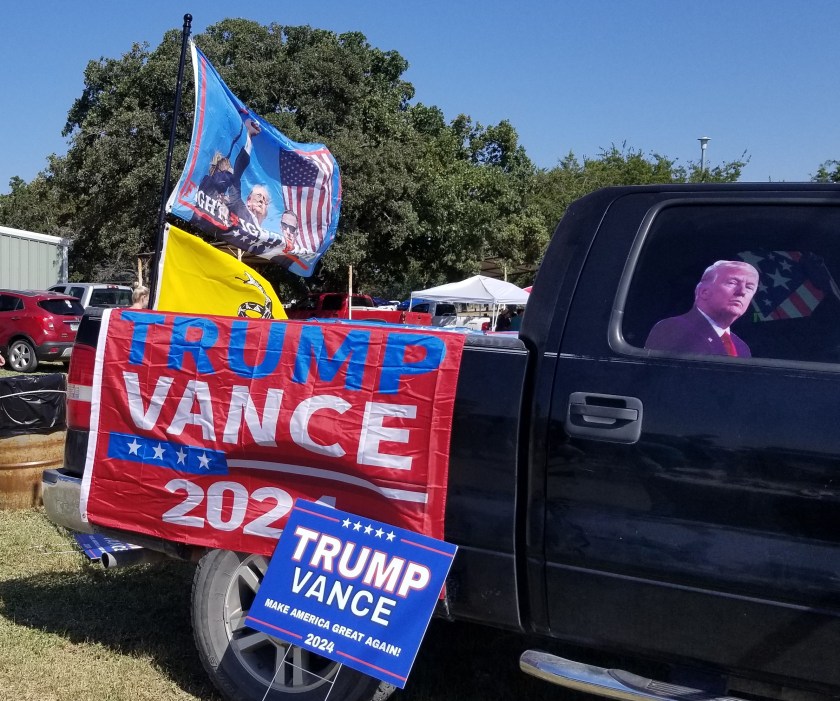
Image credit: Trump supporters by Gilbert Mercier/ Flickr, license: CC BY-NC-ND 2.0
Mr. Trump has been re-elected as the President of the United States, winning by a much larger margin than in his first term. This undoubtedly marks the beginning of a new era, one that will significantly reshape many U.S. policies and international politics. This article will discuss the possible trajectory of Taiwan-U.S. relations, highlighting aspects that may remain stable and those that might change, particularly in response to shifts influenced by Trump’s transactional rhetoric.
From Trump 1.0 to Biden Administration
Four years ago, in 2020, surveys showed that Taiwan was one of the countries most supportive of Trump’s re-election. This was because the Trump administration introduced many Taiwan-friendly policies, and the U.S. Congress passed numerous Taiwan-related bills. At the time, U.S.-Taiwan relations could truly be described as the best in history.
After Mr. Biden took office, U.S.-Taiwan relations continued to progress, and the strategic competition between the U.S. and China persisted, particularly with the continuation of the Indo-Pacific strategy. The Biden administration strengthened relations with allies and adopted a multilateral approach to enhance containment efforts against China. It also “internationalized” the Taiwan Strait issue, raising it in various international forums. Regarding Taiwan, President Biden has repeatedly publicly affirmed the U.S. commitment to military assistance for Taiwan, and U.S.-Taiwan military cooperation has become more open. This is one of the reasons why, in surveys before the election this year conducted by political scientists Lev Nachman and colleagues, over half of Taiwanese respondents expressed support for the Democrats remaining in power. For the people of Taiwan, U.S. foreign policy—especially its policy toward Taiwan—is of utmost importance. Taiwanese people generally perceive the U.S. ruling party to offer more continuity and are less favourable toward party turnover and uncertainties.
From Biden to Trump 2.0
In fact, the cornerstone of U.S.-Taiwan relations, including the U.S.’s One-China policy and its approach to Taiwan, will largely remain unchanged. However, there may be significant shifts in rhetoric. One major difference in Trump’s second term compared to his first is that during the campaign, he mentioned Taiwan numerous times, often in a highly negative context. Regardless of what policies he might implement after taking office, his attitude toward Taiwan is likely to differ significantly from the traditional mainstream approach.
For the issues of the Taiwan Strait, the Biden administration has been actively engaging allies to discuss the matter collectively to achieve a deterrent effect. Under Biden’s administration, there were not only gratuitous military aid packages but also repeated public commitments to defend Taiwan. National Security Advisor Jake Sullivan even likened Taiwan to an ally of the same level as Israel.
The Trump administration, on the other hand, might not have approached U.S.-Taiwan relations in such a multilateral manner but would likely have pursued more direct bilateral exchanges or negotiations. Also, the most important factor is that Trump’s worldview is transactional. He does not subscribe to the concept of allies, as he views everything as subject to negotiation and can be measured by numbers and figures.
In such a framework, the rhetoric of the U.S.’s relationships with its allies, including Taiwan, would be significantly changed, particularly in areas of democratic values and beliefs of freedom—what are often referred to as “soft power.” These elements would retreat from the forefront of international politics under Trump’s approach.
Taiwan’s longstanding emphasis on democratic values and economic prosperity with its alliance, particularly with the U.S., may face shifts in rhetoric under Trump. For example, even Taiwan’s frequent reference to TSMC as the “sacred mountain protecting the nation” could become problematic, as Trump has accused it of “stealing American jobs.” Highlighting TSMC’s importance might inadvertently remind Trump of his negative stance, portraying TSMC as a liability for the U.S. However, in reality, TSMC collaborates closely with many major U.S. companies, such as Apple, as iPhones and other products rely on TSMC’s advanced chips. Unlike the zero-sum competition of automobiles, such as Toyota and General Motors, in the 1980s, the relationship between TSMC and U.S. corporations today is largely symbiotic. Unfortunately, it will be challenging to alter Trump’s beliefs.
Trump’s blunt and transactional style could spark a new wave of scepticism toward the U.S. in Taiwan (and globally). Historically, this scepticism has centred on doubts about America’s commitment to Taiwan, arguing that the U.S. only supports Taiwan for financial gain and treats Taiwan as a bargaining chip. Trump’s rhetoric may directly fuel these sentiments. For example, two or three years ago, when TSMC began setting up new facilities in the U.S., conspiracy theories emerged, claiming that the U.S. intended to “steal TSMC and hollow Taiwan’s industry.” Now, with the U.S. possibly imposing waves of tariffs to push more companies to establish operations domestically, these conspiracy theories in Taiwan and other places could gain further traction.
Since 2022, the content of scepticism toward the U.S. has also evolved. Some narratives blame the U.S. for global tensions, suggesting that NATO’s expansion, such as Ukraine’s alignment, provoked Russia or that the U.S. deliberately maintains tension to sell more weapons. These conspiracy theories are widespread. Trump’s transactional approach is likely to provide more material for cognitive warfare, intensifying such narratives.
The “America First” rhetoric could further impact the U.S.’s international reputation and popularity. Because most people are not familiar with the nuances of “America First” policies, it becomes easy for some propaganda machines to manipulate these ideas into claims like “America is selfish,” “America doesn’t genuinely help Taiwan,” or “America only wants to profit from arms sales.” U.S. demands for Taiwan to increase defence spending, coupled with prejudices held by Trump or his inner circles (especially some pro-China business tycoons like Elon Musk and some pro-Russia politicians), could be distorted into ideal material for cognitive warfare.
The China Factor
On the other hand, China has been aggressively promoting its “China Model” in recent years, promoting its own interpretation of democracy and freedom while leveraging local collaborators in Taiwan (and worldwide)—media figures, traditional outlets, and online influencers—to spread its narratives. This public opinion battleground is a critical aspect of cross-strait relations. To counter this, Taiwan and the U.S. could collaborate more closely on combating China’s public opinion warfare and the united front rhetoric.
The author believes that the fundamental framework and dynamics of cross-strait relations will not undergo major changes. At the same time, China is not likely to change its policy of unification (i.e., annexation) toward Taiwan. The focus should instead be on observing potential shifts in U.S. policy toward China and its allies. The Trump administration may implement numerous tough and unpredictable policies toward China. Under such circumstances, China may also adopt significant policy responses to the U.S.
As U.S.-Taiwan discussions move toward larger-scale arms sales or enhanced military exchanges beyond just arms deals, China is bound to react strongly. Both Secretary of State-designate Rubio and National Security Advisor Michael Waltz have previously advocated strengthening Taiwan’s defence and have co-sponsored several legislative proposals for Taiwan issues. Therefore, we can expect significant responses from China when deliberations on reinforcing Taiwan’s defence take place. This will, in turn, solidify the resolve of hardliners in the Trump administration’s China policy.
At the same time, the tough policies on China would also result in pushback from pro-China politicians. As we all observed, Taiwan is facing a significant tangle in domestic party politics. The opposition parties, including KMT (Chinese Nationalist Party, Kuomintang) and TPP (Taiwan People’s Party), both oppose the budget of defence and are often sceptical of U.S.-Taiwan relations. The leader of Taiwan must come up with new ways to negotiate with the opposition and communicate with citizens. For Taiwan’s foreign relations, aside from continuing to strengthen its self-defence capabilities, it must also employ various means—official diplomacy, public diplomacy, and grassroots diplomacy—to sustain the “internationalization” of the Taiwan Strait issue, ensuring more countries remain concerned and involved in the matter. In fact, regardless of who is in power in the United States, Taiwan must continue racing against time to build up capability and resilience to the potential contingency.
Fang-Yu Chen is an Assistant Professor of Political Science at Soochow University, Taiwan. He is also the chief editor of U.S. Taiwan Watch. chenfy@scu.edu.tw
This article was published as part of a special issue on ‘US Election: Implications for Taiwan’.
 Taiwan Insight