
Written by Anthony Li.
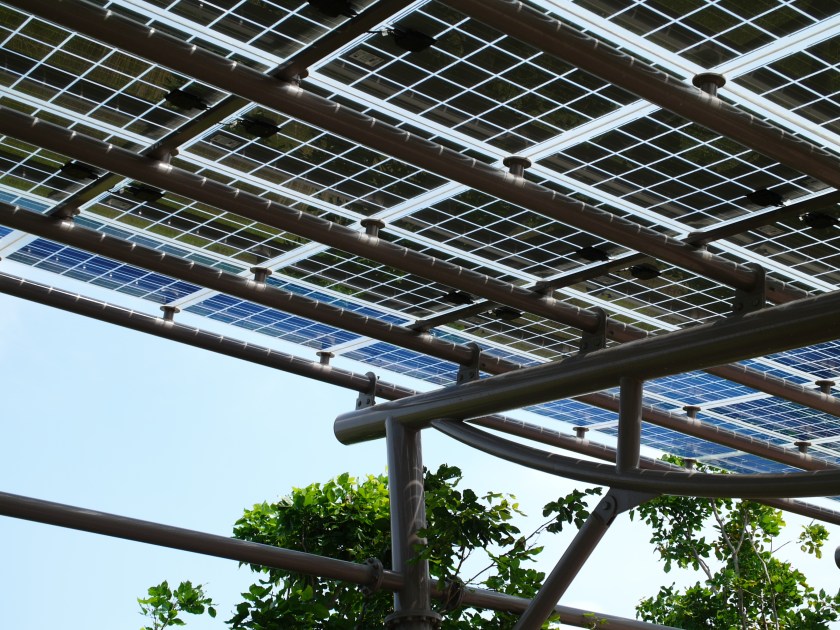
Image credit: 南科-太陽能光電公園 by Christ Peng/ Flickr, license: CC BY-NC-ND 2.0.
Since his assumption of office in May 2024, President Lai Ching-te (賴清德) elevated the policy issue of energy transitions to the highest level of the government by establishing the National Climate Change Committee (國家氣候變遷對策委員會, NCCC) under the Office of the President unprecedentedly. In the first meeting of the NCCC in August 2024, the first topic being discussed was related to the objective of net-zero emissions by 2050 and the challenges of energy transitions in the future. Vice-Premier Cheng Li-chun (鄭麗君), who serves as the vice-convenor of the NCCC, was subsequently tasked to lead a policy coordination network within the government. This network comprises the deputy heads of the ministries at the central level and the deputy magistrates/mayors of county/municipal governments at the local level with a view to achieving green growth and net-zero emissions. In the meantime, Premier Cho Jung-tai (卓榮泰) also announced the government’s aspiration to have 30% of total electricity generated from renewables by 2030. It is not surprising that actions were swift to address the issue of energy transitions, given its strategic importance. However, the insufficiency of green energy continues to pose a challenge as semiconductor manufacturing and artificial intelligence, which the central government envisions to be the driving forces of the economy in the future, are expected to be the big energy consumers in the years to come. Hence, boosting the level of renewable energy generation by all means becomes an imminent task for the government.
Solar energy and local governments
Renewable energies in Taiwan include not only solar energy, but also wind energy, geothermal, micro-hydropower, etc. According to the White Paper on Land Use for Energy (Solar Energy) (能源用地白皮書-光電篇), which was promulgated in August 2024 by the Energy Administration under the Ministry of Economic Affairs (MoEA), the development of solar energy continues to assert policy priority. The White Paper reveals the government’s strong commitment to the development of rooftop solar since its growth has overshot the government’s previous target of installed capacity. Another type of solar energy, ground-mounted solar, is not out of the picture but remains an unshaken policy objective despite the fact that it has been the source of many confrontational conflicts with agriculture and aquaculture for the past years. The White Paper posits that ground-mounted solar, which involves the coupled use of farmlands and fishponds with solar energy, should be encouraged when the institutional safeguard can be further strengthened to guarantee the cohabitation of agricultural activities and solar energy.
Regardless of the type of solar energy, the modular nature of photovoltaic panels technically allows solar energy to be flexibly installed at a scale that fits a diversity of environments. The policy choice of solar energy over other types of renewables presents a lower barrier for people from all walks of life to get aboard. Nevertheless, the vast number of applications to install solar energy could administratively overload the government which aims at achieving a higher level of capacity installation but at the same time needs to ensure the safety and stability of the entire energy infrastructure. For this reason, central-local collaboration in energy governance is instrumental, where the central government delegates more responsibilities to the local governments in solar energy development.
The White Paper not only affirms the principle of central-local collaboration from an administrative perspective but also from a political perspective, as it highlights the importance of local communication with the citizens (especially the Indigenous people) as well as the need to distribute benefits to the local residents in solar energy development. Such a decentralised mode of energy governance is supposed to be more responsive to the needs of the local residents, but concerns are raised about the capacity of local governments to live up to the tasks.
For one thing, the local governments appeared incapable of controlling the local illicit activities related to solar energy installation, and the severity of the problem in the last year rang an alarming bell for the central government as solar energy investors could be staved off. Also, the recent legislative changes may not strengthen the role of local governments in energy co-governance. While the controversial amendment to the Act Governing the Allocation of Government Revenues and Expenditures (財政收支劃分法) in December 2024 provided more fiscal resources for the local governments in general, scholars such as Professor Lu Yu-cheng (呂育誠) expressed concerns about whether the local governments could really use the new fiscal resources efficiently. Moreover, Professor Cheng An-ting (鄭安廷) noted that the suspension of the implementation of the Spatial Planning Act (國土計劃法) on the last day of 2024 could cast a big shadow over the feasibility of the coupled use of land for ground-mounted solar in the coming six years. The Spatial Planning Act is supposed to legally empower the local governments to serve as a communicative platform for the local residents so as to address their diverse use of land more flexibly. Without such legal obligation, local government officials are unlikely to play a greater role in resolving the conflicts with ground-mounted solar under the existing laws.
State-sponsored renewable energy with local communities
In addition to the policy urge of the central government to engage the local governments and solar energy companies, it is evident that central-level agencies also promote renewable energies through local communities. For example, the Ministry of Environment hopes to build on the existing Low-carbon and Sustainable Homeland Scheme (低碳永續家園計畫) to identify local communities that have idle rooftops for solar energy, but the progress was slow. Meanwhile, the Agency of Rural Development and Soil and Water Conservation (農村發展及水土保持署, RDSWC) under the Ministry of Agriculture encouraged various local communities to develop renewable energies under the objective of rural revitalisation. Together with the indispensable support of environmental NGOs such as The Society of Wilderness (荒野保護協會) and Homemaker United Foundation (主婦聯盟環境保護基金會), a new local solar energy cooperative was established in January 2024 in Neipu Township of Pingtung County and joined the small fleet of seven energy cooperatives in total since 2016. In another instance, the RDSWC guided the production of micro-hydropower by a group of local residents in Gongguan Township of Miaoli County, but it failed because of the inter-departmental disagreement over the value of local participation.
Meanwhile, the subsidy scheme by the MoEA bore some fruit as it successfully supported the formation of a solar energy company by the local residents in Penghu County. The same subsidy scheme was also conducive to another local initiative with micro-hydropower production in Jinshan District of New Taipei City. However, these are more the exception than the norm as quite a number of local initiatives failed to materialise in the end. Indeed, it takes more than the government’s subsidy for local communities to succeed, but it remains important. Some practitioners argue that reduced subsidies under the feed-in tariff scheme could further discourage local residents from taking part in solar energy. Nevertheless, governmental financial support is unlikely to increase for the foreseeable future, given the years-long fiscal deficit of the Taiwan Power Company, partly attributed to the policy-driven subsidisation of the renewables and the recent politicisation of the issue in the Legislative Yuan.
Concluding remarks
Evidence suggests that the early Lai Presidency adopted a whole-of-society approach to expediting energy transitions through the mobilisation of all levels of government, commercial enterprises, NGOs, and local communities to pool resources into renewable energy development amidst the intense politicking in the Legislative Yuan. Challenges lie ahead when the central government tries to delegate the responsibility to local governments to handle the lucrative business of renewable energy in the pursuit of efficiency. Collaboration between governmental agencies and local communities can be arduous and usually not very efficient, but it exhibits a healthy dose of experimentalism in the ways by which renewable energy can be fostered according to the local conditions. This provides valuable lessons for practitioners in Taiwan regardless of the outcomes. More importantly, as a practitioner of the Transition Town Movement in Japan Hide Enomoto (榎本英剛) once noted in a book the meaningful inclusion of citizens to collectively plan and manage renewable energy embodies the principle of energy democracy where it empowers local energy users to take greater control over the energy infrastructure they consume as a daily necessity, allows them to re-connect with one another, and re-orients energy development more in line with the local needs.
Anthony Ho-fai Li is a PhD candidate in public administration at the University of Hong Kong. He specialises in institutional analysis, collaborative governance, and Taiwan’s energy transitions. He is also an Adam Smith Fellow (2022-23) and a Research Fellow of Earth System Governance.
This article was published as part of a special issue on ‘Farewell 2024, Fresh start 2025?’.
 Taiwan Insight