
Written by Brian Hioe.
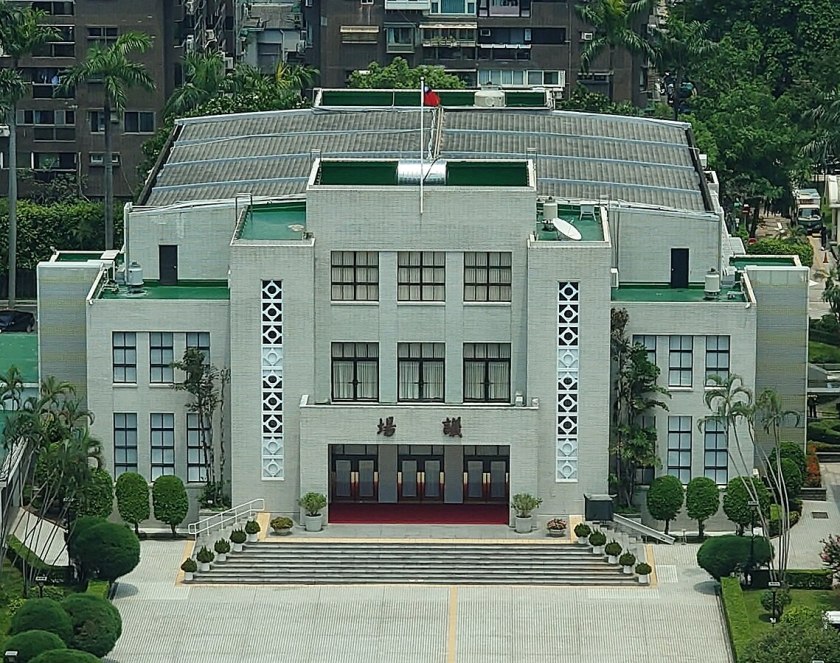
Image credit: Legislative Yuan Assembly Hall 20240626 by Yu tptw/ Wikimedia Commons, license: CC BY-SA 4.0.
Taiwan’s partisan contestation in the legislature proves a throwback to the past. Namely, during the Chen Shui-bian era, the KMT also sought to obstruct the DPP-controlled presidency in acting to block budgets. The contention in that era could be traced back in many ways to the set-up of Taiwan’s political system, as to questions of whether it is the executive branch or legislative branch that held dominance and whether Taiwan has a presidential or semi-presidential political system. At the same time, though the present superficially echoes the past, in other ways, the structural dynamics at play are different. It is important to note why.
Long-Term Structural Weakness for the Pan-Blue Camp
Compared to the Chen era, Taiwan has experienced multiple transitions of presidential power in the decades since then. When Chen took office for the first time, it was an unprecedented set of circumstances for a non-KMT president to hold power, whereas Taiwan has seen many transitions of power since then.
Even so, it was only from 2016 to 2024 that a non-KMT political party ever held power in the legislature. As such, the present outlook for Taiwanese politics can be understood as a reversion to the historical status quo, at least when it comes to the legislature. Yet, even with the KMT again in control of the legislature as it did during the Chen Shui-bian administration, what proves unprecedented in Taiwanese politics is the DPP holding presidential power for a third consecutive term.
This explains why the KMT has carried out a series of moves aimed at arrogating powers that normally belong to the executive and judicial branches of government. The KMT can no longer bank on the presidency, reverting back to its control after eight years of consecutive DPP governance. Or it may be that the KMT does not wish to wait it out for the next electoral cycle in order to try and push for power.
It may be this fact that explains the KMT’s decision to undertake moves never seen before in the history of Taiwanese politics. The budgetary cuts sought by the KMT are the largest in the history of Taiwan, even as the KMT has sought to frame its cuts as routine in nature. To this extent, with moves aimed at freezing the ability of the Constitutional Court to make rulings, the KMT would be seeking to paralyse one of Taiwan’s branches of government. Cuts to the Control Yuan are likewise aimed at paralysing another of Taiwan’s five branches of government.
To this extent, the legislative powers that were sought by the KMT last year, in granting the power to legislators to summon individuals for questioning and imposing substantial fines on them if they did not comply, lied, or deflected questioning, were similar. Namely, such powers normally belong to the executive and judicial branches of government. In this sense, the KMT’s actions point to a broader pattern of attempting to revise the system of checks and balances in the Taiwanese legislature.
The KMT has sought budgetary cuts larger than any of those that took place during the Chen administration, as well as sought to fundamentally reshape the balance of power in Taiwanese politics despite its relative weakness compared to the past. Namely, apart from failing to win the presidency back from the DPP in three election cycles, in past years, the KMT has faced internal splits and lack of traction among young people, with the party having less than 9,000 members under 40 several years ago by its own admission. Taiwanese identity trends that continue to be on the rise further call into question the KMT’s ability to hold on to power without a drastic change in course at a time when former youth reformers in the party who previously called for a change in the party’s pro-China image to become more electorally viable have now themselves embraced claims China will not make war on Taiwan Similarly, the DPP may have actually been closer to winning an outright majority in the last election cycle, except for the design of Taiwan’s electoral system.
Path Dependency?
But, the KMT may be caught in a pattern of path dependency. Namely, the KMT has for some time sought to recreate what it views as successful tactics of the Chen era in order to try to return to power. While some moves may not surprise–such as attempting to lean into the political narrative that it is the only party in Taiwan able to conduct cross-strait communications with the CCP–this also includes attempting to frame the DPP as corrupt and seeking to bring down the DPP with graft allegations such as those that led to Chen’s downfall.
Broadly speaking, this points to how the current paralysis in Taiwan’s government system reflects how many of the unresolved political issues of Taiwan’s past have now come home to roost. For one, the wide-ranging slate of actions by the KMT-controlled legislature in the past year—to seize powers over budgeting that normally belong to the executive branch, investigative powers that normally belong to the judiciary, raise barriers to recall in a way that further consolidates legislative power, and to freeze the operations of the Constitutional Court, as the highest organ of the judiciary—reflect a way in which the constitutional system that was set up in the course of Taiwan’s democratisation is being stress-tested. Again, the current struggle can be seen as one between the legislative and executive branches for dominance of the government.
Furthermore, the looming constitutional crises that are likely to occur regarding the attempt to freeze the Constitutional Court, raising barriers to recall, and over whether budgeting powers belong to the executive or legislative branches of government over budgetary powers are the recurrence of a constitutional crisis in Taiwan after a decade.
The last such crisis that occurred in Taiwan was in the course of the 2014 Sunflower Movement. Interestingly enough, the conflict then was also between executive and legislative authority, even if the KMT controlled both the legislature and the presidency. In the course of the Sunflower Movement, protesters framed the KMT as intervening in the processes of the legislature using executive power. Now, the reverse takes place, with the KMT framing its actions as reacting to executive overreach.
The events of the past year led to the reemergence of social movement dynamics in the form of the Bluebird Movement, the largest set of protests in a decade. Since then, the dynamic has now shifted toward campaigns to recall all KMT legislators and, in that way, hit reset on the legislature. This can be understood as a way in which the public is acting to make up for the fact that the set-up of the Taiwanese political system does not have a means of dissolving the legislature and calling for a new set of elections, nor that the president has any veto power over the legislature.
It is to be seen what comes next in Taiwanese politics, then. It is unclear if the recalls will succeed, in that they may not meet benchmarks to be binding. But the long-term structural dynamics of Taiwanese politics are still against the KMT, and it may be playing with fire. Attempting to reshape the Taiwanese political system as though it had a strong political mandate from the electorate may not be the wisest move.
Brian Hioe is one of the founding editors of New Bloom. He is a freelance journalist, as well as a translator. A New York native and Taiwanese-American, he has an MA in East Asian Languages and Cultures from Columbia University. He graduated from New York University with majors in History, East Asian Studies, and English Literature. He was a Democracy and Human Rights Service Fellow at the Taiwan Foundation for Democracy from 2017 to 2018. He is currently a non-resident fellow at the University of Nottingham’s Taiwan Research Hub.
This article was published as part of a special issue on ‘Taiwan’s Budget Crisis’.
 Taiwan Insight
