
Written by Hsin-Yi Chao.
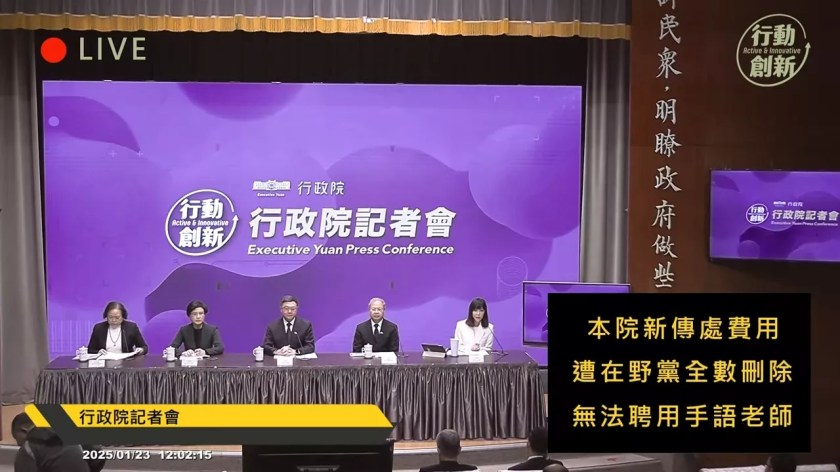
Image credit: Screenshot of the live stream of the Executive Yuan Press Conference.
Human Rights and Cultural Equity in Cultural Policy
Human rights constitute the fundamental rights that ensure dignity and equal opportunities for all individuals. While concepts of dignity and rights have evolved across different civilisations, the United Nations formally recognised cultural rights in the Universal Declaration of Human Rights (UDHR) on December 10, 1948. Article 27 of the UDHR explicitly states that “everyone has the right to participate in cultural life and enjoy the benefits of scientific progress.” This declaration established the foundation for cultural equity by acknowledging cultural participation as an essential human right. However, the recognition of the rights of persons with disabilities emerged much later. It was not until half a century later, in response to global ageing trends and the increasing awareness of social inclusion and cultural equity, that international policies began addressing this issue in greater depth. On December 13, 2006, the United Nations adopted the Convention on the Rights of Persons with Disabilities (CRPD), which established a comprehensive framework for safeguarding the fundamental rights of persons with disabilities worldwide. This convention serves as a pivotal instrument in promoting cultural accessibility and participation.
In Taiwan, the Legislative Yuan passed the Act to Implement the Convention on the Rights of Persons with Disabilities on August 1, 2014. Subsequently, on August 20 of the same year, the act was promulgated through Presidential Order No. 10300123071, marking a significant step toward institutionalising social equity and fostering broader public awareness of disability rights. Article 30 of the CRPD, incorporated into Taiwan’s legal framework, explicitly guarantees “the right of all individuals to participate in cultural, recreational, leisure, and sports activities.” This provision underscores cultural participation as a fundamental right, mandating those cultural venues—including museums, art galleries, cinemas, and performing arts centres—offer accessible infrastructure and opportunities for artistic expression. By implementing these measures, the government ensures that persons with disabilities can equitably engage with cultural resources, thereby fulfilling the principles of cultural equity and inclusion.
Trends in Cultural Equity Subsidies Since 2016
Since 2016, Taiwan’s Ministry of Culture (MOC) has promoted nationwide cultural activities under the name of “cultural equity.” Initially, subsidies for cultural equity fell under the category of “Subsidy Guidelines for Promoting Literature Reading and Humanities Activities,” specifically providing financial support for cultural equity initiatives. In 2018, MOC separated “cultural equity” into an independent subsidy program and issued specific “Guidelines for Promoting Cultural Equity Subsidies,” expanding eligibility to individuals, civil organisations, and local governments. However, after 2023, individual applications were no longer accepted, limiting funding to organisations and institutions.
From an annual budget perspective, cultural equity subsidies have shown an upward trend. In 2016, the approved funding was approximately NT$1.58 million, increasing annually. In 2017, cultural equity subsidies were not openly announced; instead, the MOC implemented a special project titled “Cultural Accessibility Program for Persons with Disabilities and the Elderly,” allocating funds to the National Taiwan Museum of Fine Arts and several lifestyle aesthetics centres for developing barrier-free guided tours and educational materials. After reopening applications in 2018, funding continued to grow, reaching a peak of NT$5.48 million between 2021 and 2022.
Cultural Equity Subsidies Lagging Behind Overall Cultural Budget Growth
In 2023, the MOC did not disclose the total amount allocated for cultural equity subsidies. However, the ministry launched the “Revitalisation and Confidence” program that year, with a total budget of NT$2.25 billion, including NT$750 million for expanded adult cultural subsidies and NT$1.5 billion for various cultural revitalisation initiatives. Despite these efforts, the cultural equity subsidy budget—including both general applications and special project subsidies—amounted to only NT$3.61 million.
In 2024, the MOC’s annual budget surpassed NT$30 billion for the first time, reaching NT$30.393 billion, with an administrative budget of NT$29.009 billion, marking an annual increase of nearly 12%. However, the allocation of cultural equity subsidies remains uncertain. Additionally, the passage of the Fiscal Distribution Act amendment at the end of 2024 mandated the central government to transfer NT$375.3 billion to local governments, resulting in an NT$7.33 billion reduction in the MOC’s budget. This could further impact the scale of cultural equity funding. Despite the overall budget increase, cultural equity subsidies—including general and special project subsidies—fell to NT$3.44 million, a decline rather than an increase.
Although the MOC’s total budget has grown, cultural equity funding remains unstable and subject to fiscal policy changes. This situation may challenge the advancement of cultural equity policies.
Cultural Budget Cuts Should Not Sacrifice Fundamental Rights
At the end of 2024, the Legislative Yuan reviewed the 2025 budget and entirely cut funding for the Executive Yuan’s Department of Information Services, leading to the suspension of sign language interpretation services. This decision sparked public concern. On January 23, 2025, during a press conference addressing the budget, the Executive Yuan displayed a sign in place of a sign language interpreter, stating, “The budget for the Department of Information Services has been eliminated by the opposition party, making it impossible to hire sign language interpreters.”
This move prompted strong reactions from disability rights groups. The Taiwan Disability Studies Association issued a statement condemning the Executive Yuan for prioritising the sacrifice of deaf individuals’ access to information in response to budget cuts, questioning whether the government was using their rights as a political bargaining chip. The Taiwan Deaf Association also called on legislators to recognise the importance of information accessibility for the deaf community and to reinstate the necessary budget for sign language interpretation services.
Opposition parties countered that the Executive Yuan was engaging in emotional manipulation, exploiting marginalised communities. They argued that the Executive Yuan should have alternative budgetary sources for sign language interpretation rather than discontinuing the service entirely due to funding cuts. In response, the Executive Yuan sought assistance from the Taipei City Government’s communication services for persons with hearing and speech impairments, allowing sign language interpretation to resume at press conferences on February 6, 2025.
This incident highlights that despite legal frameworks such as the Cultural Basic Law and the Convention on the Rights of Persons with Disabilities (CRPD) emphasising information accessibility and cultural inclusion, the government has not fully upheld these rights in budget planning and execution. As we advance, more careful budgeting is needed to protect the fundamental rights of marginalised communities.
Policy Recommendations: Strengthening Cultural Equity Implementation
To effectively implement cultural equity, Taiwan’s government must adjust policies and execution strategies in line with CRPD standards and public expectations. The following recommendations are proposed.
First, increase budget allocation. The government should significantly expand funding for cultural equity, gradually increasing its share to at least 5% of the MOC’s total budget to reflect the proportion of persons with disabilities in Taiwan’s population. This would ensure clear financial support for cultural equity initiatives and prevent disproportionate budget cuts during fiscal adjustments.
Second, institutionalise demonstration projects. The MOC should review past cultural equity demonstration projects and integrate effective measures into regular operations. For example, museums, art galleries, and cultural centres should be required to provide permanently accessible services such as barrier-free guided tours, sign language interpretation, and multisensory interactive exhibits rather than limiting them to the duration of subsidy projects.
Third, enhance inter-ministerial cooperation. Implementing cultural equity requires collaboration among various government agencies. For example, the MOC should work with the Ministry of Transportation, the Ministry of Health and Welfare, and the Ministry of Education to promote a “Comprehensive Cultural Accessibility” program. This could include increasing accessible transportation services, funding cultural accessibility education in schools, and coordinating with social welfare agencies to organise cultural experiences for persons with disabilities.
Finally, strengthen professional training and awareness. To ensure the effectiveness of cultural equity policies, capacity-building for cultural administrators and event organisers is crucial. The government should invest in training museum curators, exhibition planners, and event organisers on universal design and multisensory interpretation principles. Additionally, cultural institutions should engage persons with disabilities and other marginalised groups in planning processes to ensure their perspectives inform inclusive cultural programming.
Since Taiwan began promoting cultural equity in 2016, policy frameworks have gradually improved, and subsidy funding has increased. However, resource allocation and institutionalisation remain insufficient. To overcome these challenges, the government must reinforce budget planning, inter-ministerial cooperation, institutional design, and professional training to ensure that cultural equity policies are implemented fairly and effectively. Only through these efforts can Taiwan achieve the vision of “culture for all,” allowing diverse communities to participate equally in cultural life, fulfilling the human rights commitments outlined in the CRPD.
Dr. Hsin-Yi Chao is an Assistant Professor at National Chung Hsing University and serves as the Chairperson of the Taiwan Art Beyond Vision Association. With interdisciplinary expertise spanning art, architecture, education, museums, and psychology, her research focuses on art participation for persons with disabilities, accessible technology, and inclusive spatial environments. She has been deeply engaged in cultural equity policies and actively advocates for allocating 5% of cultural budgets to ensure the realisation of fundamental cultural rights.
Further reading by the author can be found here.
This article was published as part of a special issue on ‘Taiwan’s Budget Crisis’.
 Taiwan Insight