
Written by Dr. Josie-Marie Perkuhn M.A.
Image credit: Front of the emission-free model house at the Shalun Green Technology Demonstration Site, Tainan. Taken by the author on 06 May 2025.
On 17 May 2025, Taiwan shut down its last operational nuclear power plant (NPP3) in Maanshan (馬鞍山核能發電廠), located in Hengchun, Pingtung County. This marks the conclusion of nearly five decades of nuclear power generation on the island. Taiwan’s nuclear era began in 1978, when a boiling water reactor (BWR) unit at the Chin Shan plant (金山核能發電廠) commenced commercial operations. In total, Taiwan built four nuclear sites, each with two reactor units, including Kuosheng (國聖核能發電廠) and Lungmen (龍門核能發電廠). The Lungmen project was halted, initially in the wake of the Chernobyl disaster in 1986 and then permanently in 2016 after the Democratic Progressive Party (DPP) took office and confirmed a full phase-out by 2025. The Maanshan site housed two pressurised water reactors (PWRs). The first began operations in March 1984 and was decommissioned in July 2024. The second, connected to the grid in February 1985, is now the last to be closed. While nuclear energy once supplied 52 per cent of Taiwan’s electricity in 1985, this share had fallen to just under 20 per cent by 2000. During Tsai Ing-wen’s presidency, this decline accelerated: from 19 per cent in 2019 to 9.1 per cent in 2022, and down to merely 4 per cent in 2024. Renewables are expected to assume a growing portion of Taiwan’s energy demands—but how prepared is Taiwan for this transition? What doubts exist, what drives the commitment to a nuclear phase-out, and what role are renewables positioned to play?
Taiwan’s energy supply continues under significant strain. Although the government has honoured its commitment to phase out nuclear power, increasing consumption means that fossil fuels, particularly heavy oil and coal, still constitute over 70 per cent of electricity generation. Environmental concerns regarding fossil fuel usage are growing and now extend well beyond green advocacy groups. Between 2003 and 2023, electricity consumption per capita increased from 8,885 to 11,846 kWh. Taiwan’s globally significant technology sector, particularly semiconductor manufacturing led by TSMC, continues to drive demand for reliable, emission-free power. After signing the first power purchase agreement (PPA), tech giant Google signed another green deal in April for geothermal power production. Yet Taiwan’s domestic energy resources are limited, raising concerns over possible energy shortages. With a 97-to-3 import-to-domestic ratio, Taiwan is highly dependent on energy imports, a vulnerability in the event of a blockade. Although renewable energy output rose from 127 to 269 (in units of 102 GWh) between 2016 and 2023, sudden transformational change remains elusive.
As the final decommissioning approached, debates around extending nuclear operations reignited. On 18 February 2025, the Taipei Times reported that the opposition Kuomintang (KMT) supported extending nuclear power, citing internal polling that showed 73 per cent public support for prolonging its use. Deputy Convener of the National Climate Change Committee, Tzu-hsien Tung (童子賢), also weighed in on 9 March, stating that nuclear energy is “very important to Taiwan” as a stable and nationally controlled energy source that enhances resilience. Criticism of the DPP government has been consistent, particularly for pursuing the phase-out even after a 2018 referendum. Anton Ming-Zhi Gao, an outspoken proponent of nuclear energy and a National Tsing Hua University alumnus, has argued that the government downplayed nuclear power’s role in achieving its 2025 Net Zero Roadmap. He also criticised the handling of the referenda, suggesting that representative democracy had overridden the will expressed in direct democracy. Nonetheless, in a later referendum, a narrow majority rejected the resumption of the Lungmen 4 project, supporting the government’s stance. Recent discussions on investing in costly small modular reactors (SMRs) have further fuelled environmental concerns (BTI 2024).
Civil society continues to play a prominent role in opposing nuclear energy. One notable example is the Green Citizens’ Action Alliance (GCAA), founded in 2000 to promote environmental sustainability and social justice. Since 2013, the GCAA has organised the “No Nukes” film festival, which was renamed in 2023 as the “Climate Tipping Point Film Festival” (氣候致關影影展), reflecting broader climate concerns. In 2025, the festival featured 15 international films over two weekends. Among them was “White Flower” (百花) by Anna Lucy Tan, a US-Taiwan co-production focusing on coral bleaching off Taiwan’s coast in 2022. A thematic section titled “Truth about Nuclear” included Jan Haaken’s 2023 documentary, Atomic Bamboozle: The False Promise of a Nuclear Renaissance. These films addressed both local and global nuclear issues, countering narratives backed by corporate tech interests. GCAA activist Chen Shi-ting (陳詩婷) reported that over 1,000 people attended screenings during the festival’s first weekend, with post-film discussions receiving positive feedback.
Beyond activism, the Taiwanese government continues its efforts to promote a green energy transition. The Executive Yuan (行政院) has identified the Green Energy Transition (能源轉型) as a central political objective. Under President Tsai Ing-wen, the government has introduced numerous initiatives, including the Green Technology Industry Innovation Promotion Plan (綠能科技產業創新推動方案), the Renewable Energy Development Act (再生能源發展條例), and the target of sourcing 20 per cent of electricity from renewables. The comprehensive “Taiwan’s Pathway to Net-Zero Emissions in 2050” strategy is another milestone. Alongside large-scale industrial and international collaborations, the government introduced a 12-point action plan (二十項關鍵戰略) to ensure broader public participation. This includes promoting green, low-emission lifestyles. This feature, known as “Intelligent Green Energy Demonstration Houses,” is run by ITRI. Visitors can explore smart housing and innovative energy storage systems. Across from the near-zero-emissions model is another one that offers entirely zero-emission living.
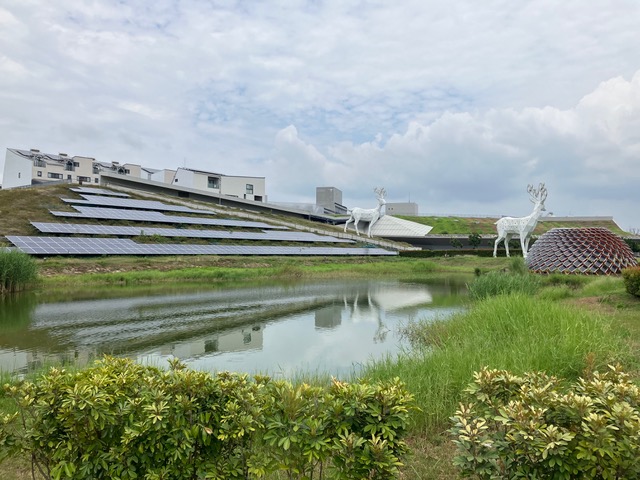
To better understand this vision, I visited the Shalun Green Energy Technology Demonstration Site in Tainan—a flagship initiative launched in November 2016 as part of the Shalun Science City project. Spanning 7.44 hectares, the site is a collaborative platform involving government agencies, universities, research institutions, and private companies to accelerate renewable energy innovation. Visitors can explore laboratories, test centres, and prototype projects that highlight the viability of sustainable energy solutions. The initiative seeks to make Taiwan a “green silicon island” and includes model homes that demonstrate near-zero and zero-emission living.
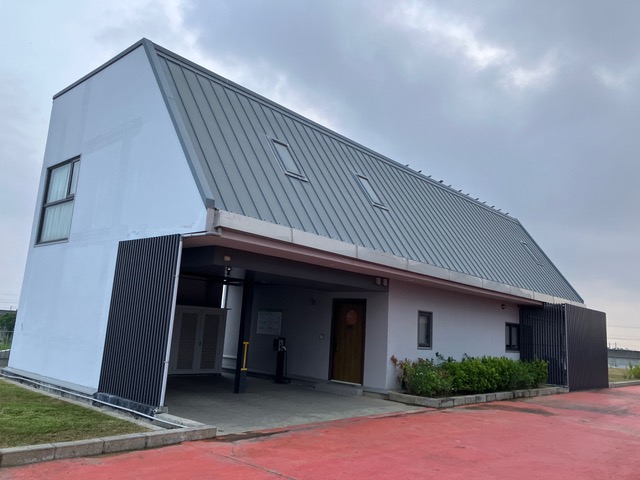
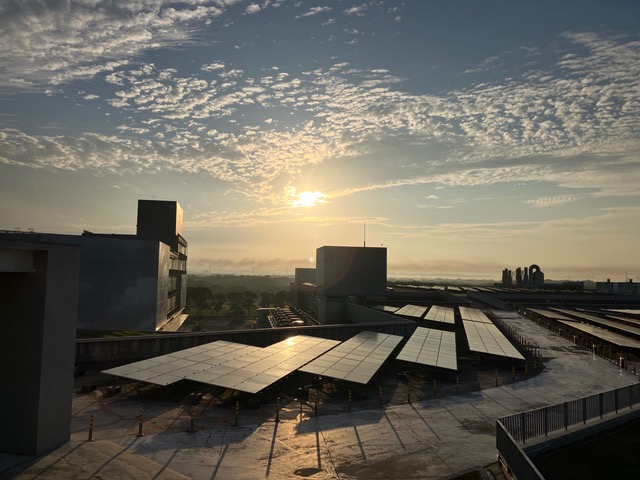
I stayed at the site for two days in early May 2025, experiencing life in a fully emission-free smart home. Spacious and thoughtfully designed, the four-bedroom house features solar-powered water heating, electricity for all appliances, and sensor-controlled lighting connected to a central panel. From the eastern-facing windows, solar panels on the demonstration site are visible.
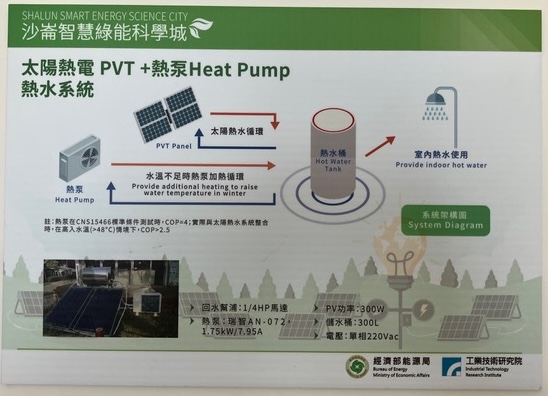
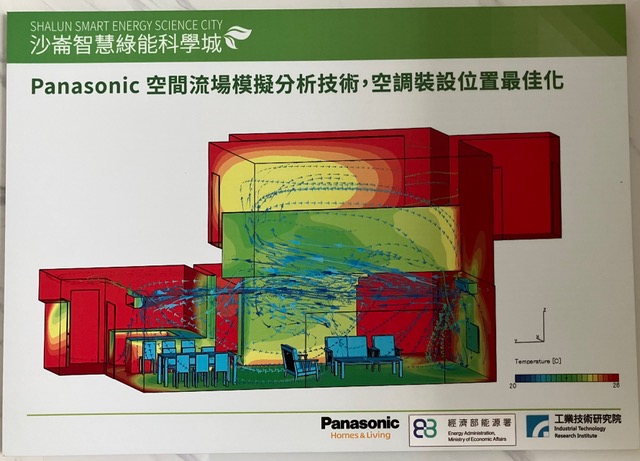
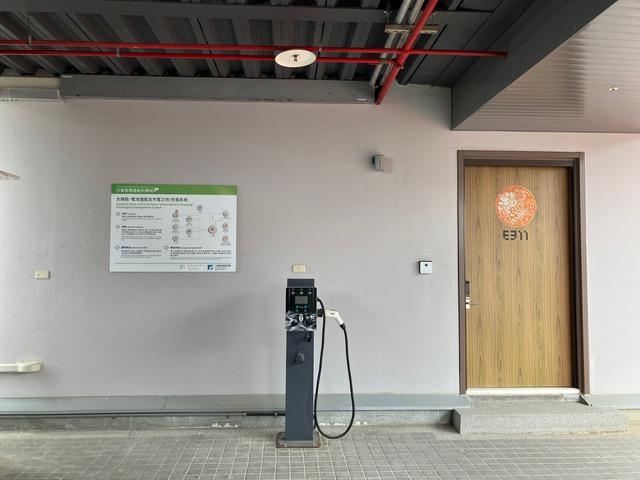
The kitchen features a gas stove, while information displays throughout the home explain the functions of smart systems, including a heat pump and an air-circulation cooling system. Outside, the garage holds batteries and meters for energy monitoring, with a dedicated EV charging station at the entrance. Surrounded by a serene landscape, the experience of sustainable living without reliance on nuclear energy or fossil fuels offers a compelling glimpse into the future. While this is but one cornerstone of Taiwan’s ambitious agenda, its broader implications remain to be seen.
This experience demonstrates the progress Taiwan has made towards a green energy future, but it also highlights the challenges that remain. While the government has laid essential groundwork and civil society continues to push for accountability and innovation, the true test lies in achieving scalability, resilience, and independence in a region characterised by geopolitical uncertainty. As the world watches Taiwan navigate its post-nuclear trajectory, the island’s approach may offer valuable lessons, both in the opportunities and constraints of a committed energy transition.
Dr Josie-Marie Perkuhn leads the joint postdoc research project Taiwan as a Pioneer at Trier University and is a non-resident fellow at the Institute for Security Policy at Kiel University (ISPK). She graduated in Political Science and Chinese Studies and received her PhD from Heidelberg University in 2018. Her current research focuses on responses to the challenges of the 21st Century, such as Digitalization, Energy and Climate, and Global Health. Her research portfolio includes Security & Strategy, Peace Studies, and China’s role in international relations and the Arctic. Being a member of the East Asia Institute (OAI e.V.), she engaged in cultural heritage and people-to-people diplomacy. In 2023, she was nominated to the German-Taiwan Dialogue Platform (DTDP) initiated by the Ministry of Foreign Affairs.
 Taiwan Insight