
Written by Yu-Ping Yang.
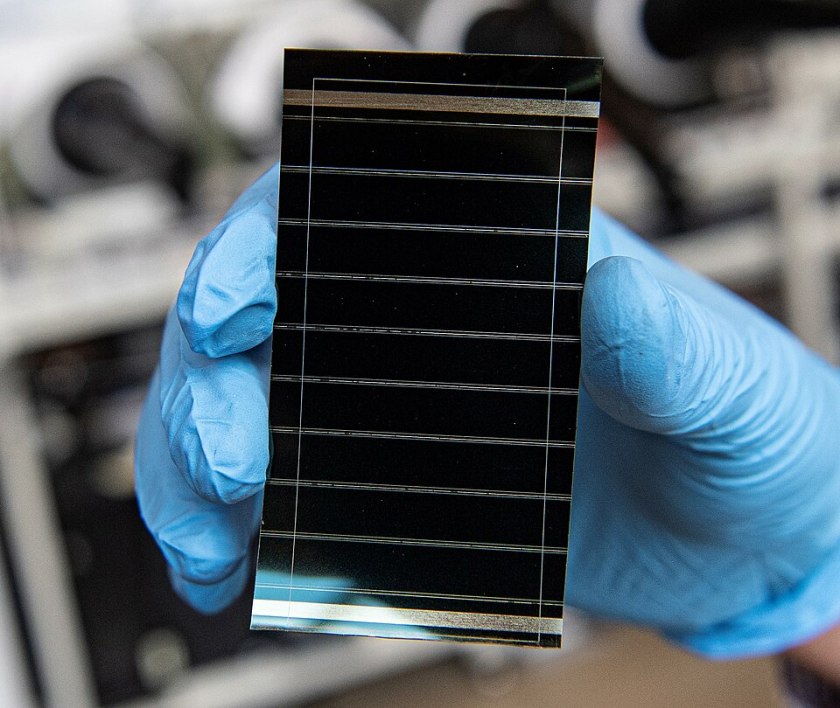
Image credit: Perovskite solar cell by United States Department of Energy/ Wikimedia Commons, license: public domain.
With the growing global demand for solar energy, China has steadily expanded its market share as the dominant player in the international market. According to the research on global solar PV supply chains conducted by the International Energy Agency (IEA), China has invested over USD 50 billion in new PV manufacturing capacity since 2011, an amount ten times greater than that of Europe, and owns the global market share of all the manufacturing stages of solar panels which exceeds 80%.
In response to China’s monopoly in the solar panel market, the European Union has launched probes on Chinese solar panel manufacturers suspected of receiving market-distorting subsidies, aiming to ensure fair competition. This concern about China’s dominance in the solar panel market was further legitimised by past events such as CEFC China Energy’s investment in the Czech Republic, which triggered widespread alarm over financial opacity and political influence. To address this concern, the EU has taken concrete steps to revive critical industries. Belgian chemicals group Solvay launched an initiative to restart rare earth metal production, aimed at strengthening regional supply chains. At the same time, the EU is actively exploring technological alternatives. In short, the EU’s growing concerns over its dependence on conventional solar panels highlight the importance of diversifying the clean energy supply chain, thereby gives perovskite solar cells (PSC) a new strategic position in global cooperation for its reduced dependency on China-dominated critical mineral, flexibility of custom application in buildings and agriculture, and with potential manufacturers “not” based in China.
Based on a prior report drafted by the Research Institute for Democracy, Society and Emerging Technology (DSET), this article will introduce the details of these strategic advantages in the following and explain how Taiwan could be a competitive player in the PSC supply chain.
Why PSC matters: Lessons from the conventional solar panel dependence on China in the EU Context
While China’s dominance in today’s silicon-based solar panel market appears firmly entrenched, next-generation solar technologies offer Europe an opportunity to reshape its strategic position and enhance supply chain resilience. PSCs are based on non-silicon materials, which offer the EU a chance to reduce its dependence on silicon supply chains and technological inputs from China. The unique structure of PSC allows countries to lessen their reliance on China’s control over silicon processing and avoid vulnerabilities linked to the increasing cost and scarcity of critical materials such as silver.
Taiwan Perovskite Science and Technology (TPSC), in collaboration with the Industrial Technology Research Institute’s (ITRI) Measurement Centre, achieved a remarkable photovoltaic conversion efficiency of 33.5% by incorporating perovskite materials into tandem cells. This achievement represents a significant milestone in the advancement and validation of third-generation solar panel technologies.
The ability of PSCs to flexibly adjust their conversion rate, combined with their thin and bendable structure, makes them highly suitable for a wide range of innovative applications. The lightweight characteristics of PSCs make them particularly suited for applications such as building-integrated photovoltaics (BIPV) and portable solar devices. Moreover, the wide range of possible applications suggests that the next-generation solar market may shift away from mass production toward more specialised, local solutions. For example, PSCs could be tailored to combine with insulated glass windows for smart buildings or modular photovoltaic systems for greenhouse agriculture. This diversification reduces reliance on China’s large-scale supply chains and opens opportunities for decentralised manufacturing.
Clearly, PSCs not only represent a significant technological breakthrough but also offer flexible application potential that can address diverse energy needs. Compared to traditional silicon-based cells, PSCs hold the promise of reducing reliance on China-centric supply chains. For the EU, which is seeking to accelerate the energy transition and enhance supply chain resilience, PSC technology presents a strategically significant and promising alternative.
How Taiwan can help in building a resilient next-generation solar module supply chain
Taiwan’s PSC development builds on existing panel industry infrastructure, where many production processes can be directly applied to perovskite cells. Techniques such as wet coating, layer assembly, and module integration are already in place. While some large-scale production still depends on facilities in China, Taiwan maintains strong capabilities in regulation, flexible manufacturing, and research. By focusing on quality and practical applications, Taiwanese firms are finding ways to reduce reliance on China and strengthen their role in the future solar technology market.
In 2024, the EU officially passed the Net-Zero Industry Act (NZIA), a landmark regulation aimed at strengthening the bloc’s capacity to produce clean technologies domestically. This Act designates solar photovoltaic technology as one of the strategic net-zero technologies and sets an ambitious target of meeting at least 40% of the EU’s annual deployment needs with domestically manufactured products by 2030. The NZIA simplifies permitting procedures, introduces sustainability and resilience criteria into procurement processes, and provides a regulatory framework to boost investments in the clean energy industry. In line with this goal, European countries have launched a variety of PSC-focused research and development projects to accelerate next-generation solar innovation. One example is the PEARL project, funded by Horizon Europe, which aims to develop flexible PSCs incorporating carbon electrodes in order to lower material costs and achieve conversion efficiencies exceeding 25%. Meanwhile, the PEPPERONI project is working to scale tandem perovskite-silicon modules for industrial production.
Against this backdrop, experienced partners like Taiwan could serve as key contributors in bridging the gap between the EU’s solar innovation and its manufacturing objectives. With a vertically integrated supply chain, advanced R&D in PSCs, and decades of collaboration with European firms, Taiwanese manufacturers are well-positioned to support local production and create jobs in Europe. According to transcripts from interviewees cited in the DSET report, proposed strategies include exporting entire manufacturing facilities to Central and Eastern Europe and pursuing patent licensing models that allow for joint production without the need to establish local factories. TPSC Chairman Chen Lai-Chu, who previously worked at AUO Corporation, noted that the proposed turnkey project in the Czech Republic offers a valuable opportunity for Taiwan-EU cooperation in developing PSC panels. In addition to facilitating joint production, the project also supports carbon reduction goals, aligns with the EU’s Carbon Border Adjustment Mechanism (CBAM), and helps cultivate skilled labour within the region. This cooperation represents a mutually beneficial pathway toward sustainable energy development and industrial revitalisation.
In terms of R&D advancement, the research team at Academia Sinica has recently developed a next-generation solar cell with a power conversion efficiency surpassing 31%, representing a performance improvement of over 30% compared to the most advanced commercial counterparts. This achievement demonstrates Taiwan’s strong capacity for scientific innovation and advanced materials research to develop PSCs. Taiwan’s current research and technological advancement in the PSC sector plays a crucial role in strengthening the resilience and diversity of the global solar photovoltaic (PV) supply chain.
Amid growing geopolitical tensions and urgent climate goals, PSCs stand at the crossroads of energy and strategy. Taiwan brings deep expertise, while the EU brings strong policy momentum. This partnership will be key to ensuring supply chain resilience and achieving long-term sustainability goals.
PSC Advancement as Geopolitical Necessity
Both Taiwan and the EU have demonstrated strong ambitions in advancing the development and deployment of PSCs. Recently, amid growing concerns in European countries over their excessive reliance on China for critical materials and clean technologies, the urgency of building diversified and resilient partnerships has become increasingly evident. Therefore, establishing cooperation with credible partners is crucial. Developing PSC technology not only reduces dependence on China but also enables European countries to achieve their clean technology goals.
There is no doubt that the role of geopolitical strategy in shaping clean energy partnerships has become increasingly pronounced. As the DSET report highlights, building resilient supply chains for emerging technologies like PSCs is not merely a climate imperative, but also a geopolitical necessity. In this context, deepening cooperation between the EU and Taiwan offers a pragmatic solution. Taiwan’s strengths in PSC innovation and flexible manufacturing present appropriate opportunities to complement Europe’s policy goals. By aligning green technology development with geopolitical risk mitigation, EU-Taiwan collaboration can help secure strategic autonomy, diversify clean tech partnerships, and ensure a more stable path toward a sustainable energy future.
Yu-Ping (Yolanda) Yang is a current master’s student in International Relations at the Department of Political Science, National Taiwan University. She also serves as a research assistant with the Energy Security and Climate Resilience Research Program at the Research Institute for Democracy, Society and Emerging Technology (DSET), a Taiwan-based think tank. Her research focuses on international disputes and geopolitical analysis, with particular interests in energy security and environmental policy. Contact: ypyang@dset.tw.
The article is published as part of a joint issue “Green Synergies: Sustainability, Security and Taiwan-Europe Collaboration” between CHOICE and Taiwan Insight.
 Taiwan Insight
