
Written by Wen-Qing (Sarah) Jiang.
Image credit: provided by the author.
China and Russia’s political and cognitive warfare
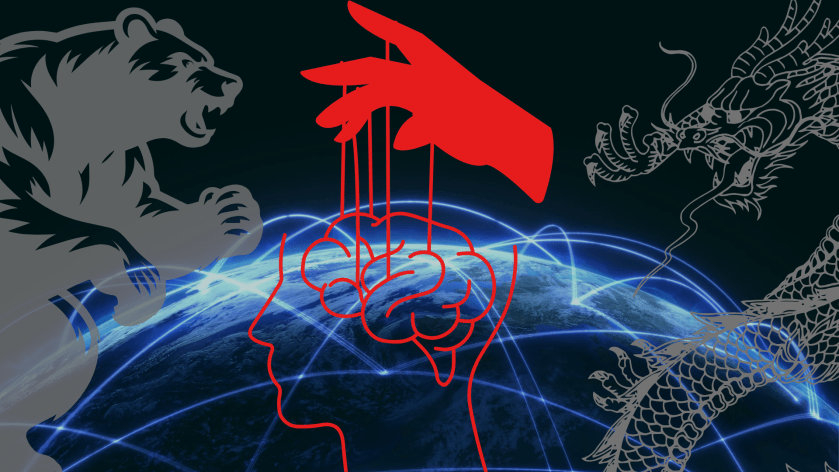
The use of cognitive tactics in information operations via social media platforms has increasingly outweighed traditional forms of warfare and has become the dominant tool for both the Kremlin and the Chinese Communist Party (CCP) to influence public opinion.
China’s multifaceted coercion, ranging from military exercises and cyberattacks to social media manipulation, continues to impact Taiwan’s national security discourse. Unsurprisingly, Taiwan perceives China as a constant security threat, as illustrated by events like the Joint-Sword 2024-B military drill conducted by the People’s Liberation Army (PLA) near Taiwanese jurisdictional waters, held in response to Taiwan’s National Day celebrations.
Despite a shared focus on confronting China’s threats, internal polarisation exists within Taiwan’s government, particularly between the Democratic Progressive Party (DPP) and the Chinese Nationalist Party (Kuomintang)/ Taiwan People’s Party (KMT/TPP) coalition. This polarisation, driven by divergent views on relations with China and national identity, thus creates a vulnerability for China to exploit through information operations such as cognitive warfare in which the aggressor could passively or proactively alter their victims’ understanding, sentiments, or even behaviours towards specific environments or issues often with the aid of technology to achieve political ambitions.
Such coercive methods of weaponising internal polarisation with the assistance of cognitive influences can be regarded as a part of “political warfare”, a term defined as “the art of achieving strategic objectives through influence, subversion, and coercion” in order to de-legitimise Taiwan’s statehood and nationhood. The ultimate purpose of political warfare is then to isolate and force the island into reunifying with China proper, “an outcome the Chinese Communist Party (CCP) Chairman Xi Jinping has declared essential for the “great rejuvenation of the Chinese nation” (中華民族偉大復興).”
Similar activities and allegations can be observed in the EU, where Russia has been accused of interfering with EU politics by influencing the European Parliament (EP) political groups. A recently adopted text by the EP states that there have been “increasing attempts by state and non-state actors from third countries to directly or indirectly interfere with democratic decision-making and electoral processes in the Union and its Member States” in the form of hybrid warfare (i.e. conventional and unconventional warfare, with cognitive domain warfare belongs to the unconventional.). Russia’s behaviour echoed Russian President Vladimir Putin’s desire to consolidate “Russia’s status as one of the world’s great powers” as well as to “undermine the US-led liberal democratic order.” — narratives that fit into the definition of political warfare.
Within these methods, information operations that involve cognition distortion, such as disinformation on social media (e.g. X, formerly known as Twitter) or utilising AI and bots to spread pro-Kremlin narratives, can be observed in recent months. The text also recognised Russia’s contacts with “far-right and far-left parties, and other personalities and movements to gain support from institutional actors within the Union in order to legitimise its illegal and criminal actions.” Research-backed findings suggest that in the EP, political groups that lean towards the far end of either side of the political spectrum tend to be more tolerant towards Russia and are willing to “go ‘business as usual’ with Russia” in terms of the EU energy narratives despite the Russian-Ukraine war and energy security crisis, making these groups easier to fall victim to cognition disrupting tactics such as disinformation or other forms of information operation campaigns.
Case Studies in Consciousness Manipulation: Taiwan and Transnistria
From the above section, we then understood that, despite a shared focus on confronting revisionist threats, Taiwan and the EU suffer from internal polarisation among political parties within their parliaments, which creates vulnerabilities that revisionist powers, such as Russia and China, could exploit through cognitive influence aimed at embedding discord and negative emotions in the minds of the populace. With the battleground moving online, cognitive warfare tactics are thus becoming less and less perceptible.
A common tactic in cognitive warfare employed frequently by the Russian and Chinese governments is manipulating narratives—termed “consciousness manipulation” (意識操縱) by Chinese scholars—defined as the gradual process which involves the understanding of human minds. Citing Soviet scholar Sergey Kara-Murza, these scholars argued that consciousness manipulation is the programming of the public’s opinion, interests, emotions, and even mental status in order to produce the desired factions and behaviours by the manipulators. In the case studies below, conscious manipulation was deployed during crises involving essential goods, which drove people to question the government’s authority, legitimacy, and competence.
For instance, at the end of 2022 and early 2023, global Avian Influenza, the COVID-19 pandemic, and the Russia-Ukraine War led to a reduced chicken supply and increased chicken feed costs, resulting in a severe egg shortage in Taiwan. Whilst imported eggs provided a temporary solution, societal anxiety over the shortage was amplified by media manipulation from pro-China politicians, media outlets, and opportunistic egg manufacturers spreading false rumours. During the crisis, PRC’s spokesperson Feng-Lian Zhu accused Taiwan’s DPP government of incompetence, employing cognitive warfare tactics to undermine the administration. In response, former Executive Yuan Premier Chien-jen Chen denounced these disinformation efforts, urging the public to stay vigilant and emphasising the importance of awareness in combating such manipulative tactics.
Similarly, since the 2022 Russian aggression in Ukraine, Europe has faced significant turbulence in the energy market. Moldova and its de facto breakaway region, Transnistria, share a Soviet history with neighbouring Ukraine and became victims of an energy security crisis due to the war. Nevertheless, the internal polarisation manifested when the Moldovan government took the pro-EU trajectory, whilst Transnistria struggled to surface from the status of being Russia’s patron state and being used as a strategic pawn to intimidate Moldova.
Following the sudden cut-off of natural gas supplies and blackouts caused by Russian missile attacks on Ukraine in November 2022, Moldova faced skyrocketing energy prices, high inflation, and unaffordable energy bills. Whilst Russia’s deliberate attempt to restrict gas supplies in Europe was widely acknowledged, residents in Moldova’s breakaway region, Transnistria, were unconvinced. Influenced by pro-Russian sentiments as opposed to Moldova and its pro-EU stances, propaganda messages from Russian state-owned media, and nostalgic sentiments for Soviet times, many in Transnistria blamed the pro-EU Moldovan authorities for “technical errors,” which they believed were responsible for their harsh winter without sufficient energy supplies.
In Taiwan’s case, however, we could observe a more resilient government and coping mechanism as the Taiwanese government swiftly reacted and denied the false information. Moreover, democratic resilience in Taiwan has grown ever since the pandemic and has thrived during the 2024 presidential election; whilst the last-minute social manipulation was targeting the younger population, it is confirmed both via the election result and research that there is a strong cohesion in society and that the youth possess deep Taiwanese identity, as have family and social groups.
Civil society organisations also play a pivotal role in reinforcing democratic resilience in the face of CCP interference. Media or news outlets easily fall victim to such manipulative disinformation and misinformation campaigns due to their strong political stances leaning towards either Blue (KMT) or Green (DPP); therefore, the establishment of Taiwan FactCheck Center, Cofacts, Doublethink Lab, Taiwan Information Environment Research Center (IORG), and Kuma academy are able to train Taiwanese public in improving media literacy and to combat disinformation, providing platforms and spaces for dialogues to engage and raise awareness of the public with abstract topics on cognitive warfare and information warfare.
Conversely, in Transnistria, we could observe a lack of government and civil society backing in combating external disinformation campaigns. Such a hostile environment has only been made worse by the exacerbation of Russia’s war against Ukraine since 2022. For instance, a false claim made by Russia’s Ministry of Foreign Affairs that NATO countries have armed Moldova was backed by the Russia-born, self-proclaimed leader of Transnistria Vadim Krasnoselsky, who voiced concern about Western countries supplying weapons to Moldova despite the claim being clarified by the EU to be false. Additionally, Russian propaganda is disseminated through broadcasts on social networks, news portals, print media, and satellite TV stations, which the older population is more likely to consume and engage with throughout the day. Reinforced by Soviet nostalgia, it is thus extremely hard to debunk Russia’s disinformation tactics as opposed to Taiwan’s effort.
These two case studies illustrate how China and Russia have employed media propaganda and internal political polarisation to shape narratives undermining public trust in governance. Notably, Taiwan and Transnistria function as de facto states. Whilst Taiwan demonstrated a whole-of-society defence mechanism. Transnistria passively accepted the information, raising important questions about the relative ease with which powerful states can exert coercive influence, particularly through cognitive warfare on different polities. However, the full scale and scope of these cognitive domain operations remain insufficiently defined and explored, offering fertile ground for further research and discussion.
Wen-Qing (Sarah) Jiang is a research assistant at the European Values Center for Security Policy and the Taiwan-Asia Exchange Foundation.
 Taiwan Insight