

Written by Paulina G. Karim
Image credits: Indigenous and local communities are the stewards of Taiwan’s biodiversity. In the photo, local youths from the Laonong community in Liugui District, Kaohsiung City, enjoy the beauty of the Shih-ba-luo-han-shan mountain landscape. Photo credit to: Professor Mei-Hui Chen.
Treasure Island – 寶島 – this is how the Taiwanese people lovingly refer to their beautiful Homeland. Shaped as a leaf or as a fish (depending on where your terrestrial or marine imagination takes you), the island of Taiwan is a true nature gem. From high, lush green mountains to deep blue ocean waters, its complex and unique geomorphological and climatic conditions have nurtured a diverse array of ecosystems and a high level of endemism. Just imagine – around 3.4% of all the world’s known species (around 60,000) are found in Taiwan! Protected areas and national forests cover around 60% of the island. This extensive coverage ensures protected habitats for some of the island’s iconic species, such as the Formosan Black Bear. What many find surprising, though, is that 55% of protected fauna and 64% of threatened flora are found within the remaining 40% of the landmass—in rural landscapes and seascapes. So, what exactly does it mean?
It means that the Indigenous and local communities are the stewards of Treasure Island. For centuries, through traditional ecological knowledge and sustainable use practices, they have been caring for their forests, rivers, farmlands, and coasts. These close nature-culture linkages have created a bio-geo-culturally diverse mosaic of shared landscapes and seascapes, known respectively as the satoyama (lishan – 里山) and satoumi (lihai – 里海). In modern times, when reinstating a harmonious coexistence between people and nature is crucial for our own survival as a species, the importance of people-centred approaches to biodiversity conservation is as relevant as ever.
The community-based journey in Taiwan’s conservation policies began with the launch of the Community Forestry program in 2002. Based on the principles of bottom-up governance, local leadership, community participation, and resource co-management, the program laid the foundations of community-based biodiversity conservation as we know it today. In 2010, the Satoyama Initiative was introduced in Taiwan. It brought attention to the importance of landscape and seascape spatial thinking, multi-stakeholder engagement, and sustainable production activities as a cornerstone of bio-geo-cultural diversity. The Taiwan Partnership for the Satoyama Initiative (TPSI) consists of four regional exchange bases—TPSI-North, TPSI-West, TPSI-South, and TPSI-East. These bases serve as local hubs for on-the-ground actions, including research, capacity-building, and community networking. In 2018, the Taiwan Ecological Network was established as a one-of-a-kind ‘whole of government, whole of society’ strategy that combined robust spatial planning, cross-sectoral cooperation, and public engagement for biodiversity conservation. Today, both the Community Forestry project and the Satoyama Initiative are key community-based pillars for weaving the Taiwan Ecological Network into all corners of the island. This is what we refer to as the ‘3-in-1’ people-centred strategy for nature conservation in Taiwan.
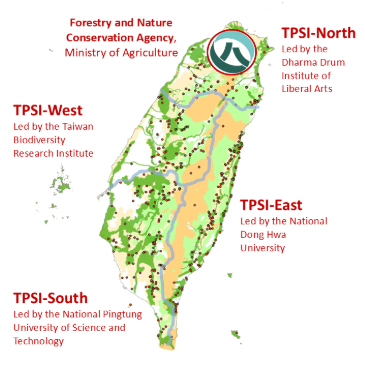
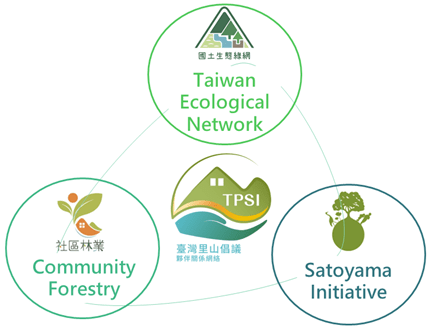
This Special Issue is a joint project by longtime Satoyama science-policy colleagues and friends who are leading the ‘3 in 1’ strategy: the Forestry and Nature Conservation Agency (FANCA), Ministry of Agriculture and four regional exchange bases of the Taiwan Partnership for the Satoyama Initiative (TPSI). From the national strategic perspective to regional and local case studies and to the global Satoyama agenda, the five articles in this Special Issue weave a colourful nature-culture patchwork of biodiversity conservation on the island.
- ‘From Conservation to Governance: Advancing Connectivity through Nature-based Strategies within the Taiwan Ecological Network,’ by the Director General of FANCA, Dr. Hwa-Ching Lin and his colleagues – Dr. Chih-Chin Shih, Hsiao-Tien Hsieh, and Chia-Tzu Chen. As the mastermind behind the Taiwan Ecological Network and the government agency responsible for conserving Taiwan’s terrestrial biodiversity, the FANCA team introduces the highlights of this state-of-the-art national program. Dr Hwa-Ching Lin and his colleagues explore the importance of nature-based solutions and integrated governance approaches for achieving the goal of living in harmony with nature.
- ‘From Co-Learning to Co-Production: Building an Innovative Satoyama Network along Taiwan’s North Coast,’ by Dr Hsin-Hsun Huang from the Dharma Drum Institute of Liberal Arts, TPSI-North regional exchange base. What does it take to build a human network for nature conservation? How can relational values of nature foster lasting human-nature and human-human connections? In his article, Professor Hsin-Hsun Huang builds on his extensive experience in environmental governance and multi-stakeholder approaches by examining the issues of co-learning, sustainable rural development, and cultivating relational populations in northern Taiwan.
- ‘Community-Based Biodiversity Monitoring of Satoyama Species in Central Taiwan,’ by Dr. Mei-Li Hsueh from the Taiwan Biodiversity Research Institute, TPSI-West regional exchange base. It takes a village to save a Leopard cat or a Chinese box turtle! Dr. Mei-Li Hsueh is a strong advocate for the importance of community engagement in biodiversity monitoring. In her article, she shares two successful case studies of habitat restoration and patrol, radio telemetry tracking, and species-friendly eco-labelling schemes for these endangered Satoyama species.
- ‘Ecotourism Destination Management Organisation – A Case Study of Shih-ba-luo-han-shan Forest Reserve in Southern Taiwan,’ by Dr. Mei-Hui Chen from the National Pingtung University of Science and Technology, TPSI-South regional exchange base. Almost every community in Taiwan knows the name of Professor Mei-Hui Chen – the founding mother of the Community Forestry program. Over the years, with her tireless efforts, community-based ecotourism has played a central role in balancing conservation and development objectives in rural areas. Shih-ba-luo-han-shan Forest Reserve is one of its best examples in southern Taiwan.
- ‘Looking Ahead to 2030: Realising Five Strategic Objectives of the Satoyama Initiative in Taiwan’, by Dr. Paulina G. Karim and Dr. Kuang-Chung Lee from the National Dong Hwa University, TPSI-East regional exchange base. Professor Kuang-Chung Lee’s name will be forever associated with the Satoyama Initiative, as he was the one who introduced it to Taiwan, initiated TPSI and established a school of research on integrated landscape and seascape approaches. As his former student and now colleague, I proudly follow his steps while fostering new linkages between our domestic efforts and the global biodiversity agenda. Our article explores the five strategic objectives of the International Partnership for the Satoyama Initiative towards 2030 and their relevance to our ‘3 in 1’ strategy.
Though far from a comprehensive overview of nature conservation in Taiwan (there’s just so much to say!), we hope that this Special Issue will provide a glimpse into its people-centred approaches – biodiversity conservation with the Satoyama characteristics, as we call it. We also hope that it will spark our readers’ interest in hiking and diving into the heights and depths of Treasure Island and its insights.
Dr. Paulina G. Karim 孫夏天 is a post-doctoral researcher with the Forestry and Nature Conservation Agency and an adjunct associate research fellow at the @ScapesLab: Integrated Landscape and Seascape Approaches Living Lab, the Centre for Sustainable Development, National Dong Hwa University. She can be reached at scapeslab@gms.ndhu.edu.tw.
This article was published as part of a special issue on ‘Co-Weaving Taiwan Ecological Network: Satoyama in Practice‘.
 Taiwan Insight